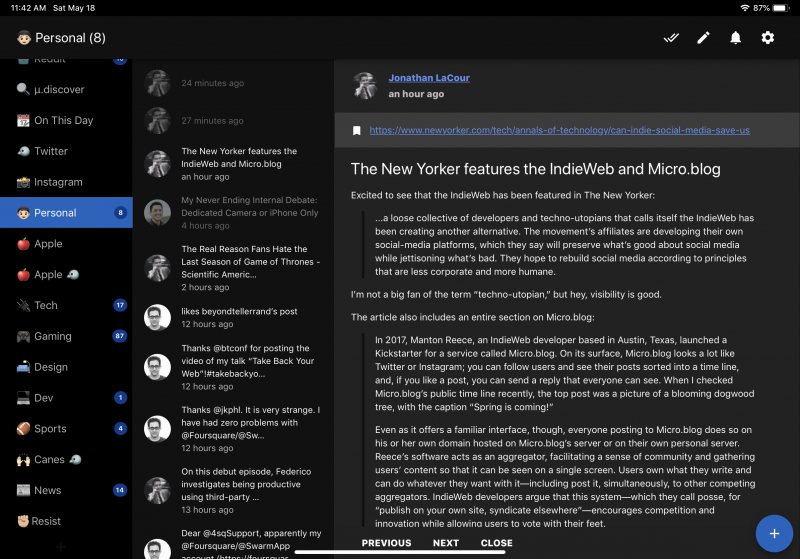
đź”– Bookmarked https://www.newyorker.com/tech/annals-of-technology/can-indie-social-media-save-us
Sounds about white
{
"type": "entry",
"published": "2019-05-21 14:03-0700",
"url": "https://gregorlove.com/2019/05/sounds-about-white/",
"syndication": [
"https://twitter.com/gRegorLove/status/1130942142052855808"
],
"in-reply-to": [
"https://twitter.com/andrehenry/status/1130935981522112512"
],
"content": {
"text": "Sounds about white",
"html": "<p>Sounds about white</p>"
},
"author": {
"type": "card",
"name": "gRegor Morrill",
"url": "https://gregorlove.com/",
"photo": "https://aperture-proxy.p3k.io/929c8777d059069a2a16a064d96f4c29b65548f8/68747470733a2f2f677265676f726c6f76652e636f6d2f736974652f6173736574732f66696c65732f333437332f70726f66696c652d323031362d6d65642e6a7067"
},
"post-type": "reply",
"refs": {
"https://twitter.com/andrehenry/status/1130935981522112512": {
"type": "entry",
"url": "https://twitter.com/andrehenry/status/1130935981522112512",
"content": {
"text": "I pity these men."
},
"author": {
"type": "card",
"name": "Andre Henry",
"url": false,
"photo": "https://gregorlove.com/site/assets/files/3540/61d09d31f1aefb80b07f55fb702864da34fdd9149e18ff38bc98f9b8bb41decd.jpg"
},
"post-type": "note"
}
},
"_id": "3579057",
"_source": "95"
}
{
"type": "entry",
"published": "2019-05-21T13:20:37-07:00",
"url": "https://boffosocko.com/2019/05/21/scale-and-scope-jim-luke/",
"category": [
"economics",
"education",
"indieweb",
"read",
"reply",
"economies-of-scale",
"mass-production",
"model-t",
"plurality",
"scale",
"scope",
"social-media"
],
"bookmark-of": [
"https://econproph.com/2019/05/20/scale-and-scope/"
],
"name": "\ud83d\udc53 Scale and Scope | Jim Luke",
"content": {
"text": "Read Scale and Scope by Jim Luke (EconProph)I\u2019ve been saying for awhile now in discussions of the commons, OER, and higher education that a \u201ccommons doesn\u2019t scale, it scopes\u201d. Before I explain why I think a commons doesn\u2019t scale very well, I probably need to briefly clarify what\u2019s meant by scale and scope. Like many terms in economics, they\u2019re both commonly used terms in both business and everyday life, but in economics they may carry a subtly different, more precise, or richer meaning. Both terms refer to the production of an increasing volume of output of some kind. Enthusiasts of particular good(s), be they an entrepreneur producing the a product they hope will make them rich or an open educator advocating for more open licensed textbooks because it will improve education, generally want to see their ideas scale. And by scale, they generally mean \u201cbe produced in larger and larger volumes\u201d. Larger volume of output, of course, brings a larger volume of benefits to more users. More output \u2013> more users \u2013> more benefits. But it\u2019s the behavior of costs that really intrigues us when we think of \u201cscaling\u201d as a way to increase output. More benefits is nice, but if more benefits also means an equal increase in costs, then it\u2019s not so attractive.I can see a relation to the economies of scope that Jim Luke is talking about here in relation to the IndieWeb principle of plurality. For a long time the IndieWeb community has put economies of scope first and foremost over that of scale. Scale may not necessarily solve some of the problems we\u2019re all looking at. In fact, scale may be directly responsible for many of the problems that social has caused in our lives and society.\nI\u2019m also reminded of a post I annotated the other day:\n\nData sharing and how it can benefit your scientific career\u00a0(Nature)\nCrowther offered everyone who shared at least a certain volume of data with his forest initiative the chance to be a co-author of a study that he and a colleague led. Published in Science in 2016, the paper used more than 770,000 data points from 44 countries to determine that forests with more tree species are more productive.\nI suspect a similar hypothesis holds for shared specs, code, and the broader idea of\u00a0plurality within the IndieWeb. More interoperable systems makes the IndieWeb more productive.\n\n\nI also can\u2019t help but think about a reply to a tweet by Chris Messina\u00a0in relation to the IndieWeb related article in this week\u2019s The New Yorker:\n\nI\u2019ve been tinkering with this again lately. Basically none of it is productized and much of the code is stale and/or only works for single user setups. \nSo yeah \u2013 classic car at best. What does a Model T assembly line look like for IndieWeb?\n\u2014 Boris Mann (@bmann) May 20, 2019\n\n\nBoris is asking a problematic question not remembering early issues with the Model T, which Jim Luke reminds us of in his article:\nRemember Henry Ford\u2019s famous quote about \u201cthe customer can get [the Model T] in any color they want as long as it\u2019s black\u201d?\nWe\u2019ve already got the Model Ts of social media\u2013it\u2019s called Facebook. It\u2019s Twitter. It\u2019s Instagram. And they\u2019re all standardized\u2013black\u2013 but they all require their own custom (toxic and limited) roads to be able to drive them! I can\u2019t drive my Model Twitter in Facebookville.\u00a0 My Instagramobile has long since broken down in Twittertown. Wouldn\u2019t you rather \u201cSee The U.S.A. In Your [IndieWeb] Chevrolet\u201c?!\nThe answer to Boris is that the IndieWeb has been working on the scope problem first knowing that once the interoperable kinks between systems can be worked out to a reasonable level that scale will be the easy part of the problem. Obviously micro.blog has been able to productize IndieWeb principles (with several thousands of users) and still work relatively flawlessly with a huge number of other platforms.\u00a0 There have been tremendous strides towards shoehorning IndieWeb principles into major CMSes like WordPress (~500+ active users currently) and Drupal (~50+ active users) not to mention several dozens of others including Known, Perch, Craft CMS, Hugo, Kirby, etc., etc.\nI haven\u2019t heard aggregate numbers recently, but I would guess that the current active IndieWeb user base is somewhere north of 10,000 people and individual websites.\u00a0 Once the UI/UX issues have all been ironed out even a single platform like WordPress, which could easily add the individual pieces into its core product in just a few hours, would create a sea-change overnight by making more than 30% of the web which runs on it IndieWeb friendly or IndieWeb compatible.\nYes, friends, scale is the easy part. Plurality and scope are the the far more difficult problems. Just ask Zuck or Jack. Or their users products.\n\nSyndicated copies to: \n Twitter icon\n Twitter icon",
"html": "<span>Read</span> <a href=\"https://econproph.com/2019/05/20/scale-and-scope/\" class=\"p-name u-url\">Scale and Scope</a> by <a href=\"https://econproph.com/\" class=\"h-card p-author\"><img class=\"u-photo\" src=\"https://aperture-proxy.p3k.io/8a25aacc3ec29000ad1960b533705819dd485dc1/68747470733a2f2f7365637572652e67726176617461722e636f6d2f626c6176617461722f6164343338376163656138356536303936313365343637303532643262613030\" alt=\"Jim Luke\" width=\"32\" height=\"32\" /><img class=\"u-photo\" src=\"https://aperture-proxy.p3k.io/8a25aacc3ec29000ad1960b533705819dd485dc1/68747470733a2f2f7365637572652e67726176617461722e636f6d2f626c6176617461722f6164343338376163656138356536303936313365343637303532643262613030\" alt=\"Jim Luke\" width=\"32\" height=\"32\" />Jim Luke</a> <em>(<span class=\"p-publication\">EconProph</span>)</em><blockquote class=\"e-summary\">I\u2019ve been saying for awhile now in discussions of the commons, OER, and higher education that a \u201ccommons doesn\u2019t scale, it scopes\u201d. Before I explain why I think a commons doesn\u2019t scale very well, I probably need to briefly clarify what\u2019s meant by scale and scope. Like many terms in economics, they\u2019re both commonly used terms in both business and everyday life, but in economics they may carry a subtly different, more precise, or richer meaning. Both terms refer to the production of an increasing volume of output of some kind. Enthusiasts of particular good(s), be they an entrepreneur producing the a product they hope will make them rich or an open educator advocating for more open licensed textbooks because it will improve education, generally want to see their ideas scale. And by scale, they generally mean \u201cbe produced in larger and larger volumes\u201d. Larger volume of output, of course, brings a larger volume of benefits to more users. More output \u2013> more users \u2013> more benefits. But it\u2019s the behavior of costs that really intrigues us when we think of \u201cscaling\u201d as a way to increase output. More benefits is nice, but if more benefits also means an equal increase in costs, then it\u2019s not so attractive.</blockquote><p>I can see a relation to the economies of scope that Jim Luke is talking about here in relation to the <a href=\"https://indieweb.org/plurality\">IndieWeb principle of plurality</a>. For a long time the IndieWeb community has put economies of scope first and foremost over that of scale. Scale may not necessarily solve some of the problems we\u2019re all looking at. In fact, scale may be directly responsible for many of the problems that social has caused in our lives and society.</p>\n<p>I\u2019m also reminded of a <a href=\"https://boffosocko.com/2019/05/15/data-sharing-and-how-it-can-benefit-your-scientific-career-l-nature-2/\">post I annotated the other day</a>:</p>\n<blockquote>\n<p><a class=\"p-name u-url\" href=\"https://www.nature.com/articles/d41586-019-01506-x\">Data sharing and how it can benefit your scientific career</a>\u00a0<em>(<span class=\"p-publication\">Nature</span>)</em></p>\n<blockquote class=\"e-summary\"><p>Crowther offered everyone who shared at least a certain volume of data with his forest initiative the chance to be a co-author of a study that he and a colleague led. Published in Science in 2016, the paper used more than 770,000 data points from 44 countries to determine that forests with more tree species are more productive.</p></blockquote>\n<p>I suspect a similar hypothesis holds for shared specs, code, and the broader idea of\u00a0<a href=\"https://indieweb.org/plurality\">plurality within the IndieWeb</a>. More interoperable systems makes the IndieWeb more productive.\n</p>\n</blockquote>\n<p>I also can\u2019t help but think about a reply to a <a href=\"https://twitter.com/chrismessina/status/1130311808437239808\">tweet by Chris Messina</a>\u00a0in relation to the <a href=\"https://www.newyorker.com/tech/annals-of-technology/can-indie-social-media-save-us\">IndieWeb related article in this week\u2019s <em>The New Yorker</em></a>:</p>\n<blockquote>\n<p dir=\"ltr\" lang=\"en\" xml:lang=\"en\">I\u2019ve been tinkering with this again lately. Basically none of it is productized and much of the code is stale and/or only works for single user setups. </p>\n<p>So yeah \u2013 classic car at best. What does a Model T assembly line look like for IndieWeb?</p>\n<p>\u2014 Boris Mann (@bmann) <a href=\"https://twitter.com/bmann/status/1130312836419211264?ref_src=twsrc%5Etfw\">May 20, 2019</a></p>\n</blockquote>\n<p></p>\n<p>Boris is asking a problematic question not remembering early issues with the Model T, which Jim Luke reminds us of in his article:</p>\n<blockquote><p>Remember Henry Ford\u2019s famous quote about \u201cthe customer can get [the Model T] in any color they want as long as it\u2019s black\u201d?</p></blockquote>\n<p>We\u2019ve already got the Model Ts of social media\u2013it\u2019s called Facebook. It\u2019s Twitter. It\u2019s Instagram. And they\u2019re all standardized\u2013black\u2013 but they all require their own custom (toxic and limited) roads to be able to drive them! I can\u2019t drive my Model Twitter in Facebookville.\u00a0 My Instagramobile has long since broken down in Twittertown. Wouldn\u2019t you rather \u201c<a href=\"https://youtu.be/boertpylK0M?t=66\">See The U.S.A. In Your [IndieWeb] Chevrolet</a>\u201c?!</p>\n<p>The answer to Boris is that the IndieWeb has been working on the scope problem first knowing that once the interoperable kinks between systems can be worked out to a reasonable level that scale will be the easy part of the problem. Obviously <a href=\"https://micro.blog\">micro.blog</a> has been able to productize <a href=\"https://indieweb.org/principles\">IndieWeb principles</a> (with several thousands of users) and still work relatively flawlessly with a huge number of other platforms.\u00a0 There have been tremendous strides towards shoehorning IndieWeb principles into major CMSes like WordPress (~500+ active users currently) and Drupal (~50+ active users) not to mention several dozens of others including Known, Perch, Craft CMS, Hugo, Kirby, etc., etc.</p>\n<p>I haven\u2019t heard aggregate numbers recently, but I would guess that the current active IndieWeb user base is somewhere north of 10,000 people and individual websites.\u00a0 Once the UI/UX issues have all been ironed out even a single platform like WordPress, which could easily add the individual pieces into its core product in just a few hours, would create a sea-change overnight by making more than 30% of the web which runs on it IndieWeb <a href=\"https://indieweb.org/friendly\">friendly</a> or IndieWeb compatible.</p>\n<p>Yes, friends, scale is the easy part. Plurality and scope are the the far more difficult problems. Just ask Zuck or Jack. Or their users products.</p>\n\n<span>Syndicated copies to:</span><ul><li><a class=\"u-syndication\" href=\"https://www.reading.am/p/5cbz/https://econproph.com/2019/05/20/scale-and-scope/\"> </a></li>\n<li><a class=\"u-syndication\" href=\"https://twitter.com/ChrisAldrich/status/1130949535398629376\"> <span style=\"max-width:1rem;margin:2px;\" title=\"twitter\">Twitter icon</span></a></li>\n<li><a class=\"u-syndication\" href=\"https://twitter.com/ChrisAldrich/status/1130950080880467968\"> <span style=\"max-width:1rem;margin:2px;\" title=\"twitter\">Twitter icon</span></a></li>\n</ul>"
},
"author": {
"type": "card",
"name": "Chris Aldrich",
"url": "https://boffosocko.com/",
"photo": "https://aperture-proxy.p3k.io/07a56dfeaeb22fa994a161bf21a4b2110aa17def/68747470733a2f2f7365637572652e67726176617461722e636f6d2f6176617461722f64356662346534393866653630396363323962303465356237616436383863343f733d343926643d6964656e7469636f6e26723d7067"
},
"post-type": "bookmark",
"refs": {
"https://econproph.com/2019/05/20/scale-and-scope/": {
"type": "entry",
"url": "https://econproph.com/2019/05/20/scale-and-scope/",
"name": "Scale and Scope",
"author": {
"type": "card",
"name": "Jim Luke Jim Luke Jim Luke",
"url": false,
"photo": "https://secure.gravatar.com/blavatar/ad4387acea85e609613e467052d2ba00"
},
"post-type": "article"
}
},
"_id": "3903306",
"_source": "2785"
}
{
"type": "entry",
"published": "2019-05-21T12:44:47-07:00",
"url": "https://boffosocko.com/2019/05/21/an-indieweb-podcast-episode-14-a-loose-collective-of-developers-and-techno-utopians/",
"category": [
"indieweb",
"podcast",
"wordpress",
"an-indieweb-podcast",
"checkin-posts",
"chicken-posts",
"duckpin-bowling",
"ducks-posts",
"fatwigoo",
"feed-readers",
"icons",
"indieauth",
"indieauth-plugin",
"indieweb-summit-2019",
"indiewebcamp",
"itches",
"iwbcmm",
"mastodon",
"on-this-day",
"post-kinds-plugin",
"scoping",
"weather",
"webmention",
"webmention-plugin",
"websub",
"yarns",
"https://david.shanske.com",
"http://boffosocko.com"
],
"name": "An IndieWeb Podcast: Episode 14 A loose collective of developers and techno-utopians",
"content": {
"text": "Episode 14: A loose collective of developers and techno-utopiansIf possible, click to play, otherwise your browser may be unable to play this audio file.\nRunning time: 1h 19m 57s | Download (37.5MB) | Subscribe by RSS | Huffduff\nSummary: Our first episode since January. David Shanske and Chris Aldrich get caught up on some recent IndieWebCamps, an article about IndieWeb in The New Yorker, changes within WordPress, and upcoming events.\nRecorded: May 19, 2019\nShownotes\n6 camps later\u2026\nAustin\nOnline\nNew Haven\nBerlin\nD\u00fcsseldorf\nUtrecht\nNational Duckpin Bowling Congress\nDuck Tours\n\nStreaming rigs for remote participation at IndieWeb Camps\nAd hoc sessions (\ud83c\udfa7 00:11:28)\nCan \u201cIndie\u201d Social Media Save Us? (The New Yorker) by Cal Newport (\ud83c\udfa7 00:13:50)\nSwarm Account deletions and posting limits\n\nNew Checkin icon within the Post Kinds Plugin: example https://david.shanske.com/kind/checkin/\n\nWeather now has microformats mark up in WordPress\nFatwigoo problems with icons\nIndieWeb Bingo\nWebmention Project\nProject of updating Matthias Pfefferle\u2018s Webmention and Semantic Linkbacks plugins (\ud83c\udfa7 00:26:10)\nhttps://github.com/pfefferle/wordpress-webmention\nhttps://github.com/pfefferle/wordpress-semantic-linkbacks\nParse This\nEkby Jarpen\nSteelCase Executive Tanker Desk\nReaders & Yarns\nReaders & Yarns update (\ud83c\udfa7 00:40:50)\n\nX-Ray\n\nIndigenous Replacement: Final Indigenous Log: The Future of the App\nPost Kinds Plugin\nPost Kinds and new exclude functionality (\ud83c\udfa7 00:48:15)\nwidgets\ntitleless posts\nOn this day\nDavid\u2019s list of 24 IndieWebCamps he\u2019s attended\n\nLooking back at past IndieWebCamp sessions and wiki pages for interesting ideas and new itches\n\nDate and time stamps on webmentions\nCall for tickets in WordPress\n\nSubscribing to h-cards with WebSub\n\nIs Mastodon IndieWeb?\n\nFixing IndieAuth\n\nImproving scoping, particularly for multi-user sites\nComing up within the community\nIndieWeb Book Club\nIndieWeb Book Club is coming up featuring Mike Monteiro\u2019s book Ruined by Design(\ud83c\udfa7 01:13:04)\nMore details: https://boffosocko.com/2019/05/04/indieweb-book-club-ruined-by-design/\n\nhttps://indieweb.xyz/en/bookclub\nIndieWeb Summit 2019\n9th annual IndieWeb Summit (Portland) is coming up in June. RSVP now.\nQuestions?\nFeel free to send us your questions or topic suggestions for upcoming episodes. (Use the comments below or your own site using Webmention).\u00a0\n\nPerhaps a future episode on Micro.blog?\n\n\n\nSyndicated copies to: Flipboard icon\n Tumblr icon\n WordPress\n Twitter icon",
"html": "<span> </span> <span class=\"p-name\">Episode 14: A loose collective of developers and techno-utopians</span><p></p><a href=\"https://david.shanske.com/wp-content/uploads/2019/05/Indieweb14.mp3\">If possible, click to play, otherwise your browser may be unable to play this audio file.</a><br />Running time: 1h 19m 57s | <a href=\"https://david.shanske.com/wp-content/uploads/2019/05/Indieweb14.mp3\">Download <i></i></a> (<span class=\"p-size\">37.5MB</span>) | Subscribe by <a href=\"http://boffosocko.com/category/podcast/feed/\">RSS</a> | <a title=\"Click to bookmark this audio file on Huffduffer.com\" href=\"https://huffduffer.com/add?page=referrer\"><img src=\"https://aperture-proxy.p3k.io/265dfee6910cfd2d8e7df53207159b4544deeab8/68747470733a2f2f69302e77702e636f6d2f626f66666f736f636b6f2e636f6d2f77702d636f6e74656e742f75706c6f6164732f323031362f30352f6170706c652d746f7563682d69636f6e2d313434783134342d707265636f6d706f7365642e706e673f726573697a653d32352532433235\" alt=\"\" width=\"25\" height=\"25\" /><img src=\"https://aperture-proxy.p3k.io/265dfee6910cfd2d8e7df53207159b4544deeab8/68747470733a2f2f69302e77702e636f6d2f626f66666f736f636b6f2e636f6d2f77702d636f6e74656e742f75706c6f6164732f323031362f30352f6170706c652d746f7563682d69636f6e2d313434783134342d707265636f6d706f7365642e706e673f726573697a653d32352532433235\" alt=\"\" width=\"25\" height=\"25\" />Huffduff</a>\n<p>Summary: Our first episode since January. <a class=\"h-card u-category\" href=\"https://david.shanske.com\">David Shanske</a> and <a class=\"h-card u-category\" href=\"http://boffosocko.com\">Chris Aldrich</a> get caught up on some recent IndieWebCamps, an article about IndieWeb in <em>The New Yorker</em>, changes within WordPress, and upcoming events.</p>\n<p>Recorded: May 19, 2019</p>\n<h2>Shownotes</h2>\n<p>6 camps later\u2026<br /><a href=\"https://indieweb.org/2019/Austin\">Austin</a><br /><a href=\"https://indieweb.org/2019/Online\">Online</a><br /><a href=\"https://indieweb.org/2019/New_Haven\">New Haven</a><br /><a href=\"https://indieweb.org/2019/Berlin\">Berlin</a><br /><a href=\"https://indieweb.org/2019/D%C3%BCsseldorf\">D\u00fcsseldorf</a><br /><a href=\"https://indieweb.org/2019/Utrecht\">Utrecht</a></p>\n<p><a href=\"https://www.ndbc.org/\">National Duckpin Bowling Congress</a><br /><a href=\"https://indieweb.org/%F0%9F%A6%86%E2%9B%B5\">Duck Tours</a><br />\nStreaming rigs for remote participation at IndieWeb Camps<br /><a href=\"https://indieweb.org/ad-hoc_sessions\">Ad hoc sessions</a> (<a title=\"jump to this portion of audio\" href=\"https://david.shanske.com/wp-content/uploads/2019/05/Indieweb14.mp3#t=688\">\ud83c\udfa7 00:11:28</a>)</p>\n<p><em><a href=\"https://www.newyorker.com/tech/annals-of-technology/can-indie-social-media-save-us\">Can \u201cIndie\u201d Social Media Save Us?</a></em> (<em>The New Yorker</em>) by <a href=\"http://www.calnewport.com/\">Cal Newport</a> (<a title=\"jump to this portion of audio\" href=\"https://david.shanske.com/wp-content/uploads/2019/05/Indieweb14.mp3#t=830\">\ud83c\udfa7 00:13:50</a>)</p>\n<p>Swarm Account <a href=\"https://tantek.com/2019/137/t1/foursquare-swarmapp-account-deleted\">deletions</a> and posting limits<br />\nNew Checkin icon within the Post Kinds Plugin: example <a href=\"https://david.shanske.com/kind/checkin/\">https://david.shanske.com/kind/checkin/</a><br />\nWeather now has microformats mark up in WordPress<br /><a href=\"https://indieweb.org/Fatwigoo\">Fatwigoo</a> problems with icons<br /><a href=\"https://indieweb.org/IndieWeb_Bingo\">IndieWeb Bingo</a></p>\n<h3>Webmention Project</h3>\n<p>Project of updating <a href=\"https://pfefferle.org/\">Matthias Pfefferle</a>\u2018s Webmention and Semantic Linkbacks plugins (<a title=\"jump to this portion of audio\" href=\"https://david.shanske.com/wp-content/uploads/2019/05/Indieweb14.mp3#t=1570\">\ud83c\udfa7 00:26:10</a>)</p>\n<ul><li><a href=\"https://github.com/pfefferle/wordpress-webmention\">https://github.com/pfefferle/wordpress-webmention</a></li>\n<li><a href=\"https://github.com/pfefferle/wordpress-semantic-linkbacks\">https://github.com/pfefferle/wordpress-semantic-linkbacks</a></li>\n<li><a href=\"https://github.com/dshanske/parse-this/\">Parse This</a></li>\n<li><a href=\"https://www.ikea.com.tr/en/catalog/home-office/wall-shelves/shelves/20094347/ekby-jarpen-wall-shelf.aspx\">Ekby Jarpen</a></li>\n<li><a href=\"https://boffosocko.com/2008/11/29/vintage-tanker-desk-hobby/\">SteelCase Executive Tanker Desk</a></li>\n</ul><h3>Readers & Yarns</h3>\n<p><a href=\"https://indieweb.org/reader\">Readers</a> & <a href=\"https://indieweb.org/Yarns_Microsub_Server\">Yarns</a> update (<a title=\"jump to this portion of audio\" href=\"https://david.shanske.com/wp-content/uploads/2019/05/Indieweb14.mp3#t=2440\">\ud83c\udfa7 00:40:50</a>)<br />\nX-Ray<br />\nIndigenous Replacement: <a href=\"https://eddiehinkle.com/2019/05/08/5/article/\">Final Indigenous Log: The Future of the App</a></p>\n<h3>Post Kinds Plugin</h3>\n<p>Post Kinds and new exclude functionality (<a title=\"jump to this portion of audio\" href=\"https://david.shanske.com/wp-content/uploads/2019/05/Indieweb14.mp3#t=2895\">\ud83c\udfa7 00:48:15</a>)</p>\n<ul><li>widgets</li>\n<li>titleless posts</li>\n<li>On this day</li>\n</ul><p><a href=\"https://david.shanske.com/indiewebcamps/\">David\u2019s list of 24 IndieWebCamps he\u2019s attended</a><br />\nLooking back at past IndieWebCamp sessions and wiki pages for interesting ideas and new itches<br />\nDate and time stamps on webmentions<br /><a href=\"https://make.wordpress.org/core/2019/05/15/wp5-3-open-call-for-tickets/\">Call for tickets in WordPress</a><br />\nSubscribing to h-cards with WebSub<br />\nIs Mastodon IndieWeb?<br />\nFixing IndieAuth<br />\nImproving scoping, particularly for multi-user sites</p>\n<h3>Coming up within the community</h3>\n<h4>IndieWeb Book Club</h4>\n<p><a href=\"https://indieweb.org/IndieWeb_Book_Club\">IndieWeb Book Club</a> is coming up featuring Mike Monteiro\u2019s book <em>Ruined by Design</em>(<a title=\"jump to this portion of audio\" href=\"https://david.shanske.com/wp-content/uploads/2019/05/Indieweb14.mp3#t=4384\">\ud83c\udfa7 01:13:04</a>)</p>\n<ul><li>More details: <a href=\"https://boffosocko.com/2019/05/04/indieweb-book-club-ruined-by-design/\">https://boffosocko.com/2019/05/04/indieweb-book-club-ruined-by-design/</a>\n</li>\n<li><a href=\"https://indieweb.xyz/en/bookclub\">https://indieweb.xyz/en/bookclub</a></li>\n</ul><h4>IndieWeb Summit 2019</h4>\n<p><a href=\"https://indieweb.org/2019\">9th annual IndieWeb Summit (Portland)</a> is coming up in June. RSVP now.</p>\n<h3>Questions?</h3>\n<p>Feel free to send us your questions or topic suggestions for upcoming episodes. (Use the comments below or your own site using Webmention).\u00a0<br />\nPerhaps a future episode on Micro.blog?</p>\n\n\n\n<span>Syndicated copies to:</span><ul><li><a class=\"u-syndication\" href=\"https://flipboard.com/@chrisaldrich/indieweb-7n1s15npy\"> <span style=\"max-width:1rem;margin:2px;\" title=\"flipboard\">Flipboard icon</span></a></li>\n<li><a class=\"u-syndication\" href=\"http://chrisaldrich.tumblr.com/post/185043914082\"> <span style=\"max-width:1rem;margin:2px;\" title=\"tumblr\">Tumblr icon</span></a></li>\n<li><a class=\"u-syndication\" href=\"https://chrisaldrich.wordpress.com/?p=55685427\"> WordPress</a></li>\n<li><a class=\"u-syndication\" href=\"https://twitter.com/ChrisAldrich/status/1130923024528490496\"> <span style=\"max-width:1rem;margin:2px;\" title=\"twitter\">Twitter icon</span></a></li>\n</ul>"
},
"author": {
"type": "card",
"name": "Chris Aldrich",
"url": "https://boffosocko.com/",
"photo": "https://aperture-proxy.p3k.io/07a56dfeaeb22fa994a161bf21a4b2110aa17def/68747470733a2f2f7365637572652e67726176617461722e636f6d2f6176617461722f64356662346534393866653630396363323962303465356237616436383863343f733d343926643d6964656e7469636f6e26723d7067"
},
"post-type": "article",
"refs": {
"https://david.shanske.com": {
"type": "card",
"name": "David Shanske",
"url": "https://david.shanske.com/",
"photo": null
},
"http://boffosocko.com": {
"type": "card",
"name": "Chris Aldrich",
"url": "http://boffosocko.com/",
"photo": null
}
},
"_id": "3903307",
"_source": "2785"
}
Hey friends, if you’re an artist/creator that lives and works on the internet, you should come to @XOXO! You can fill out your survey until May 23 at noon PT: https://2019.xoxofest.com/
I wrote about my experience last year: https://gregorlove.com/2018/11/xoxo-yes-you-do-belong-here/
{
"type": "entry",
"published": "2019-05-21 12:27-0700",
"url": "https://gregorlove.com/2019/05/hey-friends-if-youre-an/",
"syndication": [
"https://twitter.com/gRegorLove/status/1130918682878775303"
],
"content": {
"text": "Hey friends, if you\u2019re an artist/creator that lives and works on the internet, you should come to @XOXO! You can fill out your survey until May 23 at noon PT: https://2019.xoxofest.com/\n\nI wrote about my experience last year: https://gregorlove.com/2018/11/xoxo-yes-you-do-belong-here/",
"html": "<p>Hey friends, if you\u2019re an artist/creator that lives and works on the internet, you should come to @XOXO! You can fill out your survey until May 23 at noon PT: <a href=\"https://2019.xoxofest.com/\">https://2019.xoxofest.com/</a></p>\n\n<p>I wrote about my experience last year: <a href=\"https://gregorlove.com/2018/11/xoxo-yes-you-do-belong-here/\">https://gregorlove.com/2018/11/xoxo-yes-you-do-belong-here/</a></p>"
},
"author": {
"type": "card",
"name": "gRegor Morrill",
"url": "https://gregorlove.com/",
"photo": "https://aperture-proxy.p3k.io/929c8777d059069a2a16a064d96f4c29b65548f8/68747470733a2f2f677265676f726c6f76652e636f6d2f736974652f6173736574732f66696c65732f333437332f70726f66696c652d323031362d6d65642e6a7067"
},
"post-type": "note",
"_id": "3579058",
"_source": "95"
}
{
"type": "entry",
"author": {
"name": "Jared White",
"url": "https://jaredwhite.com/",
"photo": null
},
"url": "https://jaredwhite.com/pictures/20190521/1",
"published": "2019-05-21T09:01:39-07:00",
"content": {
"html": "<img alt=\"\" src=\"https://aperture-proxy.p3k.io/d6826d8ac8afaf2dd0039d042b549b084b580490/68747470733a2f2f7265732e636c6f7564696e6172792e636f6d2f6d617269706f7374612f696d6167652f75706c6f61642f775f313230302c635f6c696d69742c715f36352f42413241303933382d343534442d343345392d393838422d3338384332354346453535335f6e6c6264757a2e6a7067\" /><p>Due to circumstances somewhat beyond my control, I had to upgrade my <a href=\"https://jaredwhite.com/tag/iPhone\">#iPhone</a> from a 7 Plus to a XR (Coral, looks dope). The enchanced photo processing combined with the wide gamut display means photos like this really pop! I do miss the 2X zoom lens from my iPhone 7 Plus, but otherwise, the iPhone XR is a really solid product and I\u2019m enjoying it tremendously.</p>\n\n<p>Taken at Tanner Springs Park in <a href=\"https://jaredwhite.com/tag/portland\">#portland</a></p>",
"text": "Due to circumstances somewhat beyond my control, I had to upgrade my #iPhone from a 7 Plus to a XR (Coral, looks dope). The enchanced photo processing combined with the wide gamut display means photos like this really pop! I do miss the 2X zoom lens from my iPhone 7 Plus, but otherwise, the iPhone XR is a really solid product and I\u2019m enjoying it tremendously.\n\nTaken at Tanner Springs Park in #portland"
},
"name": "Picture for Tuesday, May 21, 2019 at 9:01 AM",
"post-type": "article",
"_id": "3903234",
"_source": "2783"
}
{
"type": "entry",
"published": "2019-05-21T07:44:24-07:00",
"url": "https://aaronparecki.com/2019/05/21/2/",
"category": [
"WriteTheDocs",
"writethedocs"
],
"syndication": [
"https://www.swarmapp.com/user/59164/checkin/5ce40ec801bc5a002caa75b1"
],
"content": {
"text": "#WriteTheDocs day 2!",
"html": "<a href=\"https://aaronparecki.com/tag/writethedocs\">#<span class=\"p-category\">WriteTheDocs</span></a> day 2!"
},
"author": {
"type": "card",
"name": "Aaron Parecki",
"url": "https://aaronparecki.com/",
"photo": "https://aperture-media.p3k.io/aaronparecki.com/41061f9de825966faa22e9c42830e1d4a614a321213b4575b9488aa93f89817a.jpg"
},
"checkin": {
"type": "card",
"name": "Crystal Ballroom",
"latitude": "45.522847",
"longitude": "-122.684786",
"url": "https://foursquare.com/v/40b13b00f964a52066f51ee3"
},
"post-type": "checkin",
"_id": "3570190",
"_source": "16"
}
{
"type": "entry",
"published": "2019-05-21T09:26:03-0400",
"summary": "\ud83d\udd16 Bookmarked https://www.newyorker.com/tech/annals-of-technology/can-indie-social-media-save-us",
"url": "https://martymcgui.re/2019/05/21/092603/",
"bookmark-of": [
"https://www.newyorker.com/tech/annals-of-technology/can-indie-social-media-save-us"
],
"author": {
"type": "card",
"name": "Marty McGuire",
"url": "https://martymcgui.re/",
"photo": "https://aperture-proxy.p3k.io/8275f85e3a389bd0ae69f209683436fc53d8bad9/68747470733a2f2f6d617274796d636775692e72652f696d616765732f6c6f676f2e6a7067"
},
"post-type": "bookmark",
"_id": "3570046",
"_source": "175"
}
{
"type": "entry",
"author": {
"name": null,
"url": "https://herestomwiththeweather.com/",
"photo": null
},
"url": "https://herestomwiththeweather.com/social/2019/05/20/78558/",
"published": "2019-05-20T21:49:18+00:00",
"post-type": "note",
"_id": "3561828",
"_source": "246"
}
Want to watch Take Back Your Web - Tantek Çelik
{
"type": "entry",
"published": "2019-05-20 11:05-0700",
"url": "https://gregorlove.com/2019/05/want-to-watch-take-back/",
"content": {
"text": "Want to watch Take Back Your Web - Tantek \u00c7elik",
"html": "<p>Want to watch <a href=\"https://vimeo.com/336343886\">Take Back Your Web - Tantek \u00c7elik</a></p>"
},
"author": {
"type": "card",
"name": "gRegor Morrill",
"url": "https://gregorlove.com/",
"photo": "https://aperture-proxy.p3k.io/929c8777d059069a2a16a064d96f4c29b65548f8/68747470733a2f2f677265676f726c6f76652e636f6d2f736974652f6173736574732f66696c65732f333437332f70726f66696c652d323031362d6d65642e6a7067"
},
"post-type": "note",
"_id": "3557227",
"_source": "95"
}
{
"type": "entry",
"published": "2019-05-20T07:50:17-07:00",
"url": "https://aaronparecki.com/2019/05/20/6/",
"category": [
"WriteTheDocs",
"writethedocs"
],
"syndication": [
"https://www.swarmapp.com/user/59164/checkin/5ce2bea92aff31002c385aaf"
],
"content": {
"text": "#WriteTheDocs",
"html": "<a href=\"https://aaronparecki.com/tag/writethedocs\">#<span class=\"p-category\">WriteTheDocs</span></a>"
},
"author": {
"type": "card",
"name": "Aaron Parecki",
"url": "https://aaronparecki.com/",
"photo": "https://aperture-media.p3k.io/aaronparecki.com/41061f9de825966faa22e9c42830e1d4a614a321213b4575b9488aa93f89817a.jpg"
},
"checkin": {
"type": "card",
"name": "Crystal Ballroom",
"latitude": "45.522847",
"longitude": "-122.684786",
"url": "https://foursquare.com/v/40b13b00f964a52066f51ee3"
},
"post-type": "checkin",
"_id": "3552806",
"_source": "16"
}
{
"type": "entry",
"published": "2019-05-19T20:50:52-04:00",
"rsvp": "yes",
"url": "https://david.shanske.com/2019/05/19/2866/",
"in-reply-to": [
"https://indieweb.org/2019/Utrecht"
],
"content": {
"text": "I remotely attended this event."
},
"author": {
"type": "card",
"name": "David Shanske",
"url": "https://david.shanske.com/",
"photo": "https://david.shanske.com/wp-content/uploads/avatar-privacy/cache/gravatar/2/c/2cb1f8afd9c8d3b646b4071c5ed887c970d81d625eeed87e447706940e2c403d-49.png"
},
"post-type": "rsvp",
"_id": "3544106",
"_source": "1905"
}
{
"type": "entry",
"published": "2019-05-19T15:05:44-07:00",
"url": "https://aaronparecki.com/2019/05/19/9/",
"category": [
"WriteTheDocs",
"writethedocs"
],
"syndication": [
"https://www.swarmapp.com/user/59164/checkin/5ce1d3382aff31002cdbff0b"
],
"content": {
"text": "Setting up for #WriteTheDocs",
"html": "Setting up for <a href=\"https://aaronparecki.com/tag/writethedocs\">#<span class=\"p-category\">WriteTheDocs</span></a>"
},
"author": {
"type": "card",
"name": "Aaron Parecki",
"url": "https://aaronparecki.com/",
"photo": "https://aperture-media.p3k.io/aaronparecki.com/41061f9de825966faa22e9c42830e1d4a614a321213b4575b9488aa93f89817a.jpg"
},
"checkin": {
"type": "card",
"name": "Crystal Ballroom",
"latitude": "45.522847",
"longitude": "-122.684786",
"url": "https://foursquare.com/v/40b13b00f964a52066f51ee3"
},
"post-type": "checkin",
"_id": "3542379",
"_source": "16"
}
{
"type": "entry",
"published": "2019-05-19T12:07:33-07:00",
"summary": "When I moved back to Seattle, I was using Ting Wireless for my cellphone service. At the time their service was a bit spotty (as they were a Sprint MVNO) and in 2013 I ended up switching back to my usual standby, T-Mobile. At the time T-Mobile had a $30/month plan which covered my needs: 100 minutes per month (with additional at 10\u00a2/minute), and enough bandwidth for my needs.\nA few months ago I decided to try out Xfinity Mobile, because it was supposedly only $10/GB/month for me since I\u2019m already an Xfinity Internet customer. (Not by choice, mind you, but that\u2019s a separate rant.)\nHowever, they seem to be a bit aggressive at \u201coverestimating\u201d my bandwidth usage (so my bill was usually more like $30/month, not actually saving me anything), and pretty much every incoming call would get dropped with a \u201cCall failure\u201d error. This is of course a common issue, which Xfinity refuses to acknowledge, and there are plenty of other complaints on the customer forum, all of which are unaddressed beyond platitudes of \u201cwe are working on this.\u201d (Going back well over a year now.)\nAnyway. I\u2019ve given Xfinity more than a fair shake. Unfortunately, the $30/month plan I was on with T-Mobile is no longer available (I\u2019d been grandfathered in for quite some time), but since 2013, Ting has improved things a lot; in particular they are now doing LTE on T-Mobile (rather than CDMA on Sprint) and given how reliable T-Mobile has always been for me in the past, and how much the folks I know on Ting have continued to sing its praises, I\u2019m pretty optimistic that this will work out better this time around. I do suspect the price will be somewhat higher than Xfinity, but at least I\u2019ll be able to accept incoming calls!\nSo, all that said, if you want to give them a try, using this referral link will get you (and me!) a $25 credit on new activations.",
"url": "https://beesbuzz.biz/blog/7958-Back-to-Ting-I-go",
"name": "Back to Ting I go",
"author": {
"type": "card",
"name": "fluffy",
"url": "https://beesbuzz.biz/",
"photo": "https://aperture-proxy.p3k.io/67f0e159262fa91b1915cde9588795b89a61ec8f/68747470733a2f2f6265657362757a7a2e62697a2f7374617469632f6865616473686f742e6a7067"
},
"post-type": "article",
"_id": "3903086",
"_source": "2778"
}
{
"type": "entry",
"author": {
"name": "Cathie",
"url": "https://cathieleblanc.com/",
"photo": null
},
"url": "https://cathieleblanc.com/2019/05/19/assessment-conference-debrief/",
"published": "2019-05-19T18:16:03+00:00",
"content": {
"html": "<p>I went to the 3rd Annual <a href=\"https://www.nec.edu/higher-education-assessment-conference/\">Higher Education Assessment Conference</a> in Henniker last week. It\u2019s kind of an amazing conference because it is so cheap to attend\u2013$50 for the main day of the conference and $20 for each half-day workshop the day before the main conference. So I got two days of assessment professional development (which included continental breakfast, lunch, and snacks) for $90. That\u2019s amazing!</p>\n<p>I went to a half-day workshop by Dan Doerr from the University of Connecticut called Connecting Planning and Assessment. The overall question of the workshop was: how do we integrate assessment with strategic planning? The strategic plan should provide a framework of priorities that are dynamic and adaptable as well as action-driven. The strategic plan should explicitly state our mission, vision, and values. As we make decisions about our daily work, we want to be able to understand how those decisions support (or not) the mission, vision, and values. The strategic plan provides the intermediate structures to connect our daily decisions to the mission, vision, and values. In other words, the strategic plan helps us to align our daily work with what we\u2019re trying to achieve in the long run. Doerr then provided us with three frameworks for helping to provide the structures for this alignment and guided us through exercises that would help us to understand the frameworks. The three frameworks he used were logic models, fishbone diagrams, and performance measures. One of the the things that he said about all of the frameworks is that they don\u2019t automatically help an individual understand the alignment. That understanding can only happen with open and frequent dialog about the strategic plan. The frameworks simply provide the structure through which we can have those discussions.</p>\n<p>For the afternoon workshop on the first day, I went to another session with Dan Doerr but this time in partnership with his colleague Christine Wilson, also from UConn. The session was called Assessment Methods. They handed out information about a lot of tools and talked about those tools. But the main thing I took away from this session is that all assessment should start with a question or set of questions. What do we authentically want to know? Only then can we understand which tool is appropriate to use. They talked explicitly about many assessment activities actually being data collection activities, rather than assessment. They also talked about using the right sized assessment method. In other words, doing a ton of work to answer small questions is not a wise use of our time. I really liked that they talked about assessment as a disposition toward inquiry and curiosity. What you want to know about your program and how to improve it should be the motivation for assessment activities.</p>\n<p>The keynote on the main day of the conference was by Natasha Jankowski. She is from the <a href=\"http://www.learningoutcomesassessment.org/\">National Institute for Learning Outcomes Assessment</a> (NILOA). She was inspiring and funny, something I never thought I would say about someone speaking about assessment. She told us that local contexts matter for assessment so you will not find any (good) step by step lessons for how to do it at your institution. She also said that we should trust that our accountability to our outside accrediting agencies will be met if we work to answer our authentic questions about how we are doing. That was refreshing and reassuring. She talked about three schools of thought when it comes to assessment: measurement (concerned about reliability, validity, and objectivity with a drive to narrow the curriculum to things we can measure), compliance (get 100% of faculty to comply and get reports in on time but it isn\u2019t clear where the reports go and no one uses the results to actually change anything), and using evidence of student learning to improve higher education. You can imagine which one she advocated for. She co-authored a book called <a href=\"https://www.wiley.com/en-us/Using+Evidence+of+Student+Learning+to+Improve+Higher+Education-p-9781118903391\">Using Evidence of Student Learning to Improve Higher Education</a> which I bought immediately. She then talked about two assessment models: institutional or program improvement (look at students at the start and end of their time with us and use what learn about what they know to change the institution or program), learning improvement (again look at students at start and end but check on individual learning all along the way using course-embedded assignments so students know where they are and how they are doing). Again, you can probably guess which one she advocated for. To improve learning then requires us to be explicit with students about what we are trying to get them to learn. The thing that I liked best about her is that she talked about assessment as an exercise in evidentiary reasoning. We are providing evidence that what we are doing matters to student learning. She also talked quite a bit about telling evidence-based stories about the ways in which what we are doing matters to student learning.</p>\n<p>I spent the rest of the day at four sessions that provided several insights about the detail of assessment practices. But the insight that I would really like to make sure we\u2019re implementing at PSU came from the last session that I attended. It was presented by Gavin Henning from New England College. The session was about creating a learning organization, an organization that is interested in answering questions about itself and its processes and practices. He said that learning organizations share several characteristics: change is embraced, conflict is accepted and managed, there is a commitment to a cycle of continuous improvement, there is a feedback mechanism integrated into daily work, assessment results are not negatively judged and punished but instead are seen as opportunities for improvement, and failure is encouraged and celebrated because we can learn a lot from it. In order for all of this to be a part of the culture, people need to be held accountable for the process, not the results (unless someone just isn\u2019t doing their job). He also said we should examine our successes in as much detail as we examine our failures. We can learn a lot from both. PSU is not yet a learning organization but I hope that we can become one.</p>\n<p>Overall, this was an informative conference that left me with a lot to think about. It was definitely worth $90!</p>",
"text": "I went to the 3rd Annual Higher Education Assessment Conference in Henniker last week. It\u2019s kind of an amazing conference because it is so cheap to attend\u2013$50 for the main day of the conference and $20 for each half-day workshop the day before the main conference. So I got two days of assessment professional development (which included continental breakfast, lunch, and snacks) for $90. That\u2019s amazing!\nI went to a half-day workshop by Dan Doerr from the University of Connecticut called Connecting Planning and Assessment. The overall question of the workshop was: how do we integrate assessment with strategic planning? The strategic plan should provide a framework of priorities that are dynamic and adaptable as well as action-driven. The strategic plan should explicitly state our mission, vision, and values. As we make decisions about our daily work, we want to be able to understand how those decisions support (or not) the mission, vision, and values. The strategic plan provides the intermediate structures to connect our daily decisions to the mission, vision, and values. In other words, the strategic plan helps us to align our daily work with what we\u2019re trying to achieve in the long run. Doerr then provided us with three frameworks for helping to provide the structures for this alignment and guided us through exercises that would help us to understand the frameworks. The three frameworks he used were logic models, fishbone diagrams, and performance measures. One of the the things that he said about all of the frameworks is that they don\u2019t automatically help an individual understand the alignment. That understanding can only happen with open and frequent dialog about the strategic plan. The frameworks simply provide the structure through which we can have those discussions.\nFor the afternoon workshop on the first day, I went to another session with Dan Doerr but this time in partnership with his colleague Christine Wilson, also from UConn. The session was called Assessment Methods. They handed out information about a lot of tools and talked about those tools. But the main thing I took away from this session is that all assessment should start with a question or set of questions. What do we authentically want to know? Only then can we understand which tool is appropriate to use. They talked explicitly about many assessment activities actually being data collection activities, rather than assessment. They also talked about using the right sized assessment method. In other words, doing a ton of work to answer small questions is not a wise use of our time. I really liked that they talked about assessment as a disposition toward inquiry and curiosity. What you want to know about your program and how to improve it should be the motivation for assessment activities.\nThe keynote on the main day of the conference was by Natasha Jankowski. She is from the National Institute for Learning Outcomes Assessment (NILOA). She was inspiring and funny, something I never thought I would say about someone speaking about assessment. She told us that local contexts matter for assessment so you will not find any (good) step by step lessons for how to do it at your institution. She also said that we should trust that our accountability to our outside accrediting agencies will be met if we work to answer our authentic questions about how we are doing. That was refreshing and reassuring. She talked about three schools of thought when it comes to assessment: measurement (concerned about reliability, validity, and objectivity with a drive to narrow the curriculum to things we can measure), compliance (get 100% of faculty to comply and get reports in on time but it isn\u2019t clear where the reports go and no one uses the results to actually change anything), and using evidence of student learning to improve higher education. You can imagine which one she advocated for. She co-authored a book called Using Evidence of Student Learning to Improve Higher Education which I bought immediately. She then talked about two assessment models: institutional or program improvement (look at students at the start and end of their time with us and use what learn about what they know to change the institution or program), learning improvement (again look at students at start and end but check on individual learning all along the way using course-embedded assignments so students know where they are and how they are doing). Again, you can probably guess which one she advocated for. To improve learning then requires us to be explicit with students about what we are trying to get them to learn. The thing that I liked best about her is that she talked about assessment as an exercise in evidentiary reasoning. We are providing evidence that what we are doing matters to student learning. She also talked quite a bit about telling evidence-based stories about the ways in which what we are doing matters to student learning.\nI spent the rest of the day at four sessions that provided several insights about the detail of assessment practices. But the insight that I would really like to make sure we\u2019re implementing at PSU came from the last session that I attended. It was presented by Gavin Henning from New England College. The session was about creating a learning organization, an organization that is interested in answering questions about itself and its processes and practices. He said that learning organizations share several characteristics: change is embraced, conflict is accepted and managed, there is a commitment to a cycle of continuous improvement, there is a feedback mechanism integrated into daily work, assessment results are not negatively judged and punished but instead are seen as opportunities for improvement, and failure is encouraged and celebrated because we can learn a lot from it. In order for all of this to be a part of the culture, people need to be held accountable for the process, not the results (unless someone just isn\u2019t doing their job). He also said we should examine our successes in as much detail as we examine our failures. We can learn a lot from both. PSU is not yet a learning organization but I hope that we can become one.\nOverall, this was an informative conference that left me with a lot to think about. It was definitely worth $90!"
},
"name": "Assessment Conference Debrief",
"post-type": "article",
"_id": "3903177",
"_source": "2782"
}
{
"type": "entry",
"published": "2019-05-19T11:04:57-07:00",
"summary": "It seems like the pro-MSG camp is really ramping up their Discourse again lately, and it\u2019s getting really frustrating.\nYes, it sucks that MSG sensitivity was labeled \u201cChinese restaurant syndrome.\u201d Yes, it is probably the case that a lot of supposed MSG sensitivity was psychosomatic and due specifically to that name. And yes, glutamic acid does exist in a lot of things naturally and does in fact contribute to the \u201cumami\u201d flavor. I don\u2019t disagree with any of those things.\nWhat I do disagree with, however, is the mischaracterization that everyone who has an MSG sensitivity is just faking it or being \u201cracist\u201d or whatever, with the same strawman \u201cgotchas\u201d like \u201cDid you know it\u2019s also in Pringles and Doritos?!\u201d (Yes, I do. It was Doritos which first gave me a reaction, for that matter. Long before I\u2019d ever heard of MSG or \u201cChinese restaurant syndrome.\u201d)\nIt turns out that there\u2019s a high correlation between MSG sensitivity and fibromyalgia. And like many things that cause fibro problems, it\u2019s not a single isolated incident that causes problems, but an accumulation of issues. If I have something with a low-ish amount of MSG on its own, I probably won\u2019t have a problem. But if I have something with a lot of it, or if I\u2019ve had it several times over the course of a week, I will have a problem and it will ruin the rest of my day.\nAnd yes, glutamic acid occurs in a lot of things, but not bound to sodium and not in the high quantities that it occurs in with processed foods!\nSeveral studies have shown MSG to be safe for the general population. And I do not doubt that it is. But these studies don\u2019t include people with nerve disorders like fibromyalgia or epilepsy, or with a general history of migraines or the like. MSG actively amplifies the action of the pleasure centers in the brain. Fibromyalgia\u2019s main issue is an inability to downregulate nerve receptors. Can you possibly see how this might cause a problem for some?\nThese fucking thinkpieces completely ignore the very real problems that a lot of people encounter, and also encourage people to actively put MSG into their food and not disclose it to be a \u201cgotcha\u201d for people with problems.\nIt\u2019s like putting gluten into the food of someone who has celiac disease because of the backlash against fad gluten-free diets.\nIt\u2019s like giving someone sugar-based Coke when they ask for diet, because they think it\u2019s funny. Or giving someone diet Coke when they ask for normal, because they think they should \u201close some weight.\u201d Both are disastrous for diabetics who have planned their glucose intake for the day. (And incidentally, artificial sweeteners are also a major migraine trigger for me.)\nIt\u2019s like \u201ctesting\u201d someone\u2019s stated food allergy by putting that thing in on purpose. Or not worrying about cross-contamination, or thinking, \u201cOh, it\u2019s only a little bit.\u201d Which can cause people to die or at least have a very bad time.\nDon\u2019t FUCKING do that.\nGenerally: if someone has a food sensitivity, believe them. Even if you think it\u2019s made up, there\u2019s no harm in believing them, while pretending you know better than them for their own issue can be incredibly harmful. Even fatal.",
"url": "https://beesbuzz.biz/blog/693-The-ongoing-MSG-discourse",
"name": "The ongoing MSG discourse",
"author": {
"type": "card",
"name": "fluffy",
"url": "https://beesbuzz.biz/",
"photo": "https://aperture-proxy.p3k.io/67f0e159262fa91b1915cde9588795b89a61ec8f/68747470733a2f2f6265657362757a7a2e62697a2f7374617469632f6865616473686f742e6a7067"
},
"post-type": "article",
"_id": "3903087",
"_source": "2778"
}
{
"type": "entry",
"author": {
"name": "Cathie",
"url": "https://cathieleblanc.com/",
"photo": null
},
"url": "https://cathieleblanc.com/2019/05/19/rsvp-to-indie-web-summit/",
"published": "2019-05-19T16:02:18+00:00",
"content": {
"html": "<p>RSVP yes, virtually<br />to <a href=\"https://2019.indieweb.org/summitL\">IndieWeb Summit</a></p>",
"text": "RSVP yes, virtually\nto IndieWeb Summit"
},
"name": "RSVP to Indie Web Summit",
"post-type": "article",
"_id": "3903178",
"_source": "2782"
}
{
"type": "entry",
"author": {
"name": null,
"url": "http://tinysubversions.com/",
"photo": null
},
"url": "https://tinysubversions.com/notes/sunday-gravy/",
"published": "2019-05-19T00:00:00+00:00",
"content": {
"html": "<p>This is a recipe for Italian-American \"gravy\" (red sauce with meat). It is modified from another recipe I found online. This is mostly here so I can remember it forever. (<a href=\"https://tinysubversions.com/notes/sunday-gravy/\">full item here</a>)</p>",
"text": "This is a recipe for Italian-American \"gravy\" (red sauce with meat). It is modified from another recipe I found online. This is mostly here so I can remember it forever. (full item here)"
},
"name": "[Notes] Instant Pot Italian Sunday Gravy with Sausage",
"post-type": "article",
"_id": "3903017",
"_source": "2776"
}
{
"type": "entry",
"published": "2019-05-18T16:48:10-07:00",
"url": "https://boffosocko.com/2019/05/18/can-indie-social-media-save-us-new-yorker/",
"category": [
"indieweb",
"read",
"social-stream",
"facebook",
"mastodon",
"micro-blog",
"twitter"
],
"bookmark-of": [
"https://www.newyorker.com/tech/annals-of-technology/can-indie-social-media-save-us"
],
"name": "\ud83d\udc53 Can \u201cIndie\u201d Social Media Save Us? | The New Yorker",
"content": {
"text": "Read Can \u201cIndie\u201d Social Media Save Us? by Cal Newport (The New Yorker)Alongside these official responses, a loose collective of developers and techno-utopians that calls itself the IndieWeb has been creating another alternative. The movement\u2019s affiliates are developing their own social-media platforms, which they say will preserve what\u2019s good about social media while jettisoning what\u2019s bad. They hope to rebuild social media according to principles that are less corporate and more humane.Excited to see that the IndieWeb \u201chobby\u201d I\u2019ve been spending a lot of my time on for the past few years has made it into The New Yorker!\n\nSyndicated copies to: \n Twitter icon",
"html": "<span>Read</span> <a href=\"https://www.newyorker.com/tech/annals-of-technology/can-indie-social-media-save-us\" class=\"p-name u-url\">Can \u201cIndie\u201d Social Media Save Us?</a> by <span class=\"h-card p-author\">Cal Newport</span> <em>(<span class=\"p-publication\">The New Yorker</span>)</em><blockquote class=\"e-summary\">Alongside these official responses, a loose collective of developers and techno-utopians that calls itself the IndieWeb has been creating another alternative. The movement\u2019s affiliates are developing their own social-media platforms, which they say will preserve what\u2019s good about social media while jettisoning what\u2019s bad. They hope to rebuild social media according to principles that are less corporate and more humane.</blockquote><p>Excited to see that the IndieWeb \u201chobby\u201d I\u2019ve been spending a lot of my time on for the past few years has made it into <em>The New Yorker</em>!</p>\n\n<span>Syndicated copies to:</span><ul><li><a class=\"u-syndication\" href=\"https://www.reading.am/p/5c72/https://www.newyorker.com/tech/annals-of-technology/can-indie-social-media-save-us\"> </a></li>\n<li><a class=\"u-syndication\" href=\"https://twitter.com/ChrisAldrich/status/1129927897035096064\"> <span style=\"max-width:1rem;margin:2px;\" title=\"twitter\">Twitter icon</span></a></li>\n</ul>"
},
"author": {
"type": "card",
"name": "Chris Aldrich",
"url": "https://boffosocko.com/",
"photo": "https://aperture-proxy.p3k.io/07a56dfeaeb22fa994a161bf21a4b2110aa17def/68747470733a2f2f7365637572652e67726176617461722e636f6d2f6176617461722f64356662346534393866653630396363323962303465356237616436383863343f733d343926643d6964656e7469636f6e26723d7067"
},
"post-type": "bookmark",
"refs": {
"https://www.newyorker.com/tech/annals-of-technology/can-indie-social-media-save-us": {
"type": "entry",
"url": "https://www.newyorker.com/tech/annals-of-technology/can-indie-social-media-save-us",
"name": "Can \u201cIndie\u201d Social Media Save Us?",
"author": {
"type": "card",
"name": "Cal Newport",
"url": false,
"photo": null
},
"post-type": "article"
}
},
"_id": "3903309",
"_source": "2785"
}
{
"type": "entry",
"published": "2019-05-18T12:11:19-07:00",
"url": "https://aaronparecki.com/2019/05/18/7/perfect-meetup-recording-kit",
"category": [
"video",
"livestream",
"meetup",
"kit"
],
"name": "The Perfect Meetup Recording Kit",
"content": {
"text": "I've been helping Donut.js record their meetup talks for about 3 years now. It's been a fun way to experiment with various video recording setups, and the talks are always great so it's nice to have those recorded.\nI've always used a smaller kit compared to the rig I bring to large multi-day conferences. But lately I've had to hand off some camera gear to their volunteers since I've been out of town on work trips for most of the meetups this year.\nI've been looking for smaller and smaller gear to make this easy to transport, cut down on setup time, but also so that it can be operated by someone without a lot of experience with the gear. I've tried a few iterations of kits for them, but so far the most reliable way to record the meetup is using a camcorder, a separate device to capture the presenter's slides, and a separate audio recorder, then sync up everything in post.\nIn an ideal world, I'd be able to hand them a small box and a video camera, they could plug everything in, and it would record a single stream mixing in the presenter's slides, the video camera, and the audio. Here's a little diagram showing what I'd like in an ideal world.\nThe video camera and presenter's laptop connect to the \"magic box\" via HDMI. We use a PA in the venue, which has an XLR output, and that needs to connect to the magic box to get audio into the mix. Lastly, I want the presenter's laptop HDMI to pass through to an output so that we can feed the venue's projector from the box. The box should be able to record the video output to an SD card or hard drive. I don't need it to be able to livestream, but bonus points if it can.\nPart of the goal is also to cut down on post-production time. Right now I have to sync the audio and video (automatically) in Final Cut or Premiere, then line up the recording of the slides manually. It ultimately isn't that bad, but does mean the whole process takes around an hour for the three talks. Ideally I could record a mix of the video and slides already combined into a single video so that the only work is trimming the start and end, and adding the title slides. Here's a snapshot of the kind of layout I'd like to make.\nThis means scaling the slides and scaling and cropping the video. I would settle for a side-by-side layout like the below, where both are scaled but not cropped.\nMy last requirement, and one that rules out a few otherwise great devices, is that I need the device to be simple enough to operate to explain in a single page of instructions. I need it to be plug the HDMI and audio inputs in, then turn on the device, and hit record. Once I've set it up once, it can't require any configuration on site.\nSo far, I haven't been able to find a device that can do all of these things at the same time. Here's a list of all my requirements:\nTwo video inputs (camera and presenter's laptop)\n Presenter's laptop needs a scaler\n Pass-through from the presenter's laptop input to an output to feed the projector\n Audio input via XLR\n Can do side-by-side video from two inputs, or at least picture-in-picture\n Can record locally to an SD card or hard drive\n Simple enough to operate by someone not trained on the device with just a one-sheet of instructions\nHere are a few setups that I've tried or investigated.\nEpiphan Webcaster X2\nThis device is so close to being perfect. It has only one HDMI input, but you can also plug in a USB webcam as a second camera. While that's obviously not going to be as good quality as a real camera, I would consider it good enough for this use case. The Webcaster X2 is the device that made the screenshot above with the text \"My Great Presentation\", so you can see that it's able to scale both the HDMI input as well as the USB webcam. Here's where it fails:\nIt can't record locally at all, even though it has an SD card slot. It can only stream, and I'm not willing to risk the recording based on the venue's internet connection.\n It doesn't output audio over the HDMI out, so you can't even connect an external recorder to it.\n Audio input is limited to either the HDMI input or the USB webcam, no option to feed a separate audio source in. I would need to use an HDMI audio injector with it to accomplish the diagram above.\nI'm also not a huge fan of the fact that it's actually an Android device, but it is pretty well done anyway, and mostly you can ignore that fact while using it.\nTotal cost: $300 for the Webcaster, but this doesn't really apply because it can't record locally at all so it's not really an option.\nDIY Box\nAt a recent conference I recorded, I hacked together a DIY version of the box using a few components.\nAtomos Ninja Blade HDMI recorder\n Decimator MD-HX Scaler\n Decimator DMON-QUAD multiviewer\n Decimator MD-LX HDMI/SDI Cross-Converter\nThe inputs are connected with short HDMI extenders to expose them to the outside of the box.\nThis makes setup super easy, since you just plug in the three HDMI connectors and you're good to go. In this conference we were using a lav mic that fed into the camera, so the audio was coming in via that HDMI.\nThe scaler handles taking whatever resolution peoples' laptops throw at it and convert it to 1080p, plus outputs that back out for the projector. The multiviewer then takes the scaled computer output and the HDMI camera and creates an image with two smaller windows of each video. It's also able to select which one to use audio from. The output of the multiviewer goes into the Atomos recorder to record the final output.\nThis worked well, but is kind of a clunky solution, plus wouldn't work for Donut.js where the audio needs to get fed in separately from an XLR cable. That'd require a few more pieces of hardware such as an HDMI audio injector or such.\nTotal cost: $300 scaler, $300 multiviewer, $100 cross-converter, $500 HDMI recorder: $1200 plus some cables and maybe also an audio injector.\nRoland VR-1HD\nI haven't actually used this device yet, but it comes very very close to being a perfect solution based on all the videos and reviews I've seen.\nIt has three HDMI inputs, and one pass-through port which is perfect for feeding the projector.\nIt even has an XLR input on the side which we can use to input the feed from the PA.\nBut here's what it's missing:\nIt can do picture-in-picture, but one source will be full screen and the second will be small. This means the camera would always overlap the slides rather than be side by side.\n It has no built-in recording capability, so it would require connecting an external HDMI recorder to capture the program out, or connect it to a computer and use that to record.\nSwitching between picture-in-picture and one of the HDMI sources can be done with the physical buttons on top, and would be easy enough to instruct people how to do.\nI suppose I could live with picture-in-picture instead of side by side, but I would feel better about that if it also had built-in recording to an SD card.\nBy the time you add an external recorder, you're spending $1500 on the VR-1HD and $500 on the recorder, for a total of $2000.\u00a0\nTricaster Mini\nThe Tricaster is definitely an all-in-one solution, but I'm ruling it out immediately since it requires quite a lot of configuration to get running and isn't something I would consider handing off to a volunteer. It's also quite expensive at a baseline price of $6000.\nBlackmagic ATEM Television Studio\nThe Blackmagic ATEM is my goto for larger events, and I do really like it. However, it's still a bit too complicated to hand off to someone to use. It doesn't have built-in recording, so you have to pair it with an external recorder. It also doesn't have a built-in scaler so you need that for the slides too.\u00a0\nIt also can only do picture-in-picture, not side by side video. In order to do that you need to step up to the much larger and more expensive devices.\nI haven't actually put together a complete parts list for what it would cost for this option because I don't think it's viable at all. The ATEM TVS is $1000, the recorder is $600, and the scaler is $300, so the base cost before all the other accessories you'd need is $1900.\nComputer with OBS\nI'm including this option in the list just so people don't tell me I forgot it. It turns out this isn't actually a very good solution, because it won't be an all-in-one box, and also is kind of complicated to operate, requiring a monitor and keyboard and mouse.\u00a0\nTrying to do this on a laptop isn't really feasible since it requires two HDMI capture cards plus a USB audio interface. I wouldn't trust Windows to do this since it's very easy for a Windows computer to accidentally start running auto-updates at inopportune times. Running Linux is an option, but would then likely require more explanation to people using it.\u00a0\nI would want to be able to configure the computer to launch OBS on boot and restore a saved configuration, so that there is no fiddling with software to get it running.\nOverall I feel like there are too many moving parts and different ways this can fail, and also would require a lot of plugging wires in so the setup time would actually be pretty long.\nSlingStudio\nI've actually used the SlingStudio at Donut.js quite a bit myself, and it is again almost perfect.\u00a0\nGood: It can record to an SD card as well as stream live.\u00a0\n Okay: It has only one HDMI input, but the cameras connect wirelessly from a transmitter.\u00a0\n Okay: It has an 1/8\" audio input, so you need something to convert the XLR input to 1/8\", which is annoying but acceptable.\n Bad: Like most products, it can do picture-in-picture but not side-by-side video.\n Bad: The iPad controller is decent, but is not quite simple enough to hand off to someone else without a bit of training. Mainly the awkwardness comes from toggling into picture-in-picture mode.\nThe total cost of this setup is:\n$1000 for the SlingStudio\n $300 for an HDMI transmitter\n ~$100 for something to convert the XLR to 1/8\" audio\n $300 for an iPad to control it\n Total: ~$1700\u00a0\nEpiphan Pearl Mini\nThe Epiphan Pearl Mini sure looks like a fantastic device. I haven't tried it out myself, but I've looked at a bunch of reviews of it. It actually seems like it's the only thing that actually ticks all of the feature boxes.\nIt can do side-by-side layouts from two inputs\n It has an XLR input for audio\n It can record to an SD card\n It can be operated from the touch screen, where you tap on the layout you want to switch to\n The HDMI output can be configured to pass through one of the inputs, so that I could feed the projector\n You can even add images and text graphics would would be perfect for producing the final layout in the device\nThe only thing I am not clear on is what happens when you first boot it up. I am hoping that it would restore the last used configuration and be ready to go immediately.\nReally the only downside to this is the cost. It's a $3500 device, which is good for what it can do, but also still quite a lot of money. After this much research though, I'm coming around to the idea that maybe it's worth it.\nSo I think out of all of these options, the best is the Pearl Mini ($3500), and second best is the Roland VR-1HD with external recorder ($2000).\nI'd be curious to hear your thoughts on this! Did I forget about any options? Is there a new device that's come out that I don't know about yet?\nWrite a blog post response or ping me on Twitter\u00a0to get in touch!\nIf I ever do find the perfect solution, I will be sure to post a review video on my YouTube channel!",
"html": "<p>I've been helping Donut.js record their meetup talks for about 3 years now. It's been a fun way to experiment with various video recording setups, and the talks are always great so it's nice to have those recorded.</p>\n<p>I've always used a smaller kit compared to the rig I bring to <a href=\"https://www.youtube.com/watch?v=epKA84wK9ls&list=PLRyLn6THA5wNL1jYaabM105ta5Fepx5sa&index=10&t=0s\">large multi-day conferences</a>. But lately I've had to hand off some camera gear to their volunteers since I've been out of town on work trips for most of the meetups this year.</p>\n<p>I've been looking for smaller and smaller gear to make this easy to transport, cut down on setup time, but also so that it can be operated by someone without a lot of experience with the gear. I've tried a few iterations of kits for them, but so far the most reliable way to record the meetup is using a camcorder, a separate device to capture the presenter's slides, and a separate audio recorder, then sync up everything in post.</p>\n<p>In an ideal world, I'd be able to hand them a small box and a video camera, they could plug everything in, and it would record a single stream mixing in the presenter's slides, the video camera, and the audio. Here's a little diagram showing what I'd like in an ideal world.</p>\n<img src=\"https://aperture-media.p3k.io/aaronparecki.com/61cc5a5625f1c5696e56216504b454ee15dcc6bceb22f6005e93a33586139d58.png\" alt=\"\" /><p>The video camera and presenter's laptop connect to the \"magic box\" via HDMI. We use a PA in the venue, which has an XLR output, and that needs to connect to the magic box to get audio into the mix. Lastly, I want the presenter's laptop HDMI to pass through to an output so that we can feed the venue's projector from the box. The box should be able to record the video output to an SD card or hard drive. I don't <i>need </i>it to be able to livestream, but bonus points if it can.</p>\n<p>Part of the goal is also to cut down on post-production time. Right now I have to sync the audio and video (automatically) in Final Cut or Premiere, then line up the recording of the slides manually. It ultimately isn't <i>that </i>bad, but does mean the whole process takes around an hour for the three talks. Ideally I could record a mix of the video and slides already combined into a single video so that the only work is trimming the start and end, and adding the title slides. Here's a snapshot of the kind of layout I'd like to make.</p>\n<img src=\"https://aperture-media.p3k.io/aaronparecki.com/058209174ffa4210f22670b9bca1114f024cf7bf42fd7a7846d28b48d2894ffc.jpg\" alt=\"\" /><p>This means scaling the slides and scaling and cropping the video. I would settle for a side-by-side layout like the below, where both are scaled but not cropped.</p>\n<img src=\"https://aperture-media.p3k.io/aaronparecki.com/ace9f3b79fb7fb33320f1a8bf0f3ee81435806352c9c52f391ed0b54c92bd93b.jpg\" alt=\"\" /><p>My last requirement, and one that rules out a few otherwise great devices, is that I need the device to be simple enough to operate to explain in a single page of instructions. I need it to be plug the HDMI and audio inputs in, then turn on the device, and hit record. Once I've set it up once, it can't require any configuration on site.</p>\n<p>So far, I haven't been able to find a device that can do all of these things at the same time. Here's a list of all my requirements:</p>\n<ul><li>Two video inputs (camera and presenter's laptop)</li>\n <li>Presenter's laptop needs a scaler</li>\n <li>Pass-through from the presenter's laptop input to an output to feed the projector</li>\n <li>Audio input via XLR</li>\n <li>Can do side-by-side video from two inputs, or at least picture-in-picture</li>\n <li>Can record locally to an SD card or hard drive</li>\n <li>Simple enough to operate by someone not trained on the device with just a one-sheet of instructions</li>\n</ul><p>Here are a few setups that I've tried or investigated.</p>\n<h2>Epiphan Webcaster X2</h2>\n<img src=\"https://aperture-media.p3k.io/aaronparecki.com/6e3087a09fdb4fb913df3ee23804c517b201d85296c258a43fd678396a68659d.jpg\" alt=\"\" /><p>This device is <i>so close </i>to being perfect. It has only one HDMI input, but you can also plug in a USB webcam as a second camera. While that's obviously not going to be as good quality as a real camera, I would consider it good enough for this use case. The Webcaster X2 is the device that made the screenshot above with the text \"My Great Presentation\", so you can see that it's able to scale both the HDMI input as well as the USB webcam. Here's where it fails:</p>\n<ul><li>It can't record locally at all, even though it has an SD card slot. It can only stream, and I'm not willing to risk the recording based on the venue's internet connection.</li>\n <li>It doesn't output audio over the HDMI out, so you can't even connect an external recorder to it.</li>\n <li>Audio input is limited to either the HDMI input or the USB webcam, no option to feed a separate audio source in. I would need to use an HDMI audio injector with it to accomplish the diagram above.</li>\n</ul><p>I'm also not a huge fan of the fact that it's actually an Android device, but it is pretty well done anyway, and mostly you can ignore that fact while using it.</p>\n<p>Total cost: $300 for the Webcaster, but this doesn't really apply because it can't record locally at all so it's not really an option.</p>\n<h2>DIY Box</h2>\n<p>At a recent conference I recorded, I hacked together a DIY version of the box using a few components.</p>\n<img src=\"https://aperture-media.p3k.io/aaronparecki.com/9b9c598685347ee9e16ea591789de6edd35338b0fecd5d332b34477f0b15a3c9.jpg\" alt=\"\" /><ul><li>Atomos Ninja Blade HDMI recorder</li>\n <li>Decimator MD-HX Scaler</li>\n <li>Decimator DMON-QUAD multiviewer</li>\n <li>Decimator MD-LX HDMI/SDI Cross-Converter</li>\n</ul><img src=\"https://aperture-media.p3k.io/aaronparecki.com/791c55e85a47515d13ec416e9bde9d2fee4bd86aea63366e55aef68000fd5409.jpg\" alt=\"\" /><p>The inputs are connected with short HDMI extenders to expose them to the outside of the box.</p>\n<img src=\"https://aperture-media.p3k.io/aaronparecki.com/452e9bab5b32d1fcb62d199ae3346e728bc9896c0425b1ddb13cb27665cb416f.jpg\" alt=\"\" /><p>This makes setup super easy, since you just plug in the three HDMI connectors and you're good to go. In this conference we were using a lav mic that fed into the camera, so the audio was coming in via that HDMI.</p>\n<p>The scaler handles taking whatever resolution peoples' laptops throw at it and convert it to 1080p, plus outputs that back out for the projector. The multiviewer then takes the scaled computer output and the HDMI camera and creates an image with two smaller windows of each video. It's also able to select which one to use audio from. The output of the multiviewer goes into the Atomos recorder to record the final output.</p>\n<p>This worked well, but is kind of a clunky solution, plus wouldn't work for Donut.js where the audio needs to get fed in separately from an XLR cable. That'd require a few more pieces of hardware such as an HDMI audio injector or such.</p>\n<p>Total cost: $300 scaler, $300 multiviewer, $100 cross-converter, $500 HDMI recorder: <b>$1200 </b>plus some cables and maybe also an audio injector.</p>\n<h2>Roland VR-1HD</h2>\n<p>I haven't actually used this device yet, but it comes very very close to being a perfect solution based on all the videos and reviews I've seen.</p>\n<img src=\"https://aperture-media.p3k.io/aaronparecki.com/38a605956c3f9957ead4f40c54c1060fb1d1e79f2c754cedc38eac48b136507b.jpg\" alt=\"\" /><p>It has three HDMI inputs, and one pass-through port which is perfect for feeding the projector.</p>\n<img src=\"https://aperture-media.p3k.io/aaronparecki.com/3e6453f22c888cb2d32172ab40455f749bf0ac92f94942481226cff75fc038db.jpg\" alt=\"\" /><p>It even has an XLR input on the side which we can use to input the feed from the PA.</p>\n<img src=\"https://aperture-media.p3k.io/aaronparecki.com/cb4d9542d67e541d0d3453518f45f44ce96323f7be9d9d43f26e3529a9fd5985.jpg\" alt=\"\" /><p>But here's what it's missing:</p>\n<ul><li>It can do picture-in-picture, but one source will be full screen and the second will be small. This means the camera would always overlap the slides rather than be side by side.</li>\n <li>It has no built-in recording capability, so it would require connecting an external HDMI recorder to capture the program out, or connect it to a computer and use that to record.</li>\n</ul><p>Switching between picture-in-picture and one of the HDMI sources can be done with the physical buttons on top, and would be easy enough to instruct people how to do.</p>\n<p>I suppose I could live with picture-in-picture instead of side by side, but I would feel better about that if it also had built-in recording to an SD card.</p>\n<p>By the time you add an external recorder, you're spending $1500 on the VR-1HD and $500 on the recorder, for a total of <b>$2000</b>.\u00a0</p>\n<h2>Tricaster Mini</h2>\n<p>The Tricaster is definitely an all-in-one solution, but I'm ruling it out immediately since it requires quite a lot of configuration to get running and isn't something I would consider handing off to a volunteer. It's also quite expensive at a baseline price of <b>$6000</b>.</p>\n<h2>Blackmagic ATEM Television Studio</h2>\n<p>The Blackmagic ATEM is my goto for larger events, and I do really like it. However, it's still a bit too complicated to hand off to someone to use. It doesn't have built-in recording, so you have to pair it with an external recorder. It also doesn't have a built-in scaler so you need that for the slides too.\u00a0</p>\n<p>It also can only do picture-in-picture, not side by side video. In order to do that you need to step up to the much larger and more expensive devices.</p>\n<p>I haven't actually put together a complete parts list for what it would cost for this option because I don't think it's viable at all. The ATEM TVS is $1000, the recorder is $600, and the scaler is $300, so the base cost before all the other accessories you'd need is <b>$1900</b>.</p>\n<h2>Computer with OBS</h2>\n<p>I'm including this option in the list just so people don't tell me I forgot it. It turns out this isn't actually a very good solution, because it won't be an all-in-one box, and also is kind of complicated to operate, requiring a monitor and keyboard and mouse.\u00a0</p>\n<p>Trying to do this on a laptop isn't really feasible since it requires two HDMI capture cards plus a USB audio interface. I wouldn't trust Windows to do this since it's very easy for a Windows computer to accidentally start running auto-updates at inopportune times. Running Linux is an option, but would then likely require more explanation to people using it.\u00a0</p>\n<p>I would want to be able to configure the computer to launch OBS on boot and restore a saved configuration, so that there is no fiddling with software to get it running.</p>\n<p>Overall I feel like there are too many moving parts and different ways this can fail, and also would require a lot of plugging wires in so the setup time would actually be pretty long.</p>\n<h2>SlingStudio</h2>\n<p>I've actually used the <a href=\"https://aaronparecki.com/2018/10/15/4/portable-wireless-live-video\">SlingStudio </a>at Donut.js quite a bit myself, and it is again <i>almost </i>perfect.\u00a0</p>\n<ul><li>Good: It can record to an SD card as well as stream live.\u00a0</li>\n <li>Okay: It has only one HDMI input, but the cameras connect wirelessly from a transmitter.\u00a0</li>\n <li>Okay: It has an 1/8\" audio input, so you need something to convert the XLR input to 1/8\", which is annoying but acceptable.</li>\n <li>Bad: Like most products, it can do picture-in-picture but not side-by-side video.</li>\n <li>Bad: The iPad controller is decent, but is not quite simple enough to hand off to someone else without a bit of training. Mainly the awkwardness comes from toggling into picture-in-picture mode.</li>\n</ul><p>The total cost of this setup is:</p>\n<ul><li>$1000 for the SlingStudio</li>\n <li>$300 for an HDMI transmitter</li>\n <li>~$100 for something to convert the XLR to 1/8\" audio</li>\n <li>$300 for an iPad to control it</li>\n <li>Total: <b>~$1700</b>\u00a0</li>\n</ul><h2>Epiphan Pearl Mini</h2>\n<p>The Epiphan Pearl Mini sure looks like a fantastic device. I haven't tried it out myself, but I've looked at a bunch of reviews of it. It actually seems like it's the only thing that actually ticks all of the feature boxes.</p>\n<img src=\"https://aperture-media.p3k.io/aaronparecki.com/b87976d59424872934cb69209f88c94c389a082b4875e98b69f709dfb6e7de57.jpg\" alt=\"\" /><ul><li>It can do side-by-side layouts from two inputs</li>\n <li>It has an XLR input for audio</li>\n <li>It can record to an SD card</li>\n <li>It can be operated from the touch screen, where you tap on the layout you want to switch to</li>\n <li>The HDMI output can be configured to pass through one of the inputs, so that I could feed the projector</li>\n <li>You can even add images and text graphics would would be perfect for producing the final layout in the device</li>\n</ul><img src=\"https://aperture-media.p3k.io/aaronparecki.com/aab85ba65c3a9a092fe2d32d98f753a4aa1dca302dcaf455653a6ba8412145dc.jpg\" alt=\"\" /><p>The only thing I am not clear on is what happens when you first boot it up. I am hoping that it would restore the last used configuration and be ready to go immediately.</p>\n<p>Really the only downside to this is the cost. It's a <b>$3500 </b>device, which is good for what it can do, but also still quite a lot of money. After this much research though, I'm coming around to the idea that maybe it's worth it.</p>\n<p>So I think out of all of these options, the best is the Pearl Mini (<b>$3500</b>), and second best is the Roland VR-1HD with external recorder (<b>$2000</b>).</p>\n<p>I'd be curious to hear your thoughts on this! Did I forget about any options? Is there a new device that's come out that I don't know about yet?</p>\n<p>Write a blog post response or ping me <a href=\"https://twitter.com/aaronpk\">on Twitter</a>\u00a0to get in touch!</p>\n<p>If I ever do find the perfect solution, I will be sure to post a review video on my <a href=\"https://youtube.com/TheAaronpk\">YouTube channel</a>!</p>"
},
"author": {
"type": "card",
"name": "Aaron Parecki",
"url": "https://aaronparecki.com/",
"photo": "https://aperture-media.p3k.io/aaronparecki.com/41061f9de825966faa22e9c42830e1d4a614a321213b4575b9488aa93f89817a.jpg"
},
"post-type": "article",
"_id": "3524046",
"_source": "16"
}
{
"type": "entry",
"published": "2019-05-18T18:43:56+00:00",
"url": "https://cleverdevil.io/2019/together-looks-great-as-a-pwa-on-the-ipad-pro",
"photo": [
"https://aperture-proxy.p3k.io/12d530e68bb21369b6effcf86e24dc85a1f7ab59/68747470733a2f2f636c65766572646576696c2e696f2f66696c652f33656366373832356138396137623634666331633431653762323935636631362f7468756d622e706e67"
],
"syndication": [
"https://twitter.com/cleverdevil/status/1129819938858917889",
"https://mastodon.social/@cleverdevil/102118525929255081"
],
"name": "Together looks great as a PWA on the iPad Pro",
"author": {
"type": "card",
"name": "Jonathan LaCour",
"url": "https://cleverdevil.io/profile/cleverdevil",
"photo": "https://aperture-proxy.p3k.io/77e5d6e5871324c43aebf2e3e7a5553e14578f66/68747470733a2f2f636c65766572646576696c2e696f2f66696c652f66646263373639366135663733383634656131316138323863383631653133382f7468756d622e6a7067"
},
"post-type": "photo",
"_id": "3526405",
"_source": "10"
}