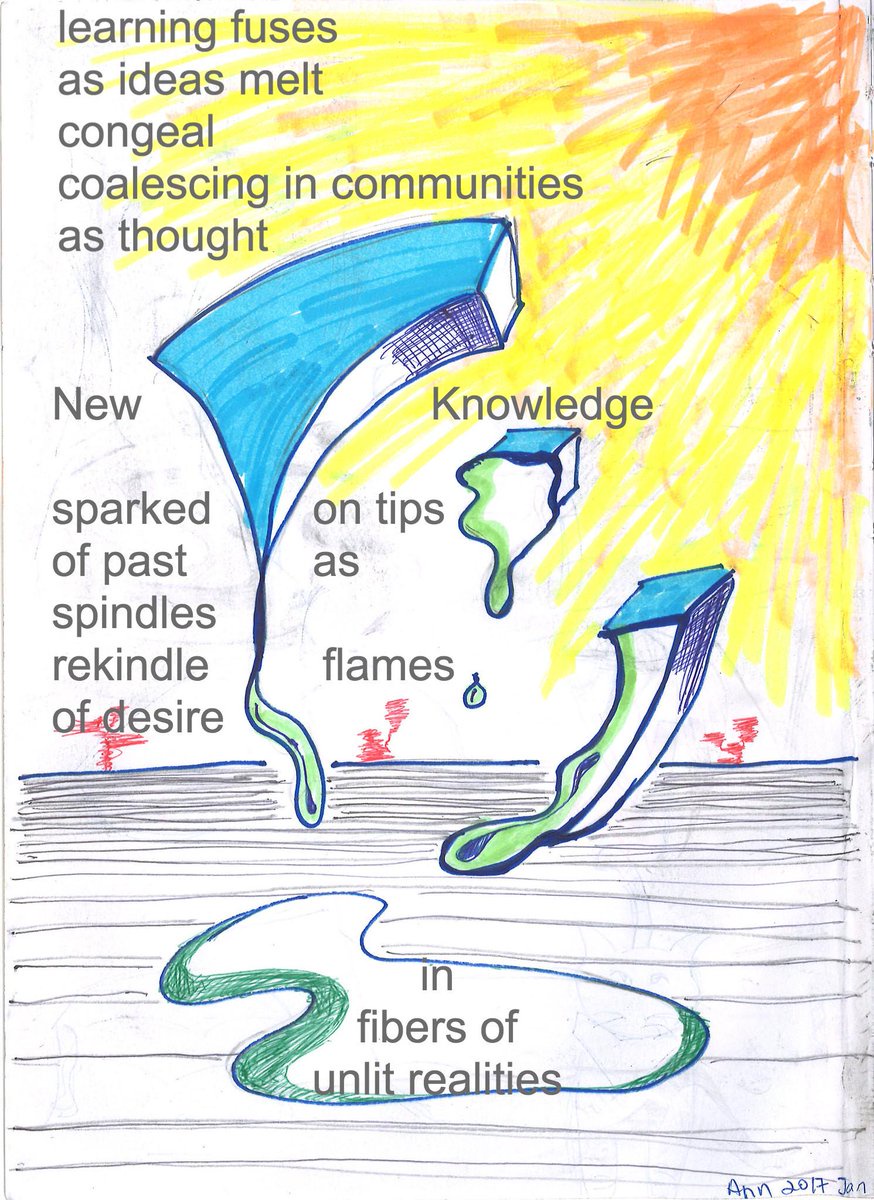

learning fuses
as ideas melt
congeal
coalescing in communities
as thought
New Knowledge
sparked on tips
of past as
spindles
rekindle flames
of desire
in
fibers of
unlit realities
img credit img credit: "Melt" by AnnLoHY is licensed under CC BY-SA


as ideas melt
congeal
coalescing in communities
as thought
New Knowledge
sparked on tips
of past as
spindles
rekindle flames
of desire
fibers of
unlit realities
#smallpoems


Predating Tupac
Lemon Henry Jefferson
lie frozen
dead in streets
of Chicago
Heart attack?
Poison?
Robbed of royalties?
Blind Lemmon Jefferson
father of American
music, forgotten
buried in an unmarked grave
#smallpoems
While Carl Hogan provided the guitar licks and Louis Jordan the vibe of rock and roll the boogey woogie piano players laid the foundation of the 2/4 beat.
Meade Lux Lewis was one of the greatest boogey-woogie bashers of ivory.
Boogey Woogey followed the same time scales of Blues but provided the upbeat rock and roll would need. Music meant for dancing and drinking. Not just drinking.
Boogey Woogey does usually follow a 12 bar meter. Rock n roll settled on an 8 bar as boogey woogey went from piano, dualing piano, and then lead guitar....thanks to Mr. Chuck Berry....
Boogey Woogey was so connected to the other elements like Western Swing, Texas/Chicago Blues, and Jump Jazz.
Blind Lemon Jefferson called the bass lines supplied by guitar "Booga Rooga" (the word derves from some West African language brought with slaves).
Boogey Woogey, like much of the Blues, got created in Texas where people noted a "Fast Western" style among Black ragtime players.
Fun fact...the "Western" in Country and Western..isn't a direction. "Freed" Slaves who built the railroads for Texas Western Railroad Company called that unique Texas ragtime "Fast Western" in reference to the railroad company.
This became the "Western" half of Country Western.

Jordan, known as the "King of the JukeBox" helped to invent jump jazz and bring Black music traditions of the South and make them front in center in Hollywood and out west.
Jump Jive kept the 2/4 beat with the piano as the lead. Carl Hogan, the tympany guitar player though laid down riffs that would lead to the guitar replacing the piano as lead in R&B and Rock and Roll.
Bob Willis took the influence of Bessie Smith and Emmit Tiller and gave rise to the Country Swing that would mix with Texas/Chcago Blues and jump blues to become rock and roll.
We can hear this evolution in his rendition of Ida Red.
Ida Red was an American folk song with no known origin. Willis recorded it in 1938 using the 2/4 Dance beat common in jazz and blues.
The same beat that traces its roots in slave fields and back to West Africa.

I wish more of the free software community gave a level of the same shits that Apple did about their environments. I think the only one that seems to is ElementaryOS. I’ve been trying it out and I think that I might end up moving away from KDE/Plasma towards it.
