Holy 2000s web design style, Batman! I literally ran blogs looking just like that. 😅 Gosh the memories…
Seriously though, congratulations to @css!
twitter.com/webdesignmuseu…
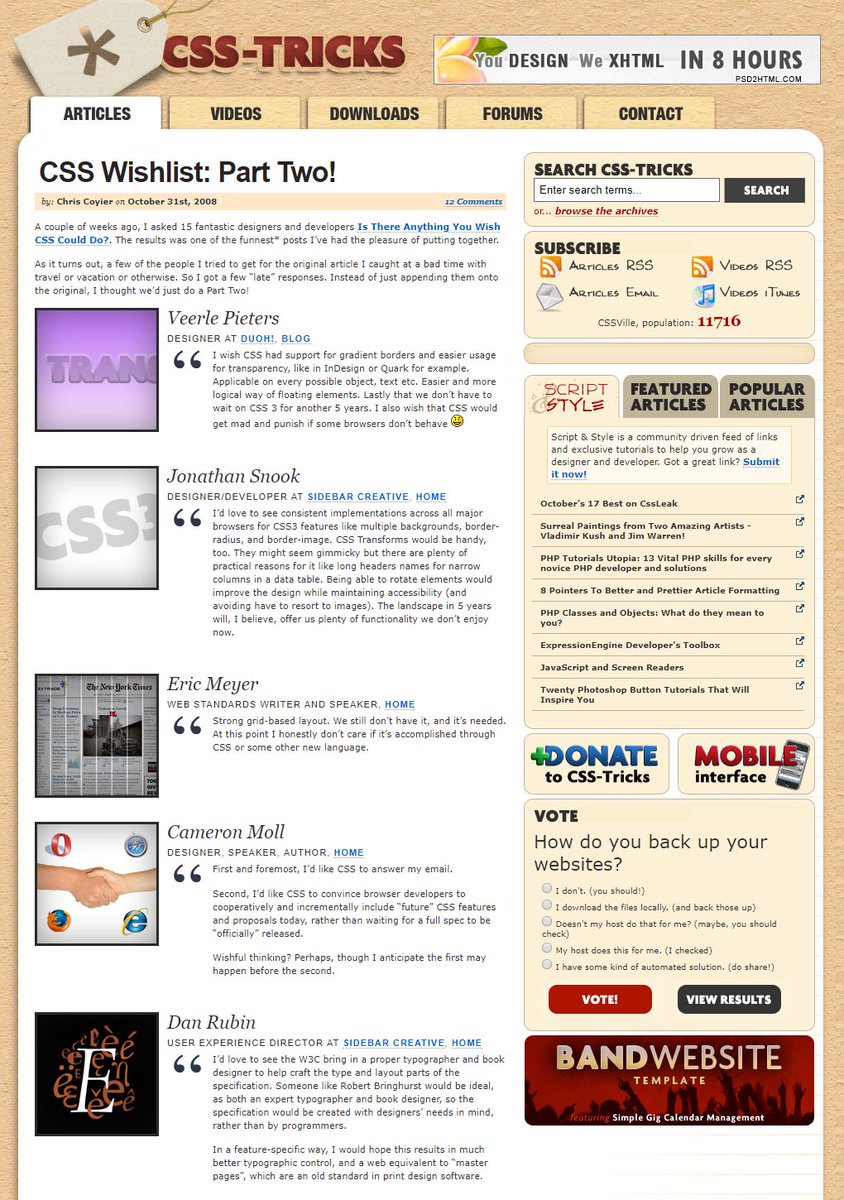
Happy 14th Birthday CSS-Tricks portal! On July 4, 2007, Chris Coyier, a web designer, established the CSS-Tricks portal. The portal brings web designers daily news and tu...
{
"type": "entry",
"published": "2021-07-04T15:40:57+00:00",
"url": "https://twitter.com/jaredcwhite/status/1411711636247781386",
"quotation-of": "https://twitter.com/WebDesignMuseum/status/1411690007018889221",
"content": {
"text": "Holy 2000s web design style, Batman! I literally ran blogs looking just like that. \ud83d\ude05 Gosh the memories\u2026\n\nSeriously though, congratulations to @css!\ntwitter.com/webdesignmuseu\u2026",
"html": "Holy 2000s web design style, Batman! I literally ran blogs looking just like that. \ud83d\ude05 Gosh the memories\u2026\n\nSeriously though, congratulations to <a href=\"https://twitter.com/css\">@css</a>!\n<a href=\"https://twitter.com/webdesignmuseum/status/1411690007018889221\">twitter.com/webdesignmuseu\u2026</a>"
},
"author": {
"type": "card",
"name": "Jared White",
"url": "https://twitter.com/jaredcwhite",
"photo": "https://pbs.twimg.com/profile_images/1349070767032438784/Pns0N1s_.jpg"
},
"post-type": "note",
"refs": {
"https://twitter.com/WebDesignMuseum/status/1411690007018889221": {
"type": "entry",
"published": "2021-07-04T14:15:00+00:00",
"url": "https://twitter.com/WebDesignMuseum/status/1411690007018889221",
"photo": [
"https://pbs.twimg.com/media/E30uLAxWQAA-8Ld.jpg"
],
"content": {
"text": "Happy 14th Birthday CSS-Tricks portal! On July 4, 2007, Chris Coyier, a web designer, established the CSS-Tricks portal. The portal brings web designers daily news and tutorials from the world of web design.\nwebdesignmuseum.org/web-design-his\u2026\n#CSSTricks",
"html": "Happy 14th Birthday CSS-Tricks portal! On July 4, 2007, Chris Coyier, a web designer, established the CSS-Tricks portal. The portal brings web designers daily news and tutorials from the world of web design.\n<a href=\"https://www.webdesignmuseum.org/web-design-history/css-tricks-2007\">webdesignmuseum.org/web-design-his\u2026</a>\n<a href=\"https://twitter.com/search?q=%23CSSTricks\">#CSSTricks</a>"
},
"author": {
"type": "card",
"name": "Web Design Museum",
"url": "https://twitter.com/WebDesignMuseum",
"photo": "https://pbs.twimg.com/profile_images/860928105975885828/8XLNUZIa.jpg"
},
"post-type": "photo"
}
},
"_id": "21791022",
"_source": "2773"
}
Doxa of
drums
crash
in
a crescendo of
One,
phenomena
pantomiming
animistic
agents
who dance
a
true name
summoning
three emperors to
court
as bellowing
beats bounce
between
scattered entities
in spheres of activity
painted on hides
pulled over
the burl
of dawn's day
and hammer hits
rock in stillness
of constant
hums
#smallpoems
Doxa of
drums
crash
in
a crescendo of
One,
phenomena
pantomiming
animistic
agents
who dance
a
true name
summoning
three emperors to
court
as bellowing
beats bounce
between
scattered entities
in spheres of activity
painted on hides… quickthoughts.jgregorymcverry.com/2021/07/04/sma…
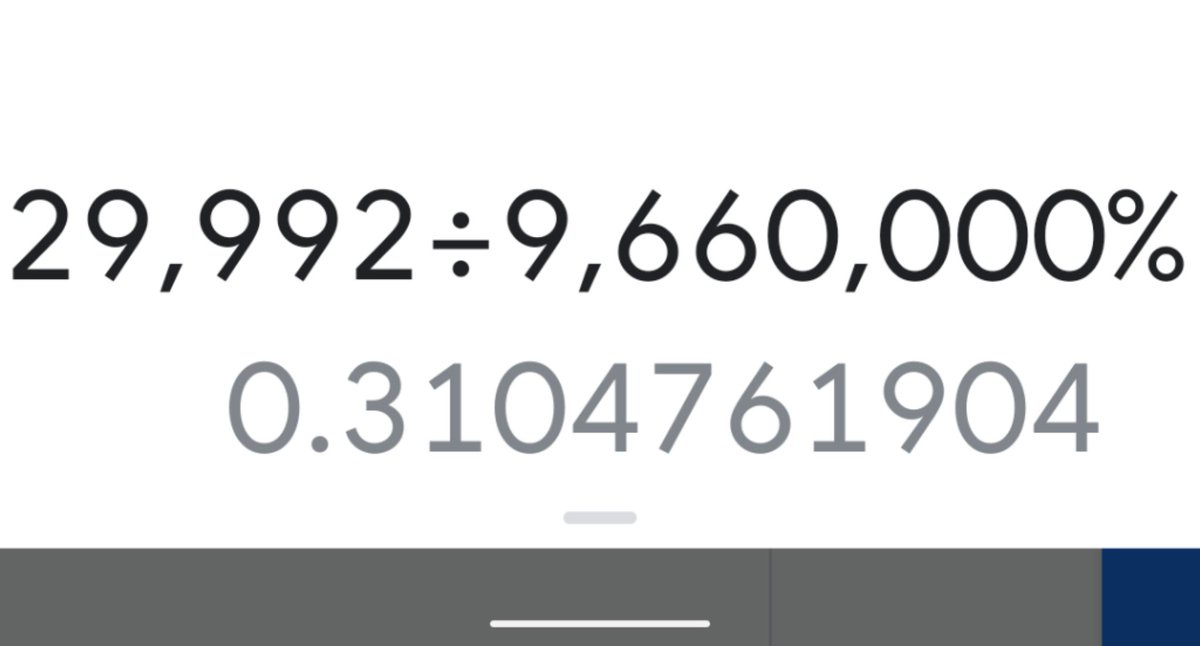
The president of Brazil killed 0.19% of his people.
The prime minister of Britain killed 0.23%
Brazilian people are marching the streets and calling for retribution. The...
{
"type": "entry",
"published": "2021-07-04T13:23:01+00:00",
"url": "https://twitter.com/slsoftworks/status/1411676924791988225",
"photo": [
"https://pbs.twimg.com/media/E5dIrAJWYAgqdWz.jpg"
],
"quotation-of": "https://twitter.com/EnglishmanAdam/status/1411575496152858624",
"content": {
"text": "The number is 0.31%.\nBut at least we can use our stadiums again\u2026 \ud83c\udded\ud83c\uddfa"
},
"author": {
"type": "card",
"name": "flaki",
"url": "https://twitter.com/slsoftworks",
"photo": "https://pbs.twimg.com/profile_images/749678683514896385/7gxIRnoC.jpg"
},
"post-type": "photo",
"refs": {
"https://twitter.com/EnglishmanAdam/status/1411575496152858624": {
"type": "entry",
"published": "2021-07-04T06:39:58+00:00",
"url": "https://twitter.com/EnglishmanAdam/status/1411575496152858624",
"content": {
"text": "The president of Brazil killed 0.19% of his people. \nThe prime minister of Britain killed 0.23%\nBrazilian people are marching the streets and calling for retribution. The British are happy they scored 4.0 against Ukraine."
},
"author": {
"type": "card",
"name": "Adam #FBPPR #FBPE \ud83c\uddea\ud83c\uddfa\ud83c\uddec\ud83c\udde7\ud83c\uddf5\ud83c\uddf9",
"url": "https://twitter.com/EnglishmanAdam",
"photo": "https://pbs.twimg.com/profile_images/1337043209323769856/u0nuLS7K.jpg"
},
"post-type": "note"
}
},
"_id": "21788413",
"_source": "2773"
}
🦊 @baelathefox demonstrating their cunning ability to stay on top of things (incl. very unstable & unreliable things, such as @badboy_ 👀) (@ Hiroshima-Nagasaki-Park - @koeln in Köln) swarmapp.com/c/iaXZHUX0L3s

{
"type": "entry",
"published": "2021-07-04T11:30:17+00:00",
"url": "https://twitter.com/slsoftworks/status/1411648555941515267",
"photo": [
"https://pbs.twimg.com/media/E5cu4YZWUAAfIqc.jpg"
],
"content": {
"text": "\ud83e\udd8a @baelathefox demonstrating their cunning ability to stay on top of things (incl. very unstable & unreliable things, such as @badboy_ \ud83d\udc40) (@ Hiroshima-Nagasaki-Park - @koeln in K\u00f6ln) swarmapp.com/c/iaXZHUX0L3s",
"html": "\ud83e\udd8a <a href=\"https://twitter.com/baelathefox\">@baelathefox</a> demonstrating their cunning ability to stay on top of things (incl. very unstable & unreliable things, such as <a href=\"https://twitter.com/badboy_\">@badboy_</a> \ud83d\udc40) (@ Hiroshima-Nagasaki-Park - <a href=\"https://twitter.com/Koeln\">@koeln</a> in K\u00f6ln) <a href=\"https://www.swarmapp.com/c/iaXZHUX0L3s\">swarmapp.com/c/iaXZHUX0L3s</a>"
},
"author": {
"type": "card",
"name": "flaki",
"url": "https://twitter.com/slsoftworks",
"photo": "https://pbs.twimg.com/profile_images/749678683514896385/7gxIRnoC.jpg"
},
"post-type": "photo",
"_id": "21786736",
"_source": "2773"
}
Physical has lost me in its first ep through use of VO, which is a 1990’s holdover that should be banned in the 2020’s along with fake documentary techniques.
{
"type": "entry",
"published": "2021-07-04T04:48:34+00:00",
"url": "https://twitter.com/karabaic/status/1411547459256426497",
"content": {
"text": "Physical has lost me in its first ep through use of VO, which is a 1990\u2019s holdover that should be banned in the 2020\u2019s along with fake documentary techniques."
},
"author": {
"type": "card",
"name": "remember srebrenica",
"url": "https://twitter.com/karabaic",
"photo": "https://pbs.twimg.com/profile_images/1256785873384861696/QfRzUvne.jpg"
},
"post-type": "note",
"_id": "21782375",
"_source": "2773"
}
Since Claire Lehmann is trending.
A note to journalists calling her a journalist.
She's the founder of a white supremacist blog in Australia called Quillette, posing as...
{
"type": "entry",
"published": "2021-07-04T04:38:55+00:00",
"url": "https://twitter.com/karabaic/status/1411545031500959744",
"photo": [
"https://pbs.twimg.com/media/E5bQuRcVgAALcv8.jpg"
],
"quotation-of": "https://twitter.com/rafaelshimunov/status/1411527067037048832",
"content": {
"text": "And liberals wonder\u2026\n\n(btw, the publication that gave that paragon A*d* N*o his start.)"
},
"author": {
"type": "card",
"name": "remember srebrenica",
"url": "https://twitter.com/karabaic",
"photo": "https://pbs.twimg.com/profile_images/1256785873384861696/QfRzUvne.jpg"
},
"post-type": "photo",
"refs": {
"https://twitter.com/rafaelshimunov/status/1411527067037048832": {
"type": "entry",
"published": "2021-07-04T03:27:32+00:00",
"url": "https://twitter.com/rafaelshimunov/status/1411527067037048832",
"content": {
"text": "Since Claire Lehmann is trending.\n\nA note to journalists calling her a journalist.\n\nShe's the founder of a white supremacist blog in Australia called Quillette, posing as libertarian.\n\nBy @Minkowitz for @thenation\n\nAnd some additional background in thread\n\nthenation.com/article/archiv\u2026",
"html": "Since Claire Lehmann is trending.\n\nA note to journalists calling her a journalist.\n\nShe's the founder of a white supremacist blog in Australia called Quillette, posing as libertarian.\n\nBy <a href=\"https://twitter.com/Minkowitz\">@Minkowitz</a> for <a href=\"https://twitter.com/thenation\">@thenation</a>\n\nAnd some additional background in thread\n\n<a href=\"https://www.thenation.com/article/archive/quillette-fascist-creep/\">thenation.com/article/archiv\u2026</a>"
},
"author": {
"type": "card",
"name": "raf",
"url": "https://twitter.com/rafaelshimunov",
"photo": "https://pbs.twimg.com/profile_images/1334555237856792577/V1xLG0Wt.jpg"
},
"post-type": "note"
}
},
"_id": "21782282",
"_source": "2773"
}
{
"type": "entry",
"published": "2021-07-03T16:25:31-07:00",
"url": "https://boffosocko.com/2021/07/03/differentiating-online-variations-of-the-commonplace-book-digital-gardens-wikis-zettlekasten-waste-books-florilegia-and-second-brains/",
"category": [
"education",
"indieweb",
"technology",
"commonplace-books",
"digital-gardens",
"florilegia",
"hypercard",
"hypothes-is",
"i-annotate-2021",
"note-taking",
"productivity",
"second-brain",
"thought-spaces",
"tools",
"tools-for-thought",
"ward-cunningham",
"waste-books",
"wikis",
"zettelkasten"
],
"name": "Differentiating online variations of the Commonplace Book: Digital Gardens, Wikis, Zettlekasten, Waste Books, Florilegia, and Second Brains",
"content": {
"text": "A fluorescence of note taking tools\nOver the past three or so years there has been a fluorescence of digital note taking tools and platforms.\nSome of these include:\nOpen source projects like Org Mode, Logseq, Foam, Jupyter, Trilium, Databyss, Athens, Dendron, Anagora, and Hypothes.is.\nClosed sourced projects like: Roam Research, Notion, Knovigator, Amplenote, RemNote, Memex, Nototo, nvUltra, and Are.na.\nSome are based on earlier incarnations of note taking and writing tools like OneNote, Evernote, Simple Note, TiddlyWiki, DEVONthink, Scrivener, etc.\nThis brief list doesn\u2019t take into account a sea of other mobile apps and platforms in addition to a broad array of social media platforms that people use for similar note taking or annotations.\nMy particular interest in some of this note taking field comes in the growing number of people who are working in public and sharing their notes in online settings with others. This has been happening organically since the rise of the internet and has happened on blogs within the blogosphere and on personal and communal wikis.\nAs was highlighted (pun intended) at the recent I Annotate 2021 conference, the note taking space seems to have been coming to a new boil. With the expansion of the ideas of keeping a zettelkasten or a digital garden, these versions of notebooks seem to be a significant part of this new note taking craze.\nOne thing I have noticed, however, is a dramatic lack of continuity in the history of note taking within the longue dur\u00e9e of Western civilization. (Other cultures including oral cultures have similar traditions, but for our purposes here, I won\u2019t go into them except to say that they\u2019re highly valuable, spectacularly rich, and something of which we should all be aware.)\nMany of these products are selling themselves based on ideas or philosophies which sound and even feel solid, but they\u2019re completely ignoring their predecessors to the tune of feeling like they\u2019re trying to reinvent the wheel. As a result, some of the pitches for these products sound like they\u2019re selling snake oil rather than tried and true methods that go back over 2,000 years of intellectual history. I can only presume that modern education is failing us all dramatically. People are \u201ctaught\u201d (maybe told is the better verb) to take notes in school, but they\u2019re never told why, what to do with them, or how to leverage them for maximum efficiency. Perhaps the idea has been so heavily imbued into our culture we\u2019ve honestly forgotten the basic parts and reasoning behind it?\nEven Vannevar Bush\u2019s dream of the Memex as stated in his article As We May Think (The Atlantic, 1945), which many of these note taking applications might point to as an inspiration, ignores this same tradition and background, so perhaps these app creators and users aren\u2019t all to blame?\nDelineating Online Forms\nI\u2019ve been doing some serious reading and research into these traditions to help uncover our missing shared history. I\u2019ll write something longer and more specific about them at a later date.\nIn the meanwhile, I want to outline just a bit about the various flavors as they relate to some of the more public online versions that I see in the related internet spaces. I hope to help better delineate what they have in common, how they differ, and what they may still add to the mix to get us to a more robust version of Bush\u2019s dream.\nOther\u2019s thoughts and comments about these various incarnations and their forms and functions are both encouraged and appreciated.\nCommonplace books\nHistorically commonplace books are one of the oldest and most influential structures in the note taking, writing, and thinking space. They have generally been physical books written by hand that contain notes which are categorized by headings (or in a modern context categories or tags. Often they\u2019re created with an index to help their creators find and organize their notes.\nThey originated in ancient Greece and Rome out of the thought of Aristotle and Cicero as a tool for thinking and writing and have generally enjoyed a solid place in history since. A huge variety of commonplaces have been either copied by hand or published in print book form over the centuries.\nMost significant thinkers, writers, and creators throughout history have kept something resembling a commonplace book. While many may want to attribute the output of historical figures like Erasmus, Newton, Darwin, Leibnitz, Locke, or Emerson to sheer genius (and many often do), I might suggest that their works were the result of sustained work of creating personal commonplace books\u2014somewhat like a portable Google search engine for their day, but honed to their particular interests. (One naturally can\u2019t ignore their other many privileges like wealth, education, and time to do this work, which were also certainly a significant factor in their success.)\nMany people over the past quarter of a century have used a variety of digital forms to keep digital commonplace books including public versions on blogs, wikis, and other software for either public or private consumption.\nFlorilegium\nFlorilegia are a subcategory of commonplace book starting around 900 CE but flourishing in the 12th and 13th centuries and primarily kept by theologians and preachers. The first were a series of short excerpted passages often arranged in order of their appearance in a single text, but eventually were arranged systematically under discrete headings. Medieval florilegia where overwhelmingly, and often exclusively, concerned with religious topics from the works of scriptures, the moral dicta of the Doctors of the Church, and\u2014less frequently\u2014the teachings of approved, classical moral philosophers. The idea and form of florilegium generally merged back into the idea of the commonplace book which had renewed interest and wide popularity during the Renaissance.\nThese didn\u2019t add any new or innovative features over what had come before. Perhaps, if anything, they were a regression because they so heavily focused only on religion as a topic.\nFew (if any) examples of florilegia can be found in modern digital contexts. Though I have seen some people talk about using digital note taking tools for religious study, I have yet to see public versions online.\nZettelk\u00e4sten\nBorn out of the commonplace tradition with modifications by Conrad Gessner (1516-1565) and descriptions by Johann Jacob Moser (1701\u20131785), the Zettelkasten, a German word translated as \u201cslip box\u201d, is generally a collection of highly curated atomic notes collected on slips of paper or index cards. Zettelkasten were made simpler to create and maintain with the introduction of the mass manufacture of index cards (and card boxes and furniture) in the early 20th century. Slips of paper which were moveable within books or files and later on index cards were a significant innovation in terms of storing and organizing a commonplace book.\nGenerally zettels (or cards) are organized by topics and often contain dates and other taxonomies or serialized numbers as a means of linking them to other cards within the system. The cross linking of these cards (and thus ideas) were certainly a historical physical precursor of the internet we have today, simply in digital form.\nAlmost all the current references I\u2019ve seen online to Zettelkasten mention Niklas Luhmann as their inspiration, but none of them reference any other well-known historical examples despite the fact the idea has been around and evolving for several centuries now.\nThis productivity system and sets of digital tools around it came to greater attention in Germany in 2013 with the exhibition \u201cZettelk\u00e4sten: Machines of Fantasy\u201d at the Museum of Modern Literature, Marbach am Neckar and in 2014 with the launch of the zettelkasten.de website. A subsequent boost in the English speaking world occurred following the publication of S\u00f6nke Ahrens\u2019s book How to Take Smart Notes \u2013 One Simple Technique to Boost Writing, Learning and Thinking \u2013 for Students, Academics and Nonfiction Book Writers in February 2017. The recent ability to use platforms like Roam Research, Obsidian, Notion, et al. has helped to fan the flames of their popularization.\nMore often than not, most of these digital tools (like their card-based predecessors) are geared toward private personal use rather than an open public model. Roam Research and Obsidian Publish have features which allow public publishing. TiddlyWiki is also an excellent tool for this as its so-called Tiddlers have a card-based appearance and can be placed in custom orders as well as transcluded, but again not many are available to the online public.\nWaste books/Sudelb\u00fccher\nThis sub-genre of notebooks comes out of the tradition of double-entry book keeping where accountants often kept a daily diary of all transactions in chronological order. These temporary notes were then later moved into a more permanent accounting ledger and the remaining book was considered \u201cwaste\u201d.\nIn the commonplace book tradition, these books for temporary notes or (fleeting notes in a Zettelkasten framing), might eventually be copied over, expanded, and indexed into one\u2019s permanent commonplace collection.\nIn modern digital settings, one might consider some of the ephemeral social media stream platforms like Twitter to be a digital version of a waste book, though to my knowledge I may be the first person to suggest this connection. (To be clear, others have certainly mentioned Twitter as being a waste and even a wasteland.)\nWikis\nInspired, in part, by Apple\u2019s HyperCard, Ward Cunningham created the first public wiki on his website on March 25, 1995. Apple had designed a system allowing users to create virtual \u201ccard stacks\u201d supporting links among the various cards (sound familiar?). HyperCard was designed as a single user system.\nWikis allowed multiple users to author and edit pages on the web with a basic web browser. They were also able to create meaningful links and associations between pages, whether they existed or not using [[WikiLinks]]. They were meant to allow the average visitor to participate in an ongoing process of creation and collaboration.\nHere there is some innovative user interface as well as the ability to collaborate with others in keeping a commonplace book. Transclusion of one page into another is a useful feature here.\nPersonal wikis have been used (as have many blogs) for information aggregation and dissemination over the years in a manner similar to their historical predecessors.\nSecond brain\nSecond brain is a marketing term which stands in for the idea of the original commonplace book. It popped up in the note taking context in early 2017 for promoting the use of commonplace books techniques using Tiago Forte\u2019s expensive online course Building a Second Brain which focused on capturing, organizing, and sharing your knowledge using (digital) notes. It is a platform agnostic method for improving productivity wholly using the commonplace underpinning.\nGoogle searches for this term will be heavily mixed in with results about the gastrointestinal system being the body\u2019s \u201csecond brain\u201d, the enteric nervous system, second brain tumors, a debunked theory that dinosaurs had two brains, and other general health-related topics.\nSome websites, personal wikis and other online versions will use the phrase second brain, but they generally have no innovative features that are missing from prior efforts. Again, I view the phrase simply as marketing with no additional substance.\nDigital Gardens\nInformed heavily by their cultural predecessors in commonplace books, zettelkasten, and wikis, digital gardens are digital first note collections which are primarily public by default and encourage the idea of working in public.\nDigital Gardens arose more formally in 2019 and 2020 out of the work and influence of Mark Bernstein\u2019s 1998 essay Hypertext Gardens: Delightful Vistas, Ward Cunningham\u2019s Smallest Federated Wiki (which just celebrated it\u2019s 10th anniversary), Mike Caulfield\u2019s essays including The Garden and the Stream: A Technopastoral as well as some influence from the broader IndieWeb Community and their focus on design and user interface.\nDigital garden design can often use the gardening metaphor to focus attention on an active tending and care of one\u2019s personal knowledge base and building toward new knowledge or creations. The idea of planting a knowledge \u201cseed\u201d (a note), tending it gradually over time with regular watering and feeding in a progression of \ud83c\udf31 Seedlings \u2192 \ud83c\udf3f Budding \u2192 \ud83c\udf33 Evergreen is a common feature.\nThere are a growing number of people with personal digital gardens in public. Many are built on pre-existing wiki software like WikiMedia, the Smallest Federated Wiki, or TiddlyWiki, static site generators like Jekyll, note taking platforms like Obsidian Publish and Roam Research, or even out of common blogging software like WordPress. A growing common feature of these platforms is that they not only link out to resources on the open web, but contain bidirectional links within themselves using either custom code (in a wiki-like manner) or using the W3C Webmention specification.\nThe Future?\nWith luck, application and platform designers and users will come to know more about the traditions, uses, and workflows of our rich cultural note taking history. Beyond this there are a few innovations, particularly in the public-facing arena which could be useful, but which aren\u2019t broadly seen or available yet.\nStill missing from the overall personal knowledge and note taking space is a more tightly integrated version of both a garden and a stream (in Mike Caulfield\u2019s excellent framing) that easily allows interaction between the two arenas. Some of the more blog-based sites with notes, bookmarks, articles and IndieWeb friendly building blocks like Webmention, feeds (RSS, JSON Feed, h-feed), Micropub, and Microsub integrations may come the closest to this ideal.\nOne of the most fascinating recent entrants on the scene is Flancian\u2019s Anagora which he uses as a personal commonplace book in a wiki-esque style. Over other incarnations it also has the ability to pull in and aggregate the notes of other digital commonplace books to create a larger marketplace of ideas. It also includes collaborative note taking space using Etherpad, which I\u2019ve seen as a standalone tool, but never integrated into a digital commonplace book.\nUltimately, my dream\u2014similar to that of Bush\u2019s\u2014is for individual commonplace books to be able to communicate not only with their users in the Luhmann-esqe sense, but also communicate with each other.\nNiklas Luhmann apparently said:\n\nOhne zu schreiben, kann man nicht denken; jedenfalls nicht in anspruchsvoller, anschlussf\u00e4higer Weise.\n\n\n(Translation) You cannot think without writing; at least not in a sophisticated, connectable way.\n\nI think his conceptualization of \u201cconnectable\u201d was much more limited and limiting than he might have guessed. Vannevar Bush, as the academic advisor of Claude Shannon, the godfather of the modern digital age, was more prepared to envision it.\n(Luhmann\u2019s \u201cyou\u201d in his quote is obviously only a Western cultural referent which erases the existence of oral based cultures which have other ways to do their sophisticated thinking. His ignorant framing on the topic shouldn\u2019t be a shared one.)\nThis post has grown out of my own personal commonplace book, portions of which are on housed on my blog, in a wiki, and in a private repository of which I hope to make more public soon. Further thoughts, ideas and expansions of it are more than welcome.\nI\u2019ve slowly been updating pieces of the history along with examples on shared commonplaces in both the IndieWeb Wiki and Wikipedia under the appropriate headings. Feel free to browse those or contribute to them as you would, at least until our digital commonplace books can communicate with each other.\nI\u2019d also invite those who are interested in this topic and who have or want online spaces to do this sort of thing to join us at the proposed upcoming Gardens and Streams II IndieWebCamp Pop up session which is being planned for later this Summer or early Fall. Comment below, stop by the page or chat to indicate your interest in attending.",
"html": "<h2>A fluorescence of note taking tools</h2>\n<p>Over the past three or so years there has been a fluorescence of digital note taking tools and platforms.</p>\n<p>Some of these include:</p>\n<p>Open source projects like <a href=\"https://orgmode.org/\">Org Mode</a>, <a href=\"https://logseq.com/\">Logseq</a>, <a href=\"https://github.com/foambubble/foam\">Foam</a>, <a href=\"https://jupyter.org/\">Jupyter</a>, <a href=\"https://github.com/zadam/trilium\">Trilium</a>, <a href=\"https://databyss.org/\">Databyss</a>, <a href=\"https://github.com/athensresearch/athens\">Athens</a>, <a href=\"https://dendron.so/\">Dendron</a>, <a href=\"https://anagora.org/\">Anagora</a>, and <a href=\"https://web.hypothes.is/\">Hypothes.is</a>.</p>\n<p>Closed sourced projects like: <a href=\"https://roamresearch.com/\">Roam Research</a>, <a href=\"https://www.notion.so/\">Notion</a>, <a href=\"https://knovigator.com/\">Knovigator</a>, <a href=\"https://www.amplenote.com/\">Amplenote</a>, <a href=\"https://www.remnote.io/homepage\">RemNote</a>, <a href=\"https://getmemex.com/\">Memex</a>, <a href=\"https://www.nototo.app/\">Nototo</a>, <a href=\"https://nvultra.com/\">nvUltra</a>, and <a href=\"https://www.are.na/about\">Are.na</a>.</p>\n<p>Some are based on earlier incarnations of note taking and writing tools like <a href=\"http://www.onenote.com/\">OneNote</a>, <a href=\"https://evernote.com/\">Evernote</a>, <a href=\"https://simplenote.com/\">Simple Note</a>, <a href=\"https://tiddlywiki.com/\">TiddlyWiki</a>, <a href=\"https://www.devontechnologies.com/apps/devonthink\">DEVONthink</a>, <a href=\"https://www.literatureandlatte.com/scrivener/overview\">Scrivener</a>, etc.</p>\n<p>This brief list doesn\u2019t take into account a sea of other mobile apps and platforms in addition to a broad array of social media platforms that people use for similar note taking or annotations.</p>\n<p>My particular interest in some of this note taking field comes in the growing number of people who are working in public and sharing their notes in online settings with others. This has been happening organically since the rise of the internet and has happened on blogs within the blogosphere and on personal and communal wikis.</p>\n<p>As was highlighted (pun intended) at the recent <a href=\"https://iannotate.org/2021/\">I Annotate 2021 conference</a>, the note taking space seems to have been coming to a new boil. With the expansion of the ideas of keeping a zettelkasten or a digital garden, these versions of notebooks seem to be a significant part of this new note taking craze.</p>\n<p>One thing I have noticed, however, is a dramatic lack of continuity in the history of note taking within the <em>longue dur\u00e9e</em> of Western civilization. (Other cultures including oral cultures have similar traditions, but for our purposes here, I won\u2019t go into them except to say that they\u2019re highly valuable, spectacularly rich, and something of which we should all be aware.)</p>\n<p>Many of these products are selling themselves based on ideas or philosophies which sound and even feel solid, but they\u2019re completely ignoring their predecessors to the tune of feeling like they\u2019re trying to reinvent the wheel. As a result, some of the pitches for these products sound like they\u2019re selling snake oil rather than tried and true methods that go back over 2,000 years of intellectual history. I can only presume that modern education is failing us all dramatically. People are \u201ctaught\u201d (maybe told is the better verb) to take notes in school, but they\u2019re never told why, what to do with them, or how to leverage them for maximum efficiency. Perhaps the idea has been so heavily imbued into our culture we\u2019ve honestly forgotten the basic parts and reasoning behind it?</p>\n<p>Even Vannevar Bush\u2019s dream of the Memex as stated in his article <a href=\"https://www.theatlantic.com/magazine/archive/1945/07/as-we-may-think/303881/\"><em>As We May Think</em></a> (<em>The Atlantic</em>, 1945), which many of these note taking applications might point to as an inspiration, ignores this same tradition and background, so perhaps these app creators and users aren\u2019t all to blame?</p>\n<h2>Delineating Online Forms</h2>\n<p>I\u2019ve been doing some serious reading and research into these traditions to help uncover our missing shared history. I\u2019ll write something longer and more specific about them at a later date.</p>\n<p>In the meanwhile, I want to outline just a bit about the various flavors as they relate to some of the more public online versions that I see in the related internet spaces. I hope to help better delineate what they have in common, how they differ, and what they may still add to the mix to get us to a more robust version of Bush\u2019s dream.</p>\n<p>Other\u2019s thoughts and comments about these various incarnations and their forms and functions are both encouraged and appreciated.</p>\n<h3>Commonplace books</h3>\n<p>Historically commonplace books are one of the oldest and most influential structures in the note taking, writing, and thinking space. They have generally been physical books written by hand that contain notes which are categorized by headings (or in a modern context categories or tags. Often they\u2019re created with an index to help their creators find and organize their notes.</p>\n<p>They originated in ancient Greece and Rome out of the thought of Aristotle and Cicero as a tool for thinking and writing and have generally enjoyed a solid place in history since. A huge variety of commonplaces have been either copied by hand or published in print book form over the centuries.</p>\n<p>Most significant thinkers, writers, and creators throughout history have kept something resembling a commonplace book. While many may want to attribute the output of historical figures like Erasmus, Newton, Darwin, Leibnitz, Locke, or Emerson to sheer genius (and many often do), I might suggest that their works were the result of sustained work of creating personal commonplace books\u2014somewhat like a portable Google search engine for their day, but honed to their particular interests. (One naturally can\u2019t ignore their other many privileges like wealth, education, and time to do this work, which were also certainly a significant factor in their success.)</p>\n<p>Many people over the past quarter of a century have used a variety of digital forms to keep digital commonplace books including public versions on blogs, wikis, and other software for either public or private consumption.</p>\n<h3>Florilegium</h3>\n<p>Florilegia are a subcategory of commonplace book starting around 900 CE but flourishing in the 12th and 13th centuries and primarily kept by theologians and preachers. The first were a series of short excerpted passages often arranged in order of their appearance in a single text, but eventually were arranged systematically under discrete headings. Medieval florilegia where overwhelmingly, and often exclusively, concerned with religious topics from the works of scriptures, the moral dicta of the Doctors of the Church, and\u2014less frequently\u2014the teachings of approved, classical moral philosophers. The idea and form of florilegium generally merged back into the idea of the commonplace book which had renewed interest and wide popularity during the Renaissance.</p>\n<p>These didn\u2019t add any new or innovative features over what had come before. Perhaps, if anything, they were a regression because they so heavily focused only on religion as a topic.</p>\n<p>Few (if any) examples of florilegia can be found in modern digital contexts. Though I have seen some people talk about using digital note taking tools for religious study, I have yet to see public versions online.</p>\n<h3>Zettelk\u00e4sten</h3>\n<p>Born out of the commonplace tradition with modifications by Conrad Gessner (1516-1565) and descriptions by Johann Jacob Moser (1701\u20131785), the Zettelkasten, a German word translated as \u201cslip box\u201d, is generally a collection of highly curated atomic notes collected on slips of paper or index cards. Zettelkasten were made simpler to create and maintain with the introduction of the mass manufacture of index cards (and card boxes and furniture) in the early 20th century. Slips of paper which were moveable within books or files and later on index cards were a significant innovation in terms of storing and organizing a commonplace book.</p>\n<p>Generally zettels (or cards) are organized by topics and often contain dates and other taxonomies or serialized numbers as a means of linking them to other cards within the system. The cross linking of these cards (and thus ideas) were certainly a historical physical precursor of the internet we have today, simply in digital form.</p>\n<p>Almost <em>all</em> the current references I\u2019ve seen online to Zettelkasten mention Niklas Luhmann as their inspiration, but none of them reference any other well-known historical examples despite the fact the idea has been around and evolving for several centuries now.</p>\n<p>This productivity system and sets of digital tools around it came to greater attention in Germany in 2013 with the exhibition \u201cZettelk\u00e4sten: Machines of Fantasy\u201d at the Museum of Modern Literature, Marbach am Neckar and in 2014 with the launch of the <a href=\"https://zettelkasten.de/\">zettelkasten.de</a> website. A subsequent boost in the English speaking world occurred following the publication of S\u00f6nke Ahrens\u2019s book <a href=\"https://amzn.to/2V5hv8p\"><em>How to Take Smart Notes \u2013 One Simple Technique to Boost Writing, Learning and Thinking \u2013 for Students, Academics and Nonfiction Book Writers</em></a> in February 2017. The recent ability to use platforms like Roam Research, Obsidian, Notion, et al. has helped to fan the flames of their popularization.</p>\n<p>More often than not, most of these digital tools (like their card-based predecessors) are geared toward private personal use rather than an open public model. Roam Research and Obsidian Publish have features which allow public publishing. TiddlyWiki is also an excellent tool for this as its so-called Tiddlers have a card-based appearance and can be placed in custom orders as well as transcluded, but again not many are available to the online public.</p>\n<h3>Waste books/Sudelb\u00fccher</h3>\n<p>This sub-genre of notebooks comes out of the tradition of double-entry book keeping where accountants often kept a daily diary of all transactions in chronological order. These temporary notes were then later moved into a more permanent accounting ledger and the remaining book was considered \u201cwaste\u201d.</p>\n<p>In the commonplace book tradition, these books for temporary notes or (fleeting notes in a Zettelkasten framing), might eventually be copied over, expanded, and indexed into one\u2019s permanent commonplace collection.</p>\n<p>In modern digital settings, one might consider some of the ephemeral social media stream platforms like Twitter to be a digital version of a waste book, though to my knowledge I may be the first person to suggest this connection. (To be clear, others have certainly mentioned Twitter as being a waste and even a wasteland.)</p>\n<h3>Wikis</h3>\n<p>Inspired, in part, by Apple\u2019s HyperCard, Ward Cunningham created the first public wiki on his website on March 25, 1995. Apple had designed a system allowing users to create virtual \u201ccard stacks\u201d supporting links among the various cards (sound familiar?). HyperCard was designed as a single user system.</p>\n<p>Wikis allowed multiple users to author and edit pages on the web with a basic web browser. They were also able to create meaningful links and associations between pages, whether they existed or not using [[WikiLinks]]. They were meant to allow the average visitor to participate in an ongoing process of creation and collaboration.</p>\n<p>Here there is some innovative user interface as well as the ability to collaborate with others in keeping a commonplace book. Transclusion of one page into another is a useful feature here.</p>\n<p>Personal wikis have been used (as have many blogs) for information aggregation and dissemination over the years in a manner similar to their historical predecessors.</p>\n<h3>Second brain</h3>\n<p>Second brain is a marketing term which stands in for the idea of the original commonplace book. It popped up in the note taking context in early 2017 for promoting the use of commonplace books techniques using Tiago Forte\u2019s expensive online course <a href=\"https://www.buildingasecondbrain.com/\">Building a Second Brain</a> which focused on capturing, organizing, and sharing your knowledge using (digital) notes. It is a platform agnostic method for improving productivity wholly using the commonplace underpinning.</p>\n<p>Google searches for this term will be heavily mixed in with results about the gastrointestinal system being the body\u2019s \u201csecond brain\u201d, the enteric nervous system, second brain tumors, a debunked theory that dinosaurs had two brains, and other general health-related topics.</p>\n<p>Some websites, personal wikis and other online versions will use the phrase second brain, but they generally have no innovative features that are missing from prior efforts. Again, I view the phrase simply as marketing with no additional substance.</p>\n<h3>Digital Gardens</h3>\n<p>Informed heavily by their cultural predecessors in commonplace books, zettelkasten, and wikis, digital gardens are digital first note collections which are primarily public by default and encourage the idea of working in public.</p>\n<p>Digital Gardens arose more formally in 2019 and 2020 out of the work and influence of Mark Bernstein\u2019s 1998 essay <a href=\"https://www.eastgate.com/garden/\">Hypertext Gardens: Delightful Vistas</a>, Ward Cunningham\u2019s <a href=\"https://indieweb.org/2011/Smallest_Federated_Wiki\">Smallest Federated Wiki</a> (which just celebrated it\u2019s 10th anniversary), Mike Caulfield\u2019s essays including <a href=\"https://hapgood.us/2015/10/17/the-garden-and-the-stream-a-technopastoral/\">The Garden and the Stream: A Technopastoral</a> as well as some influence from the broader <a href=\"https://indieweb.org/\">IndieWeb Community</a> and their focus on design and user interface.</p>\n<p>Digital garden design can often use the gardening metaphor to focus attention on an active tending and care of one\u2019s <a href=\"https://en.wikipedia.org/wiki/Personal_knowledge_base\">personal knowledge base</a> and building toward new knowledge or creations. The idea of planting a knowledge \u201cseed\u201d (a note), tending it gradually over time with regular watering and feeding in a progression of \ud83c\udf31 Seedlings \u2192 \ud83c\udf3f Budding \u2192 \ud83c\udf33 Evergreen is a common feature.</p>\n<p>There are a growing number of people with personal digital gardens in public. Many are built on pre-existing wiki software like WikiMedia, the Smallest Federated Wiki, or TiddlyWiki, static site generators like Jekyll, note taking platforms like Obsidian Publish and Roam Research, or even out of common blogging software like WordPress. A growing common feature of these platforms is that they not only link out to resources on the open web, but contain bidirectional links within themselves using either custom code (in a wiki-like manner) or using the W3C <a href=\"https://indieweb.org/Webmention\">Webmention</a> specification.</p>\n<h2>The Future?</h2>\n<p>With luck, application and platform designers and users will come to know more about the traditions, uses, and workflows of our rich cultural note taking history. Beyond this there are a few innovations, particularly in the public-facing arena which could be useful, but which aren\u2019t broadly seen or available yet.</p>\n<p>Still missing from the overall personal knowledge and note taking space is a more tightly integrated version of both a garden <strong>and</strong> a stream (in Mike Caulfield\u2019s excellent framing) that easily allows interaction between the two arenas. Some of the more blog-based sites with notes, bookmarks, articles and IndieWeb friendly building blocks like Webmention, feeds (RSS, JSON Feed, h-feed), Micropub, and Microsub integrations may come the closest to this ideal.</p>\n<p>One of the most fascinating recent entrants on the scene is Flancian\u2019s Anagora which he uses as a personal commonplace book in a wiki-esque style. Over other incarnations it also has the ability to pull in and aggregate the notes of other digital commonplace books to create a larger marketplace of ideas. It also includes collaborative note taking space using Etherpad, which I\u2019ve seen as a standalone tool, but never integrated into a digital commonplace book.</p>\n<p>Ultimately, my dream\u2014similar to that of Bush\u2019s\u2014is for individual commonplace books to be able to communicate not only with their users in the Luhmann-esqe sense, but also <strong>communicate with each other</strong>.</p>\n<p>Niklas Luhmann apparently said:</p>\n<blockquote><p>\nOhne zu schreiben, kann man nicht denken; jedenfalls nicht in anspruchsvoller, anschlussf\u00e4higer Weise.<br /><br />\n(Translation) You cannot think without writing; at least not in a sophisticated, connectable way.\n</p></blockquote>\n<p>I think his conceptualization of \u201cconnectable\u201d was much more limited and limiting than he might have guessed. Vannevar Bush, as the academic advisor of Claude Shannon, the godfather of the modern digital age, was more prepared to envision it.</p>\n<p>(Luhmann\u2019s \u201cyou\u201d in his quote is obviously only a Western cultural referent which erases the existence of oral based cultures which have other ways to do their sophisticated thinking. His ignorant framing on the topic shouldn\u2019t be a shared one.)</p>\n<p>This post has grown out of my own personal commonplace book, portions of which are on housed on my blog, in a wiki, and in a private repository of which I hope to make more public soon. Further thoughts, ideas and expansions of it are more than welcome.</p>\n<p>I\u2019ve slowly been updating pieces of the history along with examples on shared commonplaces in both the <a href=\"https://indieweb.org/commonplace_book\">IndieWeb Wiki</a> and Wikipedia under the appropriate headings. Feel free to browse those or contribute to them as you would, at least until our digital commonplace books can communicate with each other.</p>\n<p>I\u2019d also invite those who are interested in this topic and who have or want online spaces to do this sort of thing to join us at the <a href=\"https://indieweb.org/2021/Pop-ups/Sessions#Gardens_and_Streams_II\">proposed upcoming Gardens and Streams II IndieWebCamp Pop up session</a> which is being planned for later this Summer or early Fall. Comment below, stop by the page or <a href=\"https://chat.indieweb.org/\">chat</a> to indicate your interest in attending.</p>"
},
"author": {
"type": "card",
"name": "Chris Aldrich",
"url": "https://boffosocko.com/author/chrisaldrich/",
"photo": "https://secure.gravatar.com/avatar/d5fb4e498fe609cc29b04e5b7ad688c4?s=96&d=identicon&r=pg"
},
"post-type": "article",
"_id": "21782133",
"_source": "2785"
}
All seven seasons of Bosch on Amazon Prime were phenomenal. One of my favorite TV shows of all time.
I am sooooooo excited about the new spin-off series! Woo hoo!
(Minor spoilers await so don't click through if you haven't seen season 7)
"Bosch" author Michael Connelly
reveals the #Bosch continuation
series will be based on the novel,
The Wrong Side of Goodbye. @Connellybooks @welliver_titus @HenrikBastin...
{
"type": "entry",
"published": "2021-07-04T03:44:38+00:00",
"url": "https://twitter.com/jaredcwhite/status/1411531371709931520",
"quotation-of": "https://twitter.com/beloff_l/status/1411041898400206849",
"content": {
"text": "All seven seasons of Bosch on Amazon Prime were phenomenal. One of my favorite TV shows of all time.\n\nI am sooooooo excited about the new spin-off series! Woo hoo!\n\n(Minor spoilers await so don't click through if you haven't seen season 7)"
},
"author": {
"type": "card",
"name": "Jared White",
"url": "https://twitter.com/jaredcwhite",
"photo": "https://pbs.twimg.com/profile_images/1349070767032438784/Pns0N1s_.jpg"
},
"post-type": "note",
"refs": {
"https://twitter.com/beloff_l/status/1411041898400206849": {
"type": "entry",
"published": "2021-07-02T19:19:39+00:00",
"url": "https://twitter.com/beloff_l/status/1411041898400206849",
"content": {
"text": "\"Bosch\" author Michael Connelly\nreveals the #Bosch continuation\nseries will be based on the novel,\nThe Wrong Side of Goodbye. @Connellybooks @welliver_titus @HenrikBastin @madison_lintz \n@BoschTVFansite @boschtrivia \n\u25b6\ufe0f newsweek.com/bosch-author-m\u2026",
"html": "\"Bosch\" author Michael Connelly\nreveals the <a href=\"https://twitter.com/search?q=%23Bosch\">#Bosch</a> continuation\nseries will be based on the novel,\nThe Wrong Side of Goodbye. <a href=\"https://twitter.com/Connellybooks\">@Connellybooks</a> <a href=\"https://twitter.com/welliver_titus\">@welliver_titus</a> <a href=\"https://twitter.com/HenrikBastin\">@HenrikBastin</a> <a href=\"https://twitter.com/madison_lintz\">@madison_lintz</a> \n<a href=\"https://twitter.com/BoschTVFansite\">@BoschTVFansite</a> <a href=\"https://twitter.com/boschtrivia\">@boschtrivia</a> \n\u25b6\ufe0f <a href=\"https://www.newsweek.com/bosch-author-michael-connelly-reveals-book-spin-off-based-wrong-side-goodbye-1606295\">newsweek.com/bosch-author-m\u2026</a>"
},
"author": {
"type": "card",
"name": "Nancy L. Beloff",
"url": "https://twitter.com/beloff_l",
"photo": "https://pbs.twimg.com/profile_images/1177228953934802944/U3FrSOjk.jpg"
},
"post-type": "note"
}
},
"_id": "21781779",
"_source": "2773"
}
{
"type": "entry",
"published": "2021-07-04T03:38:12+00:00",
"url": "https://twitter.com/karabaic/status/1411529753878667269",
"content": {
"text": "Please give @questlove control of a timeline in Star Trek. Thanks.",
"html": "Please give <a href=\"https://twitter.com/questlove\">@questlove</a> control of a timeline in Star Trek. Thanks."
},
"author": {
"type": "card",
"name": "remember srebrenica",
"url": "https://twitter.com/karabaic",
"photo": "https://pbs.twimg.com/profile_images/1256785873384861696/QfRzUvne.jpg"
},
"post-type": "note",
"_id": "21781780",
"_source": "2773"
}
It was so smooth I had to think about it for a second.
@Flancian has set up a wiki-bot @an_agora in such a way that apparently when he includes [[wikilinks]] to his system and @mentions his wiki bot, it tweets back the full URLs for the resources.
boffosocko.com/2021/07/03/557…
{
"type": "entry",
"published": "2021-07-04T02:56:33+00:00",
"url": "https://twitter.com/ChrisAldrich/status/1411519269255335941",
"content": {
"text": "It was so smooth I had to think about it for a second.\n\n@Flancian has set up a wiki-bot @an_agora in such a way that apparently when he includes [[wikilinks]] to his system and @mentions his wiki bot, it tweets back the full URLs for the resources. \nboffosocko.com/2021/07/03/557\u2026",
"html": "It was so smooth I had to think about it for a second.\n\n<a href=\"https://twitter.com/flancian\">@Flancian</a> has set up a wiki-bot <a href=\"https://twitter.com/an_agora\">@an_agora</a> in such a way that apparently when he includes [[wikilinks]] to his system and @mentions his wiki bot, it tweets back the full URLs for the resources. \n<a href=\"https://boffosocko.com/2021/07/03/55793073/\">boffosocko.com/2021/07/03/557\u2026</a>"
},
"author": {
"type": "card",
"name": "Chris Aldrich",
"url": "https://twitter.com/ChrisAldrich",
"photo": "https://pbs.twimg.com/profile_images/890299009381916672/CafdvvxN.jpg"
},
"post-type": "note",
"_id": "21781221",
"_source": "2773"
}
New post: fluffy rambles: Short-term disability leave beesbuzz.biz/blog/4920-Shor…#Work#JobStuff#Fibromyalgia#Stress
Over the past couple weeks my pain has been flaring up again, driven especially by work stress. A few days ago I hit a breaking point and realized that this is …
{
"type": "entry",
"published": "2021-07-04T02:31:48+00:00",
"url": "https://twitter.com/fluffy/status/1411513041997418500",
"content": {
"text": "New post: fluffy rambles: Short-term disability leave beesbuzz.biz/blog/4920-Shor\u2026\n\n#Work #JobStuff #Fibromyalgia #Stress\n\nOver the past couple weeks my pain has been flaring up again, driven especially by work stress. A few days ago I hit a breaking point and realized that this is \u2026",
"html": "New post: fluffy rambles: Short-term disability leave <a href=\"https://beesbuzz.biz/blog/4920-Short-term-disability-leave\">beesbuzz.biz/blog/4920-Shor\u2026</a>\n\n<a href=\"https://twitter.com/search?q=%23Work\">#Work</a> <a href=\"https://twitter.com/search?q=%23JobStuff\">#JobStuff</a> <a href=\"https://twitter.com/search?q=%23Fibromyalgia\">#Fibromyalgia</a> <a href=\"https://twitter.com/search?q=%23Stress\">#Stress</a>\n\nOver the past couple weeks my pain has been flaring up again, driven especially by work stress. A few days ago I hit a breaking point and realized that this is \u2026"
},
"author": {
"type": "card",
"name": "fluffy \ud83d\udc9c \u272a\u25be\u032b\u272a",
"url": "https://twitter.com/fluffy",
"photo": "https://pbs.twimg.com/profile_images/1252480375646851072/Pc5osn74.jpg"
},
"post-type": "note",
"_id": "21780952",
"_source": "2773"
}
{
"type": "entry",
"published": "2021-07-04T02:23:12+00:00",
"url": "https://twitter.com/karabaic/status/1411510875991597070",
"content": {
"text": "Holy shit you could do greenscreen with the robes of the Edwin Hawkins singers. #SummerOfSoul",
"html": "Holy shit you could do greenscreen with the robes of the Edwin Hawkins singers. <a href=\"https://twitter.com/search?q=%23SummerOfSoul\">#SummerOfSoul</a>"
},
"author": {
"type": "card",
"name": "remember srebrenica",
"url": "https://twitter.com/karabaic",
"photo": "https://pbs.twimg.com/profile_images/1256785873384861696/QfRzUvne.jpg"
},
"post-type": "note",
"_id": "21780953",
"_source": "2773"
}