
📗 Want to read The Hidden Curriculum of Video Games by David I Waddington ISBN: 9780228027881

Happy Twin Peaks day to those who celebrate!
In Agent Cooper’s first appearance in the show, he’s driving a car, right hand on the steering wheel, left hand holding a small black box (a microcassette recorder), that, if you don’t look too closely, could easily be mistaken for a regular sized black iPhone with a flush battery pack attached to its back.
You may search the web for a screen capture or video if you like, or continue with this plain text description.
He's keeping his eyes on the road, and dictating audio.
“Diane, 11:30 a.m., February 24th. Entering the town of Twin Peaks.”
In 1989 he’s dictating a log entry to his presumably human assistant, Diane, for her to transcribe after the fact.
In 2026 (notwithstanding safety and legal concerns while driving) it’s not a stretch to say he could (would likely) be dictating to his (perhaps renamed) digital assistant, Diane, or at least a speech-to-text feature in a note-taking application that would automatically transcribe his words in real time.
Those transcribed words could even be saved as a private post or draft, either locally on his device, or to his personal website, for him to review and clean-up if necessary before publishing to and notifying perhaps a limited audience.
Imagine capturing your thoughts without having to look at a screen. No scrolling to first see what others have said. No attention-distracting alerts or admintax prompts to update an application. Capture your thoughts as they occur, and continue onward, focused on your current task or project, uninterrupted.
Today’s technologies and standards should enable such an interaction, all the way through to storing your dictations in a location of your choice. I wonder if anyone has built this.
This is post 8 of #100PostsOfIndieWeb. #100Posts #IndieWeb #TwinPeaksDay
← https://tantek.com/2026/007/t3/wikipedia-edited-year-in-review
→ 🔮
In Agent Cooper’s first appearance in the show, he’s driving a car, right hand on the steering wheel, left hand holding a small black box (a microcassette recorder), that, if you don’t look too closely, could easily be mistaken for a regular sized black iPhone with a flush battery pack attached to its back.
You may search the web for a screen capture or video if you like, or continue with this plain text description.
He's keeping his eyes on the road, and dictating audio.
“Diane, 11:30 a.m., February 24th. Entering the town of Twin Peaks.”
In 1989 he’s dictating a log entry to his presumably human assistant, Diane, for her to transcribe after the fact.
In 2026 (notwithstanding safety and legal concerns while driving) it’s not a stretch to say he could (would likely) be dictating to his (perhaps renamed) digital assistant, Diane, or at least a speech-to-text feature in a note-taking application that would automatically transcribe his words in real time.
Those transcribed words could even be saved as a private post or draft, either locally on his device, or to his personal website, for him to review and clean-up if necessary before publishing to and notifying perhaps a limited audience.
Imagine capturing your thoughts without having to look at a screen. No scrolling to first see what others have said. No attention-distracting alerts or admintax prompts to update an application. Capture your thoughts as they occur, and continue onward, focused on your current task or project, uninterrupted.
Today’s technologies and standards should enable such an interaction, all the way through to storing your dictations in a location of your choice. I wonder if anyone has built this.
This is post 8 of #100PostsOfIndieWeb. #100Posts #IndieWeb #TwinPeaksDay
← https://tantek.com/2026/007/t3/wikipedia-edited-year-in-review
→ 🔮

This weekend I started watching the new Netflix series “How to Get to Heaven from Belfast.” It’s from the creator of the absolutely perfect “Derry Girls,” and while it’s often funny, it’s as much a mystery and thriller as it is a comedy.
It reminds me a bit of “Hot Fuzz,” one of my all time favorite movies from the brilliant Edgar Wright. As the show pulls you deeper and deeper into its world, it becomes clear that there is something amiss.
I highly recommend it! Such a fun watch.

As rubber replacement is one of the necessary and sometimes more finnicky parts of typewriter restoration, I thought it would be useful to write up the details of a small recent repair for others as well as my future self.
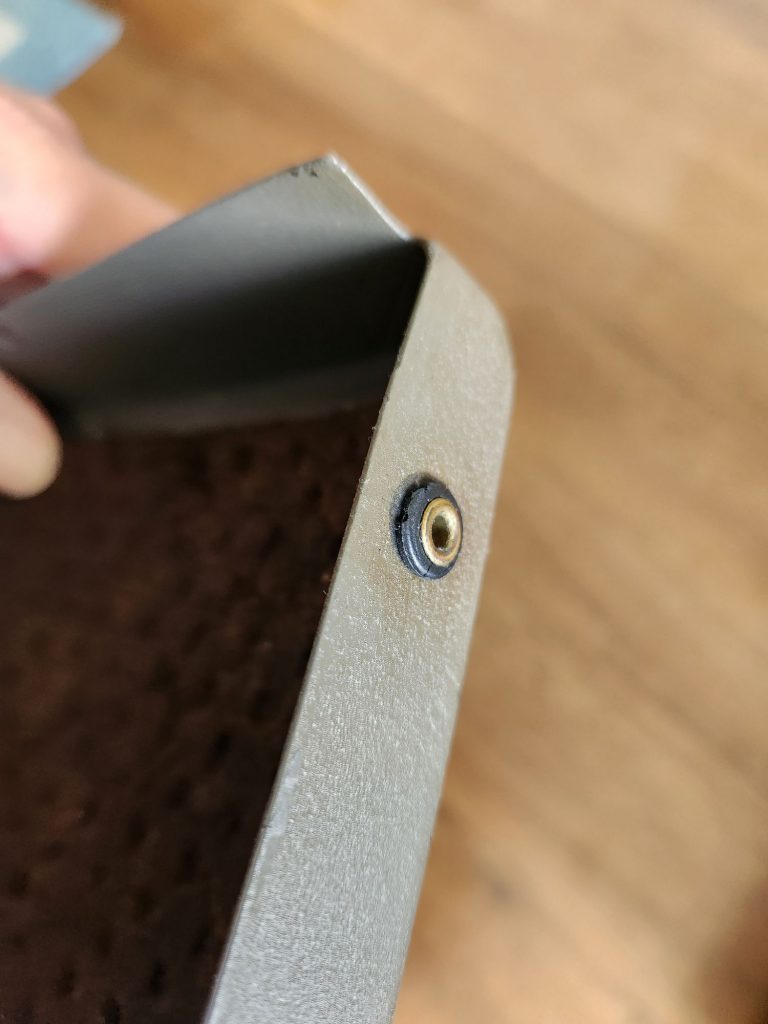
Late last May, I did a full clean, oil, and adjust (COA) on my 1951 Remington Super-Riter. One of the few restorations steps I didn't carry out at the time was the replacement of the rubber grommets on the two side panels and the rear panel. The rubber was so hard and brittle on most of them that they crumbled off leaving only the brass inserts. Some of them also left a sludgy black residue on the metal.
 [caption id="attachment_55834713" align="aligncenter" width="660"]
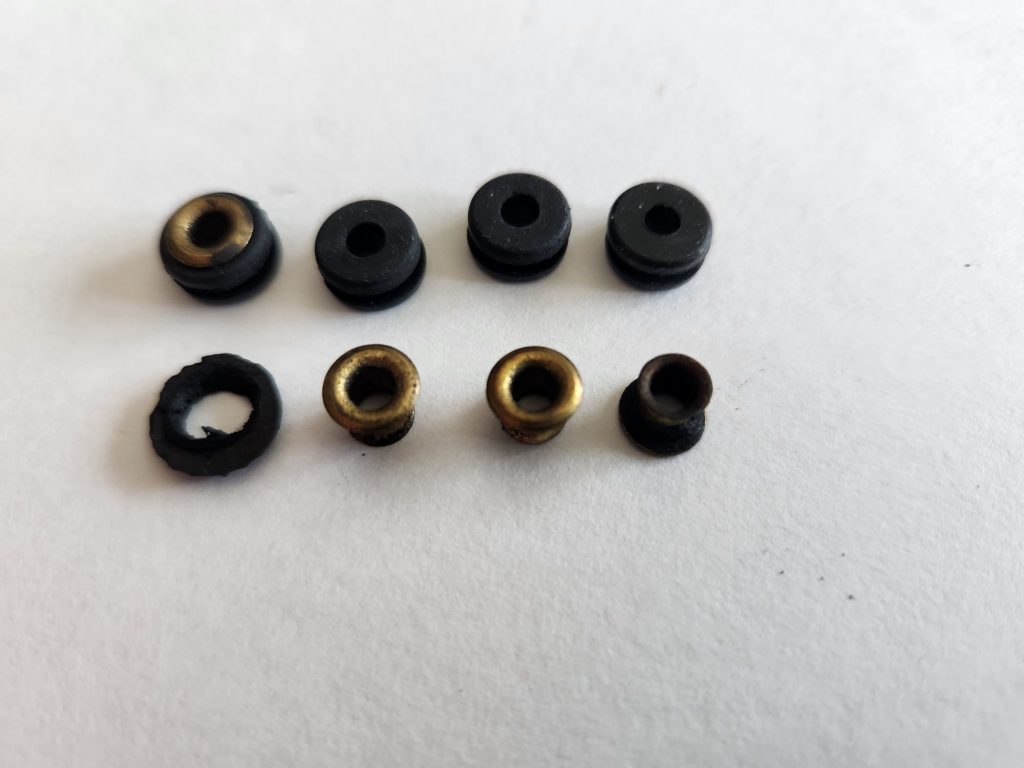 The top left is an original brass eyelet/new rubber grommet assembly next to three new rubber grommets. The bottom row features a desiccated rubber grommet next to three original brass eyelets.[/caption]
This weekend, I went foraging at the local Ace Hardware store to find some replacements for the originals.
The top left is an original brass eyelet/new rubber grommet assembly next to three new rubber grommets. The bottom row features a desiccated rubber grommet next to three original brass eyelets.[/caption]
This weekend, I went foraging at the local Ace Hardware store to find some replacements for the originals.
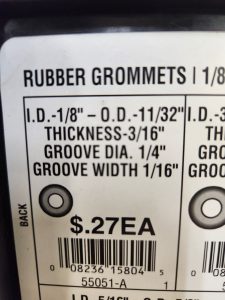
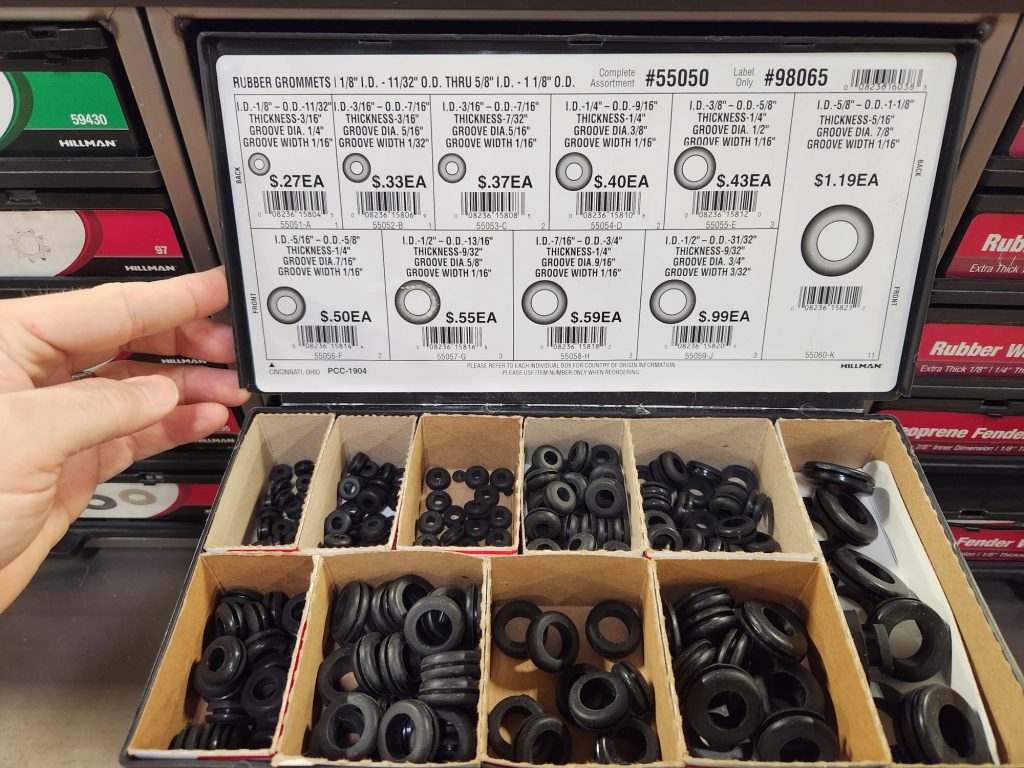 I took a reasonable guess and for 27 cents each I picked up six grommets which were the perfect size. If you're in the market for your own replacement rubber grommets, they were Hillman part number 55051-A with the following specifications: ID: 1/8"; OD: 11/32"; Thickness: 3/16"; Grove Diameter: 1/4"; Groove width: 1/16" .
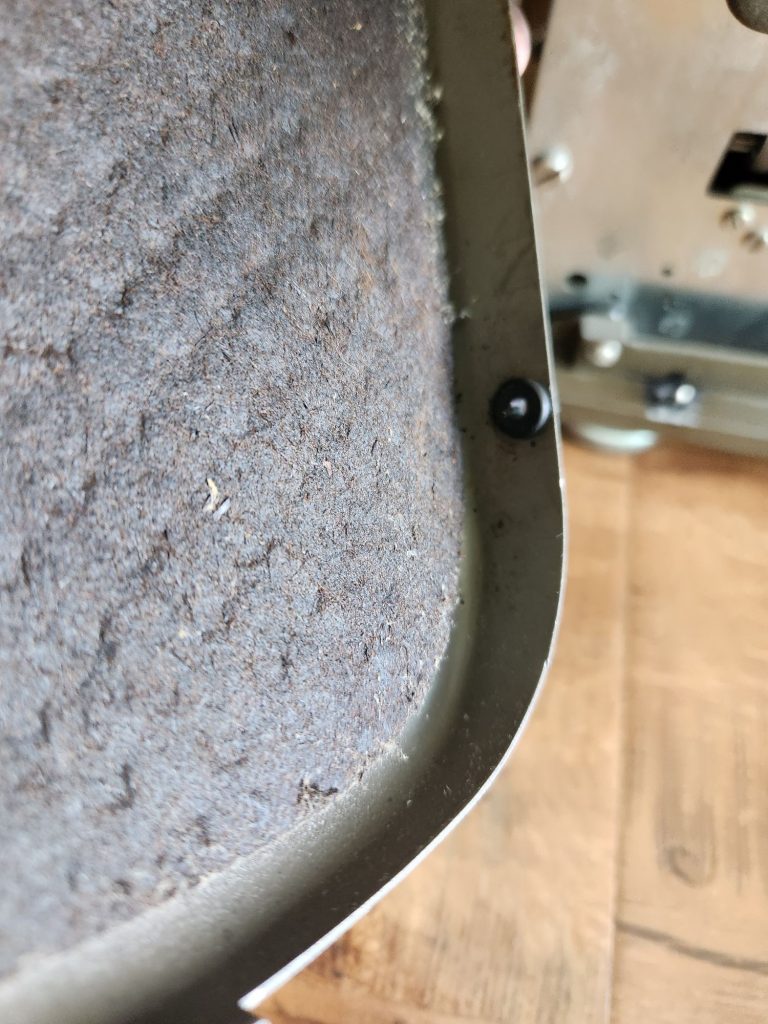
 When I went to install them, I discovered that I was able to wiggle them into the holes in the side panels. I could also get the brass grommets back in with a bit of work. However, I couldn't discern for the life of me why they included the brass grommets from an engineering perspective. Leaving them off seems to allow a nice friction fit of the panels on the appropriate metal pins against the rubber. Further, without the brass grommets one seems to get not only a better fit, but the vibration dampening of the panels seems to work better. I also suspect the grommet life of the rubber will be better this way in the long run.
 I notice that my later 1956 Remington Standard has a similar design for the side and rear panels, but in that case they'd switched to a single center pin and put two bare rubber grommets on each side of it, choosing to leave off the brass internal eyelets by this time—apparently they came to the same conclusion I had. This means that this same rubber grommet repair can be done on a variety of Remington standard typewriters made after World War II.
Editor's Note: If you're cleaning or repairing your own Remington Standard from this era, be sure to check and see if it's got the Fold-A-Matic feature for making your job much easier.
If for historical or consistency reasons, you insist on the brass gromets as part of the repair of your personal machine, you can certainly manage to use the originals with some care, however, if you've got your own eyelet tool (which many typewriter repair people may have for inserting eyelets into ribbon for the auto-reverse functionality of Smith-Corona typewriters) you can use it in combination with new 3/16" (or slightly smaller) metal eyelets to more permanently seat your rubber grommets into your metal panels.
Have you tried this restoration trick before? What did you use for replacements?
I notice that my later 1956 Remington Standard has a similar design for the side and rear panels, but in that case they'd switched to a single center pin and put two bare rubber grommets on each side of it, choosing to leave off the brass internal eyelets by this time—apparently they came to the same conclusion I had. This means that this same rubber grommet repair can be done on a variety of Remington standard typewriters made after World War II.
Editor's Note: If you're cleaning or repairing your own Remington Standard from this era, be sure to check and see if it's got the Fold-A-Matic feature for making your job much easier.
If for historical or consistency reasons, you insist on the brass gromets as part of the repair of your personal machine, you can certainly manage to use the originals with some care, however, if you've got your own eyelet tool (which many typewriter repair people may have for inserting eyelets into ribbon for the auto-reverse functionality of Smith-Corona typewriters) you can use it in combination with new 3/16" (or slightly smaller) metal eyelets to more permanently seat your rubber grommets into your metal panels.
Have you tried this restoration trick before? What did you use for replacements?
[caption id="attachment_55834713" align="aligncenter" width="660"] The top left is an original brass eyelet/new rubber grommet assembly next to three new rubber grommets. The bottom row features a desiccated rubber grommet next to three original brass eyelets.[/caption]
This weekend, I went foraging at the local Ace Hardware store to find some replacements for the originals.
I took a reasonable guess and for 27 cents each I picked up six grommets which were the perfect size. If you're in the market for your own replacement rubber grommets, they were Hillman part number 55051-A with the following specifications: ID: 1/8"; OD: 11/32"; Thickness: 3/16"; Grove Diameter: 1/4"; Groove width: 1/16" .
When I went to install them, I discovered that I was able to wiggle them into the holes in the side panels. I could also get the brass grommets back in with a bit of work. However, I couldn't discern for the life of me why they included the brass grommets from an engineering perspective. Leaving them off seems to allow a nice friction fit of the panels on the appropriate metal pins against the rubber. Further, without the brass grommets one seems to get not only a better fit, but the vibration dampening of the panels seems to work better. I also suspect the grommet life of the rubber will be better this way in the long run.
I notice that my later 1956 Remington Standard has a similar design for the side and rear panels, but in that case they'd switched to a single center pin and put two bare rubber grommets on each side of it, choosing to leave off the brass internal eyelets by this time—apparently they came to the same conclusion I had. This means that this same rubber grommet repair can be done on a variety of Remington standard typewriters made after World War II.
Editor's Note: If you're cleaning or repairing your own Remington Standard from this era, be sure to check and see if it's got the Fold-A-Matic feature for making your job much easier.
If for historical or consistency reasons, you insist on the brass gromets as part of the repair of your personal machine, you can certainly manage to use the originals with some care, however, if you've got your own eyelet tool (which many typewriter repair people may have for inserting eyelets into ribbon for the auto-reverse functionality of Smith-Corona typewriters) you can use it in combination with new 3/16" (or slightly smaller) metal eyelets to more permanently seat your rubber grommets into your metal panels.
Have you tried this restoration trick before? What did you use for replacements?

Hi! Candle expert here, this is not funny. Candles only do this when they’re in extreme distress.


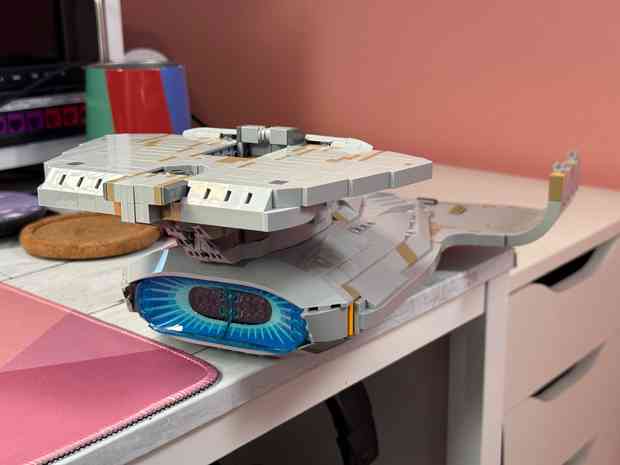
This week's LEGO build progress, got the deflector dish installed!
“[Nostalgia] is a twinge in your heart more powerful than memory alone. This device… is a time machine. It goes backwards, forwards, takes us to a place where we ache to go again. It lets us travel the way a child travels. Round and around and back home again. To a place where we know we are loved.”
Dwell’s inspiration comes from a surprising place: the hit show “Mad Men.” In a legendary scene, Don Draper delivers the pitch of his life to Kodak, describing their new slide projector as a time machine that satisfies the ache of nostalgia.
The last few weeks have been pretty squarely focused on Dwell, and I’m officially excited about it. I can see the finish line, and I’m proud of how it’s shaping up. Can’t wait to share it!
I’m committing myself to work on two specific projects to get them over the line. The first is called Horizon, and is an interactive family dashboard. The second is Dwell, my new personal website that I’ve been working on for several years.
I’ve been doing a lot of personal projects over the past few months. I find myself leaning in hard on one project, then getting a bit worn out and switching to another. I need a bit more discipline, as my time outside of work is very limited.
Less than two minutes later, I fired up the ShelfPlayer app and was greeted by precisely what I asked for. So rad.
… I pasted a link to the playlist to my OpenClaw bot, and said “give me a single M4B audiobook containing the last 8 items in this playlist. Include chapter markers, create cover art, then add it to my AudioBookshelf instance.”
I’ve been working through a YouTube playlist of summaries for the first 17 books of The Dresden Files. YouTube’s app sucks and I kept losing my place, which is annoying. So…
Started watching Fallout last night and, so far, am impressed. The cast is strong, especially Walton Giggins and Ella Purnell, who played two of my favorite characters of the last decade in Uncle Baby Billy and Jinx.