
html energy
Can you feel the energy?
{
    "type": "entry",
    "published": "2022-08-30T07:52:54Z",
    "url": "https://adactio.com/links/19401",
    "category": [
        "html",
        "energy",
        "markup",
        "creativity",
        "writing",
        "sharing",
        "indieweb",
        "frontend",
        "development",
        "complexity",
        "simplicity"
    ],
    "bookmark-of": [
        "https://html.energy/"
    ],
    "content": {
        "text": "html energy\n\n\n\nCan you feel the energy?",
        "html": "<h3>\n<a class=\"p-name u-bookmark-of\" href=\"https://html.energy/\">\nhtml energy\n</a>\n</h3>\n\n<p>Can you feel the energy?</p>"
    },
    "author": {
        "type": "card",
        "name": "Jeremy Keith",
        "url": "https://adactio.com/",
        "photo": "https://adactio.com/images/photo-150.jpg"
    },
    "post-type": "bookmark",
    "_id": "31110137",
    "_source": "2",
    "_is_read": true
}

Farewell, house
{
    "type": "entry",
    "published": "2022-08-23T03:31:07+00:00",
    "url": "https://werd.io/2022/farewell-house",
    "name": "Farewell, house",
    "content": {
        "text": "Well, we sold the house. A new family gets to enjoy the space, and the incredible surrounds. It\u2019s the start of a new chapter for us, too.I was there over the weekend, and the memories were overwhelming: the four walls of my parents\u2019 former bedroom held newly-staged furniture for show, but I could hear the laughter, remember talking to my mother at the end of the day, could hear her feeding tube apparatus rolling across the floor. So much happened there. It\u2019s sad to see it go, but the memories stay with us. All we\u2019re really leaving behind is wood, stone, and plaster.Throughout the sale, our agent Florence Sheffer was wonderful. She held our hands through the whole process, and was as fun to work with as she was knowledgable and connected. She consistently went above and beyond to help us. I\u2019d recommend her to anyone who wants to buy or sell a home in Santa Rosa and the surrounding area.I\u2019m not sure what I\u2019ll end up doing with the indieweb website that I made for the house. Probably I\u2019ll just let the domain expire. Here it is, archived for posterity on the Internet Archive.",
        "html": "<p><img src=\"https://werd.io/file/630449e5482c4b7bd97e0532/thumb.jpg\" alt=\"\" width=\"1024\" height=\"683\" /></p><p>Well, we sold <a href=\"https://werd.io/2022/my-indieweb-real-estate-website-part-two\">the house</a>. A new family gets to enjoy the space, and the <a href=\"https://5405spainave.com/our-experiences.html\">incredible surrounds</a>. It\u2019s the start of a new chapter for us, too.</p><p>I was there over the weekend, and the memories were overwhelming: the four walls of my parents\u2019 former bedroom held newly-staged furniture for show, but I could hear the laughter, remember talking to my mother at the end of the day, could hear her feeding tube apparatus rolling across the floor. So much happened there. It\u2019s sad to see it go, but the memories stay with us. All we\u2019re really leaving behind is wood, stone, and plaster.</p><p>Throughout the sale, our agent <a href=\"https://www.coldwellbankerhomes.com/ca/santa-rosa/agent/florence-sheffer/aid_37212/\">Florence Sheffer</a> was wonderful. She held our hands through the whole process, and was as fun to work with as she was knowledgable and connected. She consistently went above and beyond to help us. I\u2019d recommend her to anyone who wants to buy or sell a home in Santa Rosa and the surrounding area.</p><p>I\u2019m not sure what I\u2019ll end up doing with <a href=\"https://5405spainave.com\">the indieweb website that I made for the house</a>. Probably I\u2019ll just let the domain expire. <a href=\"https://web.archive.org/web/20220000000000*/5405spainave.com\">Here it is, archived for posterity on the Internet Archive.</a></p>"
    },
    "author": {
        "type": "card",
        "name": "Ben Werdm\u00fcller",
        "url": "https://werd.io/profile/benwerd",
        "photo": "https://werd.io/file/5d388c5fb16ea14aac640912/thumb.jpg"
    },
    "post-type": "article",
    "_id": "30985833",
    "_source": "191",
    "_is_read": true
}
A Well-Known Links Resource - Jim Nielsen’s Blog
I really like this experiment that Jim is conducting on his own site. I might try to replicate it sometime!
{
    "type": "entry",
    "published": "2022-08-22T10:08:45Z",
    "url": "https://adactio.com/links/19387",
    "category": [
        "links",
        "linking",
        "hyperlinks",
        "hypertext",
        "well-known",
        "indieweb",
        "personal",
        "publishing"
    ],
    "bookmark-of": [
        "https://blog.jim-nielsen.com/2022/well-known-links-resource/"
    ],
    "content": {
        "text": "A Well-Known Links Resource - Jim Nielsen\u2019s Blog\n\n\n\nI really like this experiment that Jim is conducting on his own site. I might try to replicate it sometime!",
        "html": "<h3>\n<a class=\"p-name u-bookmark-of\" href=\"https://blog.jim-nielsen.com/2022/well-known-links-resource/\">\nA Well-Known Links Resource - Jim Nielsen\u2019s Blog\n</a>\n</h3>\n\n<p>I really like this experiment that Jim is conducting on his own site. I might try to replicate it sometime!</p>"
    },
    "author": {
        "type": "card",
        "name": "Jeremy Keith",
        "url": "https://adactio.com/",
        "photo": "https://adactio.com/images/photo-150.jpg"
    },
    "post-type": "bookmark",
    "_id": "30971520",
    "_source": "2",
    "_is_read": true
}
A home on the web, revisited
{
    "type": "entry",
    "published": "2022-08-21T16:25:37+00:00",
    "url": "https://werd.io/2022/a-home-on-the-web-revisited",
    "name": "A home on the web, revisited",
    "content": {
        "text": "I\u2019ve been thinking a lot about redesigning my website, or even moving platforms. That\u2019s a bit of an emotional decision, because my website runs on Known, a codebase I mostly wrote myself, and started while I was taking care of my mother post-lung-transplant. It\u2019s the reason I\u2019m connected to the indieweb community, and the Matter community, and a lot of people I care deeply about. All those things are separable from this codebase now, but it got me there, and I\u2019m hugely grateful for that.The design is looking a little long in the tooth: I can make tweaks, and would commit them upstream into the open source project for other people to use, but I think there\u2019s something to be said for starting again completely, knowing what I know now.If I had unlimited time and energy - which, sadly isn\u2019t my situation; time and energy are both in very short supply right now - I\u2019d rebuild Known in something like Node, with a cleaner codebase. For now, I think I\u2019ll live with it, and clean what I can.Incidentally, I also cleaned up my public Obsidian site at werd.cloud. I intend to do more with non-linear, unbloggy writing there.",
        "html": "<p>I\u2019ve been thinking a lot about redesigning my website, or even moving platforms. That\u2019s a bit of an emotional decision, because my website runs on <a href=\"https://withknown.com\">Known</a>, a codebase I mostly wrote myself, and started while I was taking care of my mother post-lung-transplant. It\u2019s the reason I\u2019m connected to the indieweb community, and the Matter community, and a lot of people I care deeply about. All those things are separable from this codebase now, but it got me there, and I\u2019m hugely grateful for that.</p><p>The design is looking a little long in the tooth: I can make tweaks, and would commit them upstream into the open source project for other people to use, but I think there\u2019s something to be said for starting again completely, knowing what I know now.</p><p>If I had unlimited time and energy - which, sadly isn\u2019t my situation; time and energy are both in very short supply right now - I\u2019d rebuild Known in something like Node, with a cleaner codebase. For now, I think I\u2019ll live with it, and clean what I can.</p><p>Incidentally, I also cleaned up my public Obsidian site at <a href=\"https://werd.cloud\">werd.cloud</a>. I intend to do more with non-linear, unbloggy writing there.</p>"
    },
    "author": {
        "type": "card",
        "name": "Ben Werdm\u00fcller",
        "url": "https://werd.io/profile/benwerd",
        "photo": "https://werd.io/file/5d388c5fb16ea14aac640912/thumb.jpg"
    },
    "post-type": "article",
    "_id": "30961484",
    "_source": "191",
    "_is_read": true
}
No code
{
"type": "entry",
"published": "2022-08-16T14:26:24Z",
"url": "https://adactio.com/journal/19370",
"category": [
"nocode",
"democratisation",
"indieweb",
"blockprotocol",
"frontend",
"development",
"tools",
"personal",
"publishing",
"spring83",
"protocols",
"squarespace",
"wix",
"wordpress",
"bubble",
"webflow",
"carrd",
"hotglue",
"neocities",
"creativity",
"professionalism"
],
"syndication": [
"https://adactio.medium.com/b357297437ef"
],
"name": "No code",
"content": {
"text": "When I wrote about democratising dev, I made brief mention of the growing \u201cno code\u201d movement:\n\n\n Personally, I would love it if the process of making websites could be democratised more. I\u2019ve often said that my nightmare scenario for the World Wide Web would be for its fate to lie in the hands of an elite priesthood of programmers with computer science degrees. So I\u2019m all in favour of no-code tools \u2026in theory.\n\n\nBut I didn\u2019t describe what no-code is, as I understand it.\n\nI\u2019m taking the term at face value to mean a mechanism for creating a website\u2014preferably on a domain you control\u2014without having to write anything in HTML, CSS, JavaScript, or any back-end programming language.\n\nBy that definition, something like WordPress.com (as opposed to WordPress itself) is a no-code tool:\n\n\n Create any kind of website. No code, no manuals, no limits.\n\n\nI\u2019d also put Squarespace in the same category:\n\n\n Start with a flexible template, then customize to fit your style and professional needs with our website builder.\n\n\nAnd its competitor, Wix:\n\n\n Discover the platform that gives you the freedom to create, design, manage and develop your web presence exactly the way you want.\n\n\nWebflow provides the same kind of service, but with a heavy emphasis on marketing websites:\n\n\n Your website should be a marketing asset, not an engineering challenge.\n\n\nBubble is trying to cover a broader base:\n\n\n Bubble lets you create interactive, multi-user apps for desktop and mobile web browsers, including all the features you need to build a site like Facebook or Airbnb.\n\n\nWheras Carrd opts for a minimalist one-page approach:\n\n\n Simple, free, fully responsive one-page sites for pretty much anything.\n\n\nAll of those tools emphasise that don\u2019t need to need to know how to code in order to have a professional-looking website. But there\u2019s a parallel universe of more niche no-code tools where the emphasis is on creativity and self-expression instead of slickness and profressionalism.\n\nneocities.org:\n\n\n Create your own free website. Unlimited creativity, zero ads.\n\n\nmmm.page:\n\n\n Make a website in 5 minutes. Messy encouraged.\n\n\nhotglue.me:\n\n\n unique tool for web publishing & internet samizdat\n\n\nI\u2019m kind of fascinated by these two different approaches: professional vs. expressionist.\n\nI\u2019ve seen people grapple with this question when they decide to have their own website. Should it be a showcase of your achievements, almost like a portfolio? Or should it be a glorious mess of imagery and poetry to reflect your creativity? Could it be both? (Is that even doable? Or desirable?)\n\nRobin Sloan recently published his ideas\u2014and specs\u2014for a new internet protocol called Spring \u201983:\n\n\n Spring \u201883 is a protocol for the transmission and display of something I am calling a \u201cboard\u201d, which is an HTML fragment, limited to 2217 bytes, unable to execute JavaScript or load external resources, but otherwise unrestricted. Boards invite publishers to use all the richness of modern HTML and CSS. Plain text and blue links are also enthusiastically supported.\n\n\nIt\u2019s not a no-code tool (you need to publish in HTML), although someone could easily provide a no-code tool to sit on top of the protocol. Conceptually though, it feels like it\u2019s an a similar space to the chaotic good of neocities.org, mmm.page, and hotglue.me with maybe a bit of tilde.town thrown in.\n\nIt feels like something might be in the air. With Spring \u201983, the Block protocol, and other experiments, people are creating some interesting small pieces that could potentially be loosely joined. No code required.",
"html": "<p>When I wrote about <a href=\"https://adactio.com/journal/19356\">democratising dev</a>, I made brief mention of the growing \u201cno code\u201d movement:</p>\n\n<blockquote>\n <p>Personally, I would love it if the process of making websites could be democratised more. I\u2019ve often said that my nightmare scenario for the World Wide Web would be for its fate to lie in the hands of an elite priesthood of programmers with computer science degrees. So I\u2019m all in favour of no-code tools \u2026in theory.</p>\n</blockquote>\n\n<p>But I didn\u2019t describe what no-code is, as I understand it.</p>\n\n<p>I\u2019m taking the term at face value to mean a mechanism for creating a website\u2014preferably on a domain you control\u2014without having to write anything in HTML, CSS, JavaScript, or any back-end programming language.</p>\n\n<p>By that definition, something like <a href=\"https://wordpress.com/\">WordPress.com</a> (as opposed to WordPress itself) is a no-code tool:</p>\n\n<blockquote>\n <p>Create any kind of website. No code, no manuals, no limits.</p>\n</blockquote>\n\n<p>I\u2019d also put <a href=\"https://www.squarespace.com/\">Squarespace</a> in the same category:</p>\n\n<blockquote>\n <p>Start with a flexible template, then customize to fit your style and professional needs with our website builder.</p>\n</blockquote>\n\n<p>And its competitor, <a href=\"https://www.wix.com/\">Wix</a>:</p>\n\n<blockquote>\n <p>Discover the platform that gives you the freedom to create, design, manage and develop your web presence exactly the way you want.</p>\n</blockquote>\n\n<p><a href=\"https://webflow.com/\">Webflow</a> provides the same kind of service, but with a heavy emphasis on marketing websites:</p>\n\n<blockquote>\n <p>Your website should be a marketing asset, not an engineering challenge.</p>\n</blockquote>\n\n<p><a href=\"https://bubble.io/\">Bubble</a> is trying to cover a broader base:</p>\n\n<blockquote>\n <p>Bubble lets you create interactive, multi-user apps for desktop and mobile web browsers, including all the features you need to build a site like Facebook or Airbnb.</p>\n</blockquote>\n\n<p>Wheras <a href=\"https://carrd.co/\">Carrd</a> opts for a minimalist one-page approach:</p>\n\n<blockquote>\n <p>Simple, free, fully responsive one-page sites for pretty much anything.</p>\n</blockquote>\n\n<p>All of those tools emphasise that don\u2019t need to need to know how to code in order to have a professional-looking website. But there\u2019s a parallel universe of more niche no-code tools where the emphasis is on creativity and self-expression instead of slickness and profressionalism.</p>\n\n<p><a href=\"https://neocities.org/\">neocities.org</a>:</p>\n\n<blockquote>\n <p>Create your own free website. Unlimited creativity, zero ads.</p>\n</blockquote>\n\n<p><a href=\"https://mmm.page/\">mmm.page</a>:</p>\n\n<blockquote>\n <p>Make a website in 5 minutes. Messy encouraged.</p>\n</blockquote>\n\n<p><a href=\"https://hotglue.me/\">hotglue.me</a>:</p>\n\n<blockquote>\n <p>unique tool for web publishing & internet samizdat</p>\n</blockquote>\n\n<p>I\u2019m kind of fascinated by these two different approaches: professional vs. expressionist.</p>\n\n<p>I\u2019ve seen people grapple with this question when they decide to have their own website. Should it be a showcase of your achievements, almost like a portfolio? Or should it be a glorious mess of imagery and poetry to reflect your creativity? Could it be both? (Is that even doable? Or desirable?)</p>\n\n<p>Robin Sloan recently published his ideas\u2014and specs\u2014for a new internet protocol called <a href=\"https://www.robinsloan.com/lab/specifying-spring-83/\">Spring \u201983</a>:</p>\n\n<blockquote>\n <p>Spring \u201883 is a protocol for the transmission and display of something I am calling a \u201cboard\u201d, which is an HTML fragment, limited to 2217 bytes, unable to execute JavaScript or load external resources, but otherwise unrestricted. Boards invite publishers to use all the richness of modern HTML and CSS. Plain text and blue links are also enthusiastically supported.</p>\n</blockquote>\n\n<p>It\u2019s not a no-code tool (you need to publish in HTML), although someone could easily provide a no-code tool to sit on top of the protocol. Conceptually though, it feels like it\u2019s an a similar space to the chaotic good of <a href=\"https://neocities.org/\">neocities.org</a>, <a href=\"https://mmm.page/\">mmm.page</a>, and <a href=\"https://hotglue.me/\">hotglue.me</a> with maybe a bit of <a href=\"https://tilde.town/\">tilde.town</a> thrown in.</p>\n\n<p>It feels like something might be in the air. With <a href=\"https://www.robinsloan.com/lab/specifying-spring-83/\">Spring \u201983</a>, <a href=\"https://blockprotocol.org/\">the Block protocol</a>, and other experiments, people are creating some interesting small pieces that could potentially be <a href=\"https://www.smallpieces.com/\">loosely joined</a>. No code required.</p>"
},
"author": {
"type": "card",
"name": "Jeremy Keith",
"url": "https://adactio.com/",
"photo": "https://adactio.com/images/photo-150.jpg"
},
"post-type": "note",
"_id": "30874653",
"_source": "2",
"_is_read": true
}
Democratising dev
{
    "type": "entry",
    "published": "2022-08-10T16:11:54Z",
    "url": "https://adactio.com/journal/19356",
    "category": [
        "democratisation",
        "frontend",
        "development",
        "indieweb",
        "hosting",
        "blockprotocol",
        "patterns",
        "nocode",
        "publishing",
        "talks",
        "presentations"
    ],
    "syndication": [
        "https://adactio.medium.com/db9ceab2156e"
    ],
    "name": "Democratising dev",
    "content": {
        "text": "I met up with a supersmart programmer friend of mine a little while back. He was describing some work he was doing with React. He was joining up React components. There wasn\u2019t really any problem-solving or debugging\u2014the individual components had already been thoroughly tested. He said it felt more like construction than programming.\n\nMy immediate thought was \u201cthat should be automated.\u201d\n\nOr at the very least, there should be some way for just about anyone to join those pieces together rather than it requiring a supersmart programmer\u2019s time. After all, isn\u2019t that the promise of design systems and components\u2014freeing us up to tackle the meaty problems instead of spending time on the plumbing?\n\nI thought about that conversation when I was listening to Laurie\u2019s excellent talk in Berlin last month.\n\nChatting to Laurie before the talk, he was very nervous about the conclusion that he had reached and was going to share: that the time is right for web development to be automated. He figured it would be an unpopular message. Heck, even he didn\u2019t like it.\n\nBut I reminded him that it\u2019s as old as the web itself. I\u2019ve seen videos from very early World Wide Web conferences where Tim Berners-Lee was railing against the idea that anyone would write HTML by hand. The whole point of his WorldWideWeb app was that anyone could create and edit web pages as easily as word processing documents. It\u2019s almost an accident of history that HTML happened to be just easy enough\u2014but also just powerful enough\u2014for many people to learn and use.\n\nAnyway, I thoroughly enjoyed Laurie\u2019s talk. (Except for a weird bit where he dunks on people moaning about \u201cthe fundamentals\u201d. I think it\u2019s supposed to be punching up, but I\u2019m not sure that\u2019s how it came across. As Chris points out, fundamentals matter \u2026at least when it comes to concepts like accessibility and performance. I think Laurie was trying to dunk on people moaning about fundamental technologies like languages and frameworks. Perhaps the message got muddled in the delivery.)\n\nI guess Laurie was kind of talking about this whole \u201cno code\u201d thing that\u2019s quite hot right now. Personally, I would love it if the process of making websites could be democratised more. I\u2019ve often said that my nightmare scenario for the World Wide Web would be for its fate to lie in the hands of an elite priesthood of programmers with computer science degrees. So I\u2019m all in favour of  no-code tools \u2026in theory.\n\nThe problem is that unless they work 100%, and always produce good accessible performant code, then they\u2019re going to be another example of the law of leaky abstractions. If a no-code tool can get someone 90% of the way to what they want, that seems pretty good. But if that person than has to spend an inordinate amount of time on the remaining 10% then all the good work of the no-code tool is somewhat wasted.\n\nFunnily enough, the person who coined that law, Joel Spolsky, spoke right after Laurie in Berlin. The two talks made for a good double bill.\n\n(I would link to Joel\u2019s talk but for some reason the conference is marking the YouTube videos as unlisted. If you manage to track down a URL for the video of Joel\u2019s  talk, let me know and I\u2019ll update this post.)\n\nIn a way, Joel was making the same point as Laurie: why is it still so hard to do something on the web that feels like it should be easily repeatable?\n\nHe used the example of putting an event online. Right now, the most convenient way to do it is to use a third-party centralised silo like Facebook. It works, but now the business model of Facebook comes along for the ride. Your event is now something to be tracked and monetised by advertisers.\n\nYou could try doing it yourself, but this is where you\u2019ll run into the frustrations shared by Joel and Laurie. It\u2019s still too damn hard and complicated (even though we\u2019ve had years and years of putting events online). Despite what web developers tell themselves, making stuff for the web shouldn\u2019t be that complicated. As Trys put it:\n\n\n  We kid ourselves into thinking we\u2019re building groundbreakingly complex systems that require bleeding-edge tools, but in reality, much of what we build is a way to render two things: a list, and a single item. Here are some users, here is a user. Here are your contacts, here are your messages with that contact. There ain\u2019t much more to it than that.\n\n\nAnd yet here we are. You can either have the convenience of putting something on a silo like Facebook, or you can have the freedom of doing it yourself, indie web style. But you can\u2019t have both it seems.\n\nThis is a criticism often levelled at the indie web. The barrier to entry to having your own website is too high. It\u2019s a valid criticism. To have your own website, you need to have some working knowledge of web hosting and at least some web technologies (like HTML).\n\nDon\u2019t get me wrong. I love having my own website. Like, I really love it. But I\u2019m also well aware that it doesn\u2019t scale. It\u2019s unreasonable to expect someone to learn new skills just to make a web page about, say, an event they want to publicise.\n\nThat\u2019s kind of the backstory to the project that Joel wanted to talk about: the block protocol. (Note: it has absolutely nothing to do with blockchain\u2014it\u2019s just an unfortunate naming collision.)\n\nThe idea behind the project is to create a kind of crowdsourced pattern library\u2014user interfaces for creating common structures like events, photos, tables, and lists. These patterns already exist in today\u2019s silos and content management systems, but everyone is reinventing the wheel independently. The goal of this project is make these patterns interoperable, and therefore portable.\n\nAt first I thought that would be a classic /927 situation, but I\u2019m pleased to see that the focus of the project is not on formats (we\u2019ve been there and done that with microformats, RDF, schema.org, yada yada). The patterns might end up being web components or they might not. But the focus is on the interface. I think that\u2019s a good approach.\n\nThat approach chimes nicely with one of the principles of the indie web:\n\n\n  UX and design is more important than protocols, formats, data models, schema etc. We focus on UX first, and then as we figure that out we build/develop/subset the absolutely simplest, easiest, and most minimal protocols and formats sufficient to support that UX, and nothing more. AKA UX before plumbing.\n\n\nThat said, I don\u2019t think this project is a cure-all. Interoperable (portable) chunks of structured content would be great, but that\u2019s just one part of the challenge of scaling the indie web. You also need to have somewhere to put those blocks.\n\nConvenience isn\u2019t the only thing you get from using a silo like Facebook, Twitter, Instagram, or Medium. You also get \u201cfree\u201d hosting \u2026until you don\u2019t (see GeoCities, MySpace, and many, many more).\n\nWouldn\u2019t it be great if everyone had a place on the web that they could truly call their own? Today you need to have an uneccesary degree of technical understanding to publish something at a URL you control.\n\nI\u2019d love to see that challenge getting tackled.",
        "html": "<p>I met up with a supersmart programmer friend of mine a little while back. He was describing some work he was doing with React. He was joining up React components. There wasn\u2019t really any problem-solving or debugging\u2014the individual components had already been thoroughly tested. He said it felt more like construction than programming.</p>\n\n<p>My immediate thought was \u201cthat should be automated.\u201d</p>\n\n<p>Or at the very least, there should be some way for just about anyone to join those pieces together rather than it requiring a supersmart programmer\u2019s time. After all, isn\u2019t that the promise of design systems and components\u2014freeing us up to tackle the meaty problems instead of spending time on the plumbing?</p>\n\n<p>I thought about that conversation when I was listening to <a href=\"https://www.youtube.com/watch?v=hWjT_OOBdOc\">Laurie\u2019s excellent talk in Berlin last month</a>.</p>\n\n<p>Chatting to Laurie before the talk, he was very nervous about the conclusion that he had reached and was going to share: that the time is right for web development to be automated. He figured it would be an unpopular message. Heck, even <em>he</em> didn\u2019t like it.</p>\n\n<p>But I reminded him that it\u2019s as old as the web itself. I\u2019ve seen videos from very early World Wide Web conferences where Tim Berners-Lee was railing against the idea that anyone would write HTML by hand. The whole point of <a href=\"https://worldwideweb30.com/\">his WorldWideWeb app</a> was that anyone could create and edit web pages as easily as word processing documents. It\u2019s almost an accident of history that HTML happened to be just easy enough\u2014but also just powerful enough\u2014for many people to learn and use.</p>\n\n<p>Anyway, I thoroughly enjoyed Laurie\u2019s talk. (Except for a weird bit where he dunks on people moaning about \u201cthe fundamentals\u201d. I think it\u2019s supposed to be punching up, but I\u2019m not sure that\u2019s how it came across. As Chris points out, <a href=\"https://gomakethings.com/fundamentals-matter/\">fundamentals matter</a> \u2026at least when it comes to <em>concepts</em> like accessibility and performance. I think Laurie was trying to dunk on people moaning about fundamental <em>technologies</em> like languages and frameworks. Perhaps the message got muddled in the delivery.)</p>\n\n<p>I guess Laurie was kind of talking about this whole \u201cno code\u201d thing that\u2019s quite hot right now. Personally, I would love it if the process of making websites could be democratised more. I\u2019ve often said that my nightmare scenario for the World Wide Web would be for its fate to lie in the hands of an elite priesthood of programmers with computer science degrees. So I\u2019m all in favour of  no-code tools \u2026in theory.</p>\n\n<p>The problem is that unless they work 100%, and always produce good accessible performant code, then they\u2019re going to be another example of <a href=\"https://www.joelonsoftware.com/2002/11/11/the-law-of-leaky-abstractions/\">the law of leaky abstractions</a>. If a no-code tool can get someone 90% of the way to what they want, that seems pretty good. But if that person than has to spend an inordinate amount of time on the remaining 10% then all the good work of the no-code tool is somewhat wasted.</p>\n\n<p>Funnily enough, the person who coined that law, Joel Spolsky, spoke right after Laurie in Berlin. The two talks made for a good double bill.</p>\n\n<p>(I would link to Joel\u2019s talk but for some reason the conference is marking the YouTube videos as unlisted. If you manage to track down a URL for the video of Joel\u2019s  talk, let me know and I\u2019ll update this post.)</p>\n\n<p>In a way, Joel was making the same point as Laurie: why is it still so hard to do something on the web that feels like it should be easily repeatable?</p>\n\n<p>He used the example of putting an event online. Right now, the most convenient way to do it is to use a third-party centralised silo like Facebook. It works, but now the business model of Facebook comes along for the ride. Your event is now something to be tracked and monetised by advertisers.</p>\n\n<p>You could try doing it yourself, but this is where you\u2019ll run into the frustrations shared by Joel and Laurie. It\u2019s still too damn hard and complicated (even though we\u2019ve had years and years of putting events online). Despite what web developers tell themselves, making stuff for the web shouldn\u2019t be that complicated. <a href=\"https://www.trysmudford.com/blog/city-life/\">As Trys put it</a>:</p>\n\n<blockquote>\n  <p>We kid ourselves into thinking we\u2019re building groundbreakingly complex systems that require bleeding-edge tools, but in reality, much of what we build is a way to render two things: a list, and a single item. Here are some users, here is a user. Here are your contacts, here are your messages with that contact. There ain\u2019t much more to it than that.</p>\n</blockquote>\n\n<p>And yet here we are. You can either have the convenience of putting something on a silo like Facebook, or you can have the freedom of doing it yourself, <a href=\"https://indieweb.org/\">indie web</a> style. But you can\u2019t have both it seems.</p>\n\n<p>This is a criticism often levelled at <a href=\"https://indieweb.org/\">the indie web</a>. The barrier to entry to having your own website is too high. It\u2019s a valid criticism. To have your own website, you need to have some working knowledge of web hosting and at least some web technologies (like HTML).</p>\n\n<p>Don\u2019t get me wrong. I love having my own website. Like, I <em>really</em> love it. But I\u2019m also well aware that it doesn\u2019t scale. It\u2019s unreasonable to expect someone to learn new skills just to make a web page about, say, an event they want to publicise.</p>\n\n<p>That\u2019s kind of the backstory to the project that Joel wanted to talk about: <a href=\"https://blockprotocol.org/\">the block protocol</a>. (Note: it has absolutely nothing to do with block<em>chain</em>\u2014it\u2019s just an unfortunate naming collision.)</p>\n\n<p>The idea behind the project is to create a kind of crowdsourced pattern library\u2014user interfaces for creating common structures like events, photos, tables, and lists. These patterns already exist in today\u2019s silos and content management systems, but everyone is reinventing the wheel independently. The goal of this project is make these patterns interoperable, and therefore portable.</p>\n\n<p>At first I thought that would be <a href=\"https://xkcd.com/927/\">a classic <code>/927</code> situation</a>, but I\u2019m pleased to see that the focus of the project is <em>not</em> on formats (we\u2019ve been there and done that with microformats, RDF, schema.org, yada yada). The patterns might end up being web components or they might not. But the focus is on the <em>interface</em>. I think that\u2019s a good approach.</p>\n\n<p>That approach chimes nicely with one of <a href=\"https://indieweb.org/principles\">the principles of the indie web</a>:</p>\n\n<blockquote>\n  <p>UX and design is more important than protocols, formats, data models, schema etc. We focus on UX first, and then as we figure that out we build/develop/subset the absolutely simplest, easiest, and most minimal protocols and formats sufficient to support that UX, and nothing more. AKA UX before plumbing.</p>\n</blockquote>\n\n<p>That said, I don\u2019t think this project is a cure-all. Interoperable (portable) chunks of structured content would be great, but that\u2019s just one part of the challenge of scaling the indie web. You also need to have somewhere to put those blocks.</p>\n\n<p>Convenience isn\u2019t the only thing you get from using a silo like Facebook, Twitter, Instagram, or Medium. You also get \u201cfree\u201d hosting \u2026until you don\u2019t (see GeoCities, MySpace, and <a href=\"https://indieweb.org/site-deaths\">many, many more</a>).</p>\n\n<p>Wouldn\u2019t it be great if everyone had a place on the web that they could truly call their own? Today you need to have an uneccesary degree of technical understanding to publish something at a URL you control.</p>\n\n<p>I\u2019d love to see that challenge getting tackled.</p>"
    },
    "author": {
        "type": "card",
        "name": "Jeremy Keith",
        "url": "https://adactio.com/",
        "photo": "https://adactio.com/images/photo-150.jpg"
    },
    "post-type": "article",
    "_id": "30772785",
    "_source": "2",
    "_is_read": true
}
Comments are hard
{
    "type": "entry",
    "published": "2022-08-02T20:38:43+00:00",
    "url": "https://werd.io/2022/comments-are-hard",
    "name": "Comments are hard",
    "content": {
        "text": "Building a comments system is really hard. I tried to build one for Known, which powers my website, but found that spammers circumvented it surprisingly easily. You can flag spam using Akismet (which was built for WordPress but works across platforms), but this process tends to require you to pre-screen comments and make them public after the fact. That\u2019s a fair amount of work and a fair amount of unnecessary friction for building community.If you have a blog - you do have a blog, don\u2019t you? - you can post a response to one of my posts and send a webmention. But not everybody has their own website, and the barrier to entry for sending webmentions is pretty high.So I\u2019ve been looking for something else.Fred Wilson gave up on comments and asks people to discuss on Twitter. That works pretty well, but I\u2019m not really into forcing people to use a particular service. That\u2019s also why I\u2019m not particularly into using Disqus embeds, which also unnecessarily track you across sites. Finally, I was using Cactus Comments, which is based on the decentralized Matrix network for a while, but it occasionally seemed to break in ways that were disconcerting for site visitors. (It\u2019s still a very cool project.)I love comments, and I guess that means I\u2019m writing my own system again. To do so means getting into an arms race with spammers, which I\u2019m not very excited about, but I don\u2019t see an alternative that I\u2019m completely happy about.Do you run a blog with comments? How do you deal with these issues? I\u2019d love to learn from you.",
        "html": "<p>Building a comments system is really hard. I tried to build one for <a href=\"https://withknown.com\">Known</a>, which powers my website, but found that spammers circumvented it surprisingly easily. You can flag spam using <a href=\"https://akismet.com/\">Akismet</a> (which was built for WordPress but works across platforms), but this process tends to require you to pre-screen comments and make them public after the fact. That\u2019s a fair amount of work and a fair amount of unnecessary friction for building community.</p><p>If you have a blog - you <em>do</em> have a blog, don\u2019t you? - you can post a response to one of my posts and send a <a href=\"https://indieweb.org/Webmention\">webmention</a>. But not everybody has their own website, and the barrier to entry for sending webmentions <a href=\"https://jamesmead.org/blog/2020-10-13-sending-webmentions-from-a-static-website\">is pretty high</a>.</p><p>So I\u2019ve been looking for something else.</p><p><a href=\"https://avc.com/\">Fred Wilson gave up on comments and asks people to discuss on Twitter</a>. That works pretty well, but I\u2019m not really into forcing people to use a particular service. That\u2019s also why I\u2019m not particularly into using <a href=\"https://disqus.com/\">Disqus</a> embeds, which also <a href=\"https://fatfrogmedia.com/delete-disqus-comments-wordpress/\">unnecessarily track you across sites</a>. Finally, I was using <a href=\"https://cactus.chat/\">Cactus Comments</a>, which is based on the decentralized <a href=\"https://matrix.org/\">Matrix network</a> for a while, but it occasionally seemed to break in ways that were disconcerting for site visitors. (It\u2019s still a very cool project.)</p><p>I love comments, and I guess that means I\u2019m writing my own system again. To do so means getting into an arms race with spammers, which I\u2019m not very excited about, but I don\u2019t see an alternative that I\u2019m completely happy about.</p><p>Do you run a blog with comments? How do you deal with these issues? I\u2019d love to learn from you.</p>"
    },
    "author": {
        "type": "card",
        "name": "Ben Werdm\u00fcller",
        "url": "https://werd.io/profile/benwerd",
        "photo": "https://werd.io/file/5d388c5fb16ea14aac640912/thumb.jpg"
    },
    "post-type": "article",
    "_id": "30628125",
    "_source": "191",
    "_is_read": true
}
Just hit publish | Marco Heine - Freelance Web Developer
I have days were I can write a well researched blog post in a few hours. And I have days were I don’t feel like writing. Or I want to add one more thing but don’t know how to speak my mind. So this is a reminder to myself: just hit publish.
{
    "type": "entry",
    "published": "2022-08-02T15:20:05Z",
    "url": "https://adactio.com/links/19343",
    "category": [
        "indieweb",
        "personal",
        "publishing",
        "writing",
        "sharing",
        "blogging",
        "blogs"
    ],
    "bookmark-of": [
        "https://marcoheine.com/blog/just-hit-publish/"
    ],
    "content": {
        "text": "Just hit publish | Marco Heine - Freelance Web Developer\n\n\n\n\n  I have days were I can write a well researched blog post in a few hours. And I have days were I don\u2019t feel like writing. Or I want to add one more thing but don\u2019t know how to speak my mind. So this is a reminder to myself: just hit publish.",
        "html": "<h3>\n<a class=\"p-name u-bookmark-of\" href=\"https://marcoheine.com/blog/just-hit-publish/\">\nJust hit publish | Marco Heine - Freelance Web Developer\n</a>\n</h3>\n\n<blockquote>\n  <p>I have days were I can write a well researched blog post in a few hours. And I have days were I don\u2019t feel like writing. Or I want to add one more thing but don\u2019t know how to speak my mind. So this is a reminder to myself: <strong>just hit publish</strong>.</p>\n</blockquote>"
    },
    "author": {
        "type": "card",
        "name": "Jeremy Keith",
        "url": "https://adactio.com/",
        "photo": "https://adactio.com/images/photo-150.jpg"
    },
    "post-type": "bookmark",
    "_id": "30623598",
    "_source": "2",
    "_is_read": true
}
Building an inclusive, independent, open newsroom
{
    "type": "entry",
    "published": "2022-08-01T18:07:32+00:00",
    "url": "https://werd.io/2022/building-an-inclusive-independent-open-newsroom",
    "name": "Building an inclusive, independent, open newsroom",
    "content": {
        "text": "I didn\u2019t make a big announcement about it, but for the last few months I\u2019ve been working as the CTO at The 19th, a nonprofit newsroom that reports on stories at the intersection of gender, politics, and policy.It was a necessary move for me: I needed stronger work/life balance for my own health, and I also wanted to feel like I was helping in the midst of a very tumultuous social and political climate. It was also a move back into the core ideas my career has been built on.The 19th was launched in January 2020 by veterans of the Texas Tribune and ProPublica who understood the need to report stories from a more diverse perspective than is normally offered by an industry still dominated by white men. I\u2019ve been following it from the beginning as a prominent subscription in my RSS reader, and was deeply impressed by the detailed, empathetic, unsensational reporting.The 19th\u2019s technical platform is largely based on self-hosted WordPress, with some interesting theme modifications that allow for visualizations and in-page interactivity. (Did I immediately add simple microformats support to articles as soon as I arrived? Yes, I did.) Importantly for me, the team cares about the same privacy issues I do: particularly in an environment where abortion-related surveillance is becoming a safety issue, dealing with audience data intentionally is crucial.Openness is core to what The 19th is. Its financial backers are published in full, so you know exactly whose is bankrolling the non-profit. Since the beginning, the newsroom has also made its content available via a Creative Commons license that allows anyone else to republish it for free. Those partners have included the Guardian, USA Today, Teen Vogue, PBS NewsHour, Ms. Magazine, RawStory, and many more. It could be you, too, if you wanted to: you can find the full HTML source to republish on every article page. Because The 19th\u2019s newsroom is more diverse, every republished article furthers its mission of improving representation in the news media overall.It\u2019s an obvious extension to this strategy to make our technology available as well, via a permissive open source license. That\u2019s my ambition: to package up some of our supporting tools and make them available in a way that other newsrooms can take advantage of. If they have the technical capability to collaborate on building them, great; if not, they can still pick up the technology and use them. Open source itself has a giant diversity problem, and if we can apply an equity lens to building our technical community in the same way we build our journalistic ecosystem, perhaps we can be a part of the solution there, too.I\u2019ve long been a member of the indieweb community, which encourages everyone to own and control their own website and domain. Both technically and ideologically, the overlaps with news are obvious: every newsroom must own its relationship with its audience in order to build trust, understand their needs, and above all to build community. Trends on the web have been in the opposite direction for most of the last decade: social media platforms like Facebook seek to intermediate and monetize that relationship, stripping newsrooms of resources and undermining the ability of voters to receive information in the process. Building an independent website for representative news content and community, and then helping others to do the same, is an important mission.Right now it\u2019s a very small team: Abby Blachman and me. I\u2019m looking for a third member of the technology team to help with everything I\u2019ve discussed.And so far, it\u2019s been joyful. Abby is amazing; everyone is. I\u2019ve never been part of an organization - least of all a remote team - that understands the need for a supportive culture so clearly. As an organization, it continues to listen and evolve. The people team - led by Jayo Miko Macasaquit - has put procedures and benefits in place that I haven\u2019t seen in organizations ten times the size. To build representative, empathetic news, you first need to build a representative, empathetic organization, and that\u2019s what\u2019s happening here. I hope they do more to tell their story and share what they\u2019re doing, because it\u2019s genuinely phenomenal.I can\u2019t believe my luck; it\u2019s a real privilege to be on this team. I want to be a good ambassador: although I knew about the journalism, which should always be front and center, I wasn\u2019t as familiar with the organization\u2019s ecosystem and openness chops before I joined. It was the nicest of surprises, and I want to tell you more about it. We don\u2019t have an internal blog right now, so from time to time I\u2019ll discuss what we\u2019ve been working on over here.I\u2019m also working on building some tools of my own to support my management process; the first is all about building a consistent culture of transparent feedback. More on that when I\u2019m ready.In the meantime, if you have any questions, I\u2019d love to answer them. And if you happen to be interested in our technology position, you should definitely apply.",
        "html": "<p><a href=\"https://19thnews.org\"><img src=\"https://werd.io/file/62e8178716d1b4005910d4b2/thumb.png\" alt=\"\" width=\"1024\" height=\"462\" /></a></p><p>I didn\u2019t make a big announcement about it, but for the last few months I\u2019ve been working as the CTO at <a href=\"https://19thnews.org\">The 19th</a>, a nonprofit newsroom that reports on stories at the intersection of gender, politics, and policy.</p><p>It was a necessary move for me: I needed stronger work/life balance for my own health, and I also wanted to feel like I was helping in the midst of a very tumultuous social and political climate. It was also a move back into the core ideas my career has been built on.</p><p><a href=\"https://www.washingtonpost.com/lifestyle/new-media-outlet-covering-the-intersection-of-women-and-politics-launches-as-2020-election-kicks-off/2020/01/25/34c2a2ac-3ee9-11ea-baca-eb7ace0a3455_story.html\">The 19th was launched in January 2020</a> by veterans of the Texas Tribune and ProPublica who understood the need to report stories from a more diverse perspective than is normally offered by an industry <a href=\"https://womensmediacenter.com/news-features/why-white-male-dominance-of-news-media-is-so-persistent\">still dominated by white men</a>. I\u2019ve been following it from the beginning as a prominent subscription in my RSS reader, and was deeply impressed by the detailed, empathetic, unsensational reporting.</p><p>The 19th\u2019s technical platform is largely based on self-hosted WordPress, with some interesting theme modifications that allow for visualizations and in-page interactivity. (Did I immediately add <a href=\"https://indieweb.org/microformats\">simple microformats support</a> to articles as soon as I arrived? Yes, I did.) Importantly for me, the team cares about the same privacy issues I do: particularly in an environment where <a href=\"https://www.pbs.org/newshour/economy/why-some-fear-that-big-tech-data-could-become-a-tool-for-abortion-surveillance\">abortion-related surveillance is becoming a safety issue</a>, dealing with audience data intentionally is crucial.</p><p>Openness is core to what The 19th is. Its financial backers <a href=\"https://19thnews.org/membership/\">are published in full</a>, so you know exactly whose is bankrolling the non-profit. Since the beginning, the newsroom has also made its content available <a href=\"https://19thnews.org/republishing-guidelines/\">via a Creative Commons license</a> that allows anyone else to republish it for free. Those partners have included the Guardian, USA Today, Teen Vogue, PBS NewsHour, Ms. Magazine, RawStory, and many more. It could be you, too, if you wanted to: you can find the full HTML source to republish on every article page. Because The 19th\u2019s newsroom <a href=\"https://19thnews.org/team/\">is more diverse</a>, every republished article furthers its mission of improving representation in the news media overall.</p><p>It\u2019s an obvious extension to this strategy to make our <em>technology</em> available as well, via a permissive open source license. That\u2019s my ambition: to package up some of our supporting tools and make them available in a way that other newsrooms can take advantage of. If they have the technical capability to collaborate on building them, great; if not, they can still pick up the technology and use them. <a href=\"https://en.wikipedia.org/wiki/Diversity_in_open-source_software\">Open source itself has a giant diversity problem</a>, and if we can apply an equity lens to building our technical community in the same way we build our journalistic ecosystem, perhaps we can be a part of the solution there, too.</p><p>I\u2019ve long been a member of the <a href=\"https://indieweb.org\">indieweb</a> community, which encourages everyone to own and control their own website and domain. Both technically and ideologically, the overlaps with news are obvious: every newsroom must own its relationship with its audience in order to build trust, understand their needs, and above all to build community. Trends on the web have been in the opposite direction for most of the last decade: social media platforms like Facebook seek to intermediate and <em>monetize</em> that relationship, stripping newsrooms of resources and undermining the ability of voters to receive information in the process. Building an independent website for representative news content and community, and then helping others to do the same, is an important mission.</p><p>Right now it\u2019s a very small team: <a href=\"https://twitter.com/abbyblachman\">Abby Blachman</a> and me. I\u2019m looking for <a href=\"https://19thnews.org/19th-news-web-applications-engineer-job-posting/\">a third member of the technology team</a> to help with everything I\u2019ve discussed.</p><p>And so far, it\u2019s been <em>joyful</em>. Abby is amazing; everyone is. I\u2019ve never been part of an organization - least of all a remote team - that understands the need for a supportive culture so clearly. As an organization, it <a href=\"https://www.businessinsider.com/how-the-19th-case-study-survived-pandemic-2021-2\">continues to listen and evolve</a>. The people team - led by <a href=\"https://twitter.com/jayomiko\">Jayo Miko Macasaquit</a> - has put procedures and benefits in place that I haven\u2019t seen in organizations ten times the size. To build representative, empathetic news, you first need to build a representative, empathetic organization, and that\u2019s what\u2019s happening here. I hope they do more to tell their story and share what they\u2019re doing, because it\u2019s genuinely phenomenal.</p><p>I can\u2019t believe my luck; it\u2019s a real privilege to be on this team. I want to be a good ambassador: although I knew about the journalism, which should always be front and center, I wasn\u2019t as familiar with the organization\u2019s ecosystem and openness chops before I joined. It was the nicest of surprises, and I want to tell you more about it. We don\u2019t have an internal blog right now, so from time to time I\u2019ll discuss what we\u2019ve been working on over here.</p><p>I\u2019m also working on building some tools of my own to support my management process; the first is all about building a consistent culture of transparent feedback. More on that when I\u2019m ready.</p><p>In the meantime, if you have any questions, I\u2019d love to answer them. <a href=\"https://19thnews.org/19th-news-web-applications-engineer-job-posting/\">And if you happen to be interested in our technology position, you should definitely apply.</a></p>"
    },
    "author": {
        "type": "card",
        "name": "Ben Werdm\u00fcller",
        "url": "https://werd.io/profile/benwerd",
        "photo": "https://werd.io/file/5d388c5fb16ea14aac640912/thumb.jpg"
    },
    "post-type": "article",
    "_id": "30606285",
    "_source": "191",
    "_is_read": true
}
The Quest for a Memex
{
    "type": "entry",
    "published": "2022-08-01T00:12:20+00:00",
    "url": "https://werd.io/2022/the-quest-for-a-memex",
    "category": [
        "Technology"
    ],
    "bookmark-of": [
        "https://www.kevinmarks.com/memex.html"
    ],
    "name": "The Quest for a Memex",
    "content": {
        "text": "\u201cThis made me think about making a new view of a post, where the inbound and outbound links are shown in the margins of the page, and the flow is more dynamic. The inbound links can be found with Webmention, which is already here, but scanning the outbound links and making previews for them is a separate task. It seems related though - if a webmention tool can provide a prevew for inbound lnks, why not for outbound ones too?\u201d  #Technology\n            [Link]",
        "html": "<p>\u201cThis made me think about making a new view of a post, where the inbound and outbound links are shown in the margins of the page, and the flow is more dynamic. The inbound links can be found with Webmention, which is already here, but scanning the outbound links and making previews for them is a separate task. It seems related though - if a webmention tool can provide a prevew for inbound lnks, why not for outbound ones too?\u201d  <a href=\"https://werd.io/tag/Technology\" class=\"p-category\">#Technology</a></p>\n            <p>[<a href=\"https://www.kevinmarks.com/memex.html\">Link</a>]</p>"
    },
    "author": {
        "type": "card",
        "name": "Ben Werdm\u00fcller",
        "url": "https://werd.io/profile/benwerd",
        "photo": "https://werd.io/file/5d388c5fb16ea14aac640912/thumb.jpg"
    },
    "post-type": "bookmark",
    "_id": "30592587",
    "_source": "191",
    "_is_read": true
}

Switching costs for an IndieAuth server
{
    "type": "entry",
    "published": "2022-07-31T14:32:34-0400",
    "url": "https://martymcgui.re/2022/07/31/switching-costs-for-an-indieauth-server/",
    "category": [
        "site-update",
        "IndieAuth"
    ],
    "name": "Switching costs for an IndieAuth server",
    "content": {
        "text": "One of the things I love about building with IndieWeb building blocks is that (sometimes through more work than anticipated) you can swap out pieces of your site without (much) disruption because the seams between building blocks are well specified.\n\nSo, this is me documenting how I replaced my IndieAuth setup to stop leaning on Aaron\u2019s IndieAuth.com (which has been on the verge of retiring any day now for some years).\n\nPlease excuse this long and rambling post. Feel free to skip around!\n\n\n\nWhat is IndieAuth?\n\nAt a high-level, IndieAuth is a way to sign in using your website as an identity.\n\nWithout digging too deeply into the plumbing, you start by updating your website\u2019s homepage with some extra header info that says \u201cmy IndieAuth service is over there\u201d. From there, you can sign into services that support IndieAuth (like the IndieWeb wiki, the social feed reader service Aperture, and more. And you can use your IndieAuth server to protect your own services, such as a Micropub server that can create new posts on your site.\n\nWhy switch?\n\nI\u2019ve been using indieauth.com as my IndieAuth setup since late 2016 because it was easy to set up, because it uses something called RelMeAuth to let me sign in using services I already trust (like GitHub).\n\nHowever, indieauth.com has been growing stale as the IndieAuth spec has evolved. indieauth.com\u2019s maintainer has been discussing replacing it since at least 2017.\n\nThe inciting incident for my switch was looking at OwnCast - a self-hostable video streaming service with attached chatroom. OwnCast\u2019s chat allows using IndieAuth to sign in, which sounded great to me, but OwnCast\u2019s implementation wasn\u2019t expecting indieauth.com\u2019s old-style response format.\n\nWhy set up my own?\n\nThere are a bunch of IndieAuth server implementations listed on the IndieWeb wiki. However: simplest of them (selfauth + mintoken) are now out of date with the spec and haven\u2019t been replaced, yet. Others tend to be built into other CMSes like WordPress. A couple of standalone servers exist but are in languages I am not comfortable working in (hello Rust and Go) or have deployment requirements I wasn\u2019t thrilled about supporting (hello Rails).\n\nI found Taproot/IndieAuth on this page and that looked promising - a PHP library intended to be deployed within a fairly standard PHP web app style (\u201cany PSR-7 compatible app\u201d).\n\nI knew this would be some work but it sounded promising and so I began the week-ish long process of actually writing and deploying that \u201cPSR-7 compatible app\u201d built on taproot/indieauth.\n\ntl;dr say hello to Belding\n\nBelding is an \u201cPSR-7 compatible\u201d PHP web app that provides a standalone IndieAuth endpoint for a single user with a simple password form for authentication.\n\nI would love to go into the process and pitfalls of putting it together, but instead I\u2019ll link to the README where you can learn more about how it works, how to use it, its limitations, etc.\n\nSwitching costs for an IndieAuth server\n\n1. Tell the World\n\nFirst up, you\u2019ll need to update the headers on your site. I switched my authorization_endpoint and token_endpoint to my new server from indieauth.com. Since I\u2019m updating to support the latest spec, I also added the indieauth-metadata header (which should eventually replace the other two).\n\nNow that your site is advertising the new IndieAuth server, you will likely experience logouts or weird access denied reponses everywhere that your site has been used with IndieAuth.\n\n2. Tell your own services\n\nI needed to configure my own \u201crelying apps\u201d so they know to talk to the new server when checking that a request is allowed. This list thankfully wasn\u2019t too long.\n\nMy Micropub server\nMy Micropub media server\nBeyond the effort of getting my server working as an indieauth.com replacement, I also took steps to try and support the latest in the IndieAuth spec. That meant updating these micropub servers to use the new \u201ctoken introspection\u201d feature which has some tighter security requirements.\n\n(Note: I initially made the same change for my self-hosted copy of Aperture, but found it would be too many changes for me to take on at the moment. Instead, I updated by IndieAuth server to allow the older and less secure token verification method used by Aperture.)\n\n3. Sign-in to all the things again \\o|\n\nOnce all my relying apps were all talking to the new IndieAuth server, it was time to re-sign-in to all the things:\n\nThe IndieWeb wiki\n\nMonocle social reader client\n\nQuill Micropub posting client\nOwnYourSwarm\niOS apps\n\nmicro.blog\nIndigenous\n\nManually issue new IndieAuth tokens for automation that uses them:\n\nMy personal YouTube manager\n\nMy command line tool for media uploads\niOS shortcuts like the one I use to post Caturday.\n\nTakeaways\n\nThere are a lot of improvements I\u2019d like to make to Belding, but in general I am happy that it seems to work and, outside of the time to develop the server itself, my website and the tools I use to manage it were only broken for about a day.\n\nI think it\u2019d also be really nice to wrap up Belding a bit so it\u2019s easy to configure and deploy on free-and-cheap platforms like fly.io. I believe it should be easier for folks to spin up and control their own IndieWeb building blocks where possible!\n\nIt\u2019s also become clear to me that there are some user- and developer-experience holes around setting up relying apps. The auth requirements for token introspection, for example, means you need a way to manage access for each \u201cbackend\u201d that you have that relies on IndieAuth to protect itself!\n\nLong story short (too late) I am finally able to sign into OwnCast server chat using my domain. \ud83d\ude02\ud83d\ude05",
        "html": "<p>One of the things I love about building with <a href=\"https://indieweb.org/Category:building-blocks\">IndieWeb building blocks</a> is that (sometimes through more work than anticipated) you can swap out pieces of your site without (much) disruption because the seams between building blocks are well specified.</p>\n\n<p>So, this is me documenting how I replaced my <a href=\"https://indieauth.spec.indieweb.org/\">IndieAuth</a> setup to stop leaning on <a href=\"https://aaronparecki.com/\">Aaron\u2019s</a> <a href=\"https://indieauth.com/\">IndieAuth.com</a> (which has been on the verge of retiring any day now for some years).</p>\n\n<p>Please excuse this long and rambling post. Feel free to skip around!</p>\n\n\n\n<h2>What is IndieAuth?</h2>\n\n<p>At a high-level, IndieAuth is a way to sign in using your website as an identity.</p>\n\n<p>Without digging too deeply into the plumbing, you start by updating your website\u2019s homepage with some extra header info that says \u201cmy IndieAuth service is over there\u201d. From there, you can sign into services that support IndieAuth (like the <a href=\"https://indieauth.org/\">IndieWeb wiki</a>, the social feed reader service <a href=\"https://aperture.p3k.io/\">Aperture</a>, and more. And you can use your IndieAuth server to protect your own services, such as a <a href=\"https://indieweb.org/Micropub\">Micropub server</a> that can create new posts on your site.</p>\n\n<h2>Why switch?</h2>\n\n<p>I\u2019ve been using indieauth.com as my IndieAuth setup since late 2016 because it was easy to set up, because it uses something called <a href=\"https://indieweb.org/RelMeAuth\">RelMeAuth</a> to let me sign in using services I already trust (like GitHub).</p>\n\n<p>However, indieauth.com has been growing stale as the IndieAuth spec has evolved. indieauth.com\u2019s maintainer has been <a href=\"https://chat.indieweb.org/dev/2017-12-17#t1513485617181300\">discussing replacing it since at least 2017</a>.</p>\n\n<p>The inciting incident for my switch was looking at <a href=\"https://owncast.online/\">OwnCast</a> - a self-hostable video streaming service with attached chatroom. OwnCast\u2019s chat allows using IndieAuth to sign in, which sounded great to me, but OwnCast\u2019s implementation wasn\u2019t expecting indieauth.com\u2019s old-style response format.</p>\n\n<h3>Why set up my own?</h3>\n\n<p>There are <a href=\"https://indieweb.org/IndieAuth#Server_Implementations\">a bunch of IndieAuth server implementations listed on the IndieWeb wiki</a>. However: simplest of them (selfauth + mintoken) are now out of date with the spec and haven\u2019t been replaced, yet. Others tend to be built into other CMSes like WordPress. A couple of standalone servers exist but are in languages I am not comfortable working in (hello Rust and Go) or have deployment requirements I wasn\u2019t thrilled about supporting (hello Rails).</p>\n\n<p>I found <a href=\"https://github.com/taproot/indieauth\">Taproot/IndieAuth</a> on this page and that looked promising - a PHP library intended to be deployed within a fairly standard PHP web app style (\u201cany PSR-7 compatible app\u201d).</p>\n\n<p>I knew this would be some work but it sounded promising and so I began the week-ish long process of actually writing and deploying that \u201cPSR-7 compatible app\u201d built on taproot/indieauth.</p>\n\n<h2>tl;dr say hello to Belding</h2>\n\n<p><a href=\"https://git.schmarty.net/schmarty/belding\">Belding</a> is an \u201cPSR-7 compatible\u201d PHP web app that provides a standalone IndieAuth endpoint for a single user with a simple password form for authentication.</p>\n\n<p>I would love to go into the process and pitfalls of putting it together, but instead I\u2019ll link to the <a href=\"https://git.schmarty.net/schmarty/belding#user-content-belding\">README</a> where you can learn more about how it works, how to use it, its limitations, etc.</p>\n\n<h2>Switching costs for an IndieAuth server</h2>\n\n<h3>1. Tell the World</h3>\n\n<p>First up, you\u2019ll need to update the headers on your site. I switched my <code>authorization_endpoint</code> and <code>token_endpoint</code> to my new server from indieauth.com. Since I\u2019m updating to support the latest spec, I also added the <code>indieauth-metadata</code> header (which should eventually replace the other two).</p>\n\n<p>Now that your site is advertising the new IndieAuth server, you will likely experience logouts or weird access denied reponses everywhere that your site has been used with IndieAuth.</p>\n\n<h3>2. Tell your own services</h3>\n\n<p>I needed to configure my own \u201crelying apps\u201d so they know to talk to the new server when checking that a request is allowed. This list thankfully wasn\u2019t too long.</p>\n\n<ul><li><a href=\"https://github.com/martymcguire/micropub-1\">My Micropub server</a></li>\n<li><a href=\"https://github.com/martymcguire/spano\">My Micropub media server</a></li>\n</ul><p>Beyond the effort of getting my server working as an indieauth.com replacement, I also took steps to try and support the latest in the IndieAuth spec. That meant updating these micropub servers to use the new \u201ctoken introspection\u201d feature which has some tighter security requirements.</p>\n\n<p>(<em><strong>Note:</strong> I initially made the same change for my self-hosted copy of Aperture, but found it would be too many changes for me to take on at the moment. Instead, I updated by IndieAuth server to allow the older and less secure token verification method used by Aperture.</em>)</p>\n\n<h3>3. Sign-in to all the things again \\o|</h3>\n\n<p>Once all my relying apps were all talking to the new IndieAuth server, it was time to re-sign-in to all the things:</p>\n\n<ul><li><a href=\"https://indieweb.org/\">The IndieWeb wiki</a></li>\n<li>\n<a href=\"https://indieweb.org/Monocle\">Monocle</a> social reader client</li>\n<li>\n<a href=\"https://indieweb.org/Quill\">Quill</a> Micropub posting client</li>\n<li><a href=\"https://indieweb.org/OwnYourSwarm\">OwnYourSwarm</a></li>\n<li>iOS apps\n\n<ul><li><a href=\"https://indieweb.org/Micro.blog\">micro.blog</a></li>\n<li><a href=\"https://indieweb.org/Indigenous_for_iOS\">Indigenous</a></li>\n</ul></li>\n<li>Manually issue new IndieAuth tokens for automation that uses them:\n\n<ul><li>My <a href=\"https://martymcgui.re/2020/10/03/unsubscribing-from-youtubes-recommender/\">personal YouTube manager</a>\n</li>\n<li>My command line tool for media uploads</li>\n<li>iOS shortcuts like the one I use to post <a href=\"https://martymcgui.re/tag/caturday/\">Caturday</a>.</li>\n</ul></li>\n</ul><h2>Takeaways</h2>\n\n<p>There are <a href=\"https://git.schmarty.net/schmarty/belding#user-content-possible-future-work\">a lot of improvements I\u2019d like to make to Belding</a>, but in general I am happy that it seems to work and, outside of the time to develop the server itself, my website and the tools I use to manage it were only broken for about a day.</p>\n\n<p>I think it\u2019d also be really nice to wrap up Belding a bit so it\u2019s easy to configure and deploy on free-and-cheap platforms like <a href=\"https://fly.io/\">fly.io</a>. I believe it should be easier for folks to spin up and control their own IndieWeb building blocks where possible!</p>\n\n<p>It\u2019s also become clear to me that there are some user- and developer-experience holes around setting up relying apps. The auth requirements for token introspection, for example, means you need a way to manage access for each \u201cbackend\u201d that you have that relies on IndieAuth to protect itself!</p>\n\n<p>Long story short (too late) I am finally able to sign into OwnCast server chat using my domain. \ud83d\ude02\ud83d\ude05</p>"
    },
    "author": {
        "type": "card",
        "name": "Marty McGuire",
        "url": "https://martymcgui.re/",
        "photo": "https://martymcgui.re/images/logo.jpg"
    },
    "post-type": "note",
    "_id": "30589793",
    "_source": "175",
    "_is_read": true
}

{
    "type": "entry",
    "published": "2022-07-29 14:09-0700",
    "url": "https://gregorlove.com/2022/07/the-webmentioning/",
    "category": [
        "indieweb"
    ],
    "syndication": [
        "https://news.indieweb.org/en"
    ],
    "bookmark-of": [
        "https://lukeb.co.uk/blog/2022/06/28/no-comment-2-the-webmentioning/"
    ],
    "content": {
        "text": "No Comment 2: The Webmentioning",
        "html": "<p><a class=\"u-bookmark-of\" href=\"https://lukeb.co.uk/blog/2022/06/28/no-comment-2-the-webmentioning/\">No Comment 2: The Webmentioning</a></p>"
    },
    "author": {
        "type": "card",
        "name": "gRegor Morrill",
        "url": "https://gregorlove.com/",
        "photo": "https://gregorlove.com/site/assets/files/3473/profile-2016-med.jpg"
    },
    "post-type": "bookmark",
    "_id": "30564841",
    "_source": "95",
    "_is_read": true
}
fluffy rambles: VRChat continued
{
"type": "entry",
"author": {
"name": "fluffy",
"url": "http://beesbuzz.biz/",
"photo": null
},
"url": "http://beesbuzz.biz/blog/10109-VRChat-continued",
"published": "2022-07-27T00:12:59-07:00",
"content": {
"html": "<a href=\"http://beesbuzz.biz/blog/?id=10109&tag=vrchat\">#VRChat</a><a href=\"http://beesbuzz.biz/blog/?id=10109&tag=vr\">#VR</a><a href=\"http://beesbuzz.biz/blog/?id=10109&tag=indieweb\">#indieweb</a>",
"text": "#VRChat#VR#indieweb"
},
"name": "fluffy rambles: VRChat continued",
"post-type": "article",
"_id": "30509167",
"_source": "3782",
"_is_read": true
}

Proposal for a new-generation social reader concept
{
    "type": "entry",
    "published": "2022-07-27T09:43:57.419006560+03:00",
    "url": "https://fireburn.ru/posts/a-new-generation-of-social-readers",
    "category": [
        "IndieWeb",
        "Microsub",
        "social reader"
    ],
    "syndication": [
        "https://news.indieweb.org/en"
    ],
    "name": "Proposal for a new-generation social reader concept",
    "content": {
        "text": "This content is also featured in IndieNews, the IndieWeb news aggregator.The new generation of my own website was in its early stages of development for way too long. Several years passed before I was able to finally ship even a proof-of-concept, and yet ambitious thoughts don't stop leaving my head. While not being able to use my website and fully engage with the IndieWeb, I was forced to regress to some older technologies, such as RSS feeds and traditional social network silos, and yet I think this might've inspired me to create something new.\nThis is a proposal for a new generation of social readers, built right into the browser and based on open standards, such as Microsub and Micropub; allowing the user to seamlessly transition from the old-style web that we know to the new generation of social web - self-hosted, self-sovereign and free of unneccesary corporate influence, while not being bound to inferior and redundant technologies such as the blockchain and the \"Web 3.0\" fad that it started.\nThe role of a modern web browser\nThe modern web landscape has significantly changed since the invention of the World Wide Web by Tim Berners-Lee in 1989. From a document sharing system it was then transformed by its users into a proto-social network of personal webpages that mixed graphical media with textual content. Then it was once again transformed by the \"dot-com boom\", which accelerated both development of the technology and its commercialization and centralization.\nThe modern web browser is now the center-piece of every computing device, since without the web, modern computing as we know it wouldn't exist. The Internet supports many usecases we have, from simple filesharing to videoconferencing, completely transforming our lives. And all of this in a single app. But... something is lacking here.\nCurrent social networks present in the Internet landscape are mostly designed to show undesirable and irrelevant advertisments to users, and not to connect them and facilitate communication. Many services which were used by friend groups to communicate now transition away from a social network paradigm and turn into content-pushing machines, where the only choice the user has is to whether scroll down or stay on the current page. Control is being slowly taken away from users, turning what was intended into a primary means of communication and information exchange in the 21st century into a glorified TV with a touchscreen instead of buttons.\nThe fundamental concepts of \"self-hosting\" and \"the social web\"\nBut control can be taken back. Taking control of one's own social web experience and shaping it can primarily be facilitated through the concept of \"self-hosting\" - provisioning resources for oneself that facilitate information exchange and are controlled by the user instead of third-parties. Delegation of control is possible when neccesary and authorized - but data souvereignity is a must. Corporations come and go; their services may come down and never return. By taking control of one's own data and the responsibility for hosting content produced, an individual will gain the ability to fully control and curate their own unique online experience.\n\n  The\u00a0IndieWeb\u00a0community is based on exactly that thought and is building new Internet protocols to help people reclaim their space on the modern web. As part of their work, open standards and protocols were developed to facilitate the new generation of social web and data exchange, using a personal website as the centerpoint of data souvereignity and control. The user, being in control of their website, uses it to engage with other people on the social web while staying in control of the content they produce and consume, unlike current social networks, where accounts can be banned instantly with all their data gone, and instead of choosing things to read or watch or listen to, content is being forced down a user's throat by a black-box set of numbers masquerading as \"artificial intelligence\" (which is sometimes acting directly against its own moniker, lacking any true intelligence or understanding of human nature and humanity's wishes).\n  \n\nHowever, this concept, while being perfect otherwise, is incomplete. The level of integration between the IndieWeb and its protocols and the old-style web is lower than it could be, and the main point where the two can be reconciled is what we use the most to interact with the web - the web browser itself.\nCurrent state of affairs in the social web\nIn the collection of protocols and concepts developed by the IndieWeb community, there is a certain one that stands out the most, encompassing one of the central concepts of any social network - the feed. It's called a \"social reader\" - an application, most commonly a web app, that presents to user a social network-style interactive feed or a set of feeds that allows not only to consume content, but actively engage and interact with it. It borrows from conventional social network experience, but uses modern IndieWeb protocols such as Microsub\u00a0to let the user stay in control of their data and prevent any third parties from messing with it without the user's explicit consent or disrespecting the user's freedoms in any way.\nThe social reader allows one to curate a set of feeds filled with content, and then interact with them, posting replies, comments and notes (and even bookmarking whole articles, or expressing their appreciation of content with a \"like\" post, mirroring the \"like\" feature of conventional social network silos) to one's own website, allowing the user to stay in control of their own data and rely on third parties as little as possible while retaining the ability to interact with the wider World Wide Web. Sadly, being often confined to a web application, social readers are limited in their ability to interact with anything outside of the user's feeds, which limits the user's reach on the social web. While discovery engines based on syndication (such as indieweb.xyz, created by the community, or the old-style \"planet\" content aggregators) allow to expand that, the current experience of discovering new content can eventually take the user out of the social reader on a standalone non-social-web-aware webpage, where social interactions on one's own website are harder to facilitate. Solutions are being explored to remedy that, such as \"webactions\" - custom protocol handlers that indicate a prompt for an action to be performed inside of a social reader app and posted to the user's website.\nHowever, webactions are not natively supported by browsers, requiring JavaScript polyfills and often degrading user experience because of that. The epitome of that concept would be integrating the social reader directly into the browser, allowing it to facilitiate social web interactions without any external client-side software.\nA new generation of social readers\nModern web browsers include a \"new tab\" page that opens whenever an empty tab or window is opened. This experience can be redesigned to take users straight to their social reader, integrated directly into the browser instead of being a standalone web page. This will allow users to never degrade their experience, even when they're taken out of their reader to a standalone webpage - the browser could show buttons corresponding to actions that can be taken on the current page being viewed - for example, posting a comment on one's own website and then notifying the author using a Webmention, or syndicating the content to one's own website (commonly called \"repost\" in social network silo parlance), or simply bookmarking it as something interesting to refer to in later discussions, or for personal use.\nNative UX should be designed so that the social reader doesn't feel like a wart on top of a browser, but a natural extension of it. Such a design could allow users to seamlessly interact even with pages that aren't aware of the new generation of \"social web\", since the user's website will still be able to retain their interactions with the old-style page.\nMost browsers allow usage of so-called \"Web Extensions\" to augment the browser experience. Sadly, this often leaves the \"extension\" with minimal UI to show the user, aside from a single button beside the omnibox, or injecting itself into every webpage and projecting its UI in there, potentially breaking the page's layout in process. This leaves this mechanism ill-suited for integrating a social reader experience into the browser. Therefore, development of a new browser chrome, powered by one of the conventional engines such as Gecko or Blink, would be the most likely way to proceed with the implementation of this concept.\u00a0\nWeb Extensions could still be used to prototype and experiment with the concept. Omnibear\u00a0is an existing extension that allows one to author posts and interact with the social web. However, it was abandoned around 2019, and doesn't provide the social reader experience - only minimal ways to send interactions with foreign content to one's own website. Some of the concepts are similar enough to be reused, and inspiration could be taken from its UX.\nThe endgame\nBy fully taking control of one's own data, the user will gain control over their social web life. A modern web browser must be augmented with features to faciliate social web interactions to prevent UX degradation when inevitably landing on a page not aware of social web features. This will help users have a more pleasant and seamless experience on the social web, and help boost adoption by enhancing experience where social web interactions aren't natively supported by the websites themselves, due to ignorance, oversight or corporate malice.",
        "html": "<p><i>This content is also featured in <a href=\"https://news.indieweb.org/en\" class=\"u-syndication\">IndieNews</a>, the IndieWeb news aggregator.</i></p><p>The new generation of my own website was in its early stages of development for way too long. Several years passed before I was able to finally ship even a proof-of-concept, and yet ambitious thoughts don't stop leaving my head. While not being able to use my website and fully engage with the IndieWeb, I was forced to regress to some older technologies, such as RSS feeds and traditional social network silos, and yet I think this might've inspired me to create something new.</p>\n<p>This is a proposal for a new generation of social readers, built right into the browser and based on open standards, such as Microsub and Micropub; allowing the user to seamlessly transition from the old-style web that we know to the new generation of social web - self-hosted, self-sovereign and free of unneccesary corporate influence, while not being bound to inferior and redundant technologies such as the blockchain and the \"Web 3.0\" fad that it started.</p>\n<h2>The role of a modern web browser</h2>\n<p>The modern web landscape has significantly changed since the invention of the World Wide Web by <a href=\"https://www.w3.org/People/Berners-Lee/\">Tim Berners-Lee</a> in 1989. From a document sharing system it was then transformed by its users into a proto-social network of personal webpages that mixed graphical media with textual content. Then it was once again transformed by the \"dot-com boom\", which accelerated both development of the technology and its commercialization and centralization.</p>\n<p>The modern web browser is now the center-piece of every computing device, since without the web, modern computing as we know it wouldn't exist. The Internet supports many usecases we have, from simple filesharing to videoconferencing, completely transforming our lives. And all of this in a single app. But... something is lacking here.</p>\n<p>Current social networks present in the Internet landscape are mostly designed to show undesirable and irrelevant advertisments to users, and not to connect them and facilitate communication. Many services which were used by friend groups to communicate now transition away from a social network paradigm and turn into content-pushing machines, where the only choice the user has is to whether scroll down or stay on the current page. Control is being slowly taken away from users, turning what was intended into a primary means of communication and information exchange in the 21st century into a glorified TV with a touchscreen instead of buttons.</p>\n<h2>The fundamental concepts of \"self-hosting\" and \"the social web\"</h2>\n<p>But control can be taken back. Taking control of one's own social web experience and shaping it can primarily be facilitated through the concept of \"self-hosting\" - provisioning resources for oneself that facilitate information exchange and are controlled by the user instead of third-parties. Delegation of control is possible when neccesary and authorized - but data souvereignity is a must. Corporations come and go; their services may come down and never return. By taking control of one's own data and the responsibility for hosting content produced, an individual will gain the ability to fully control and curate their own unique online experience.</p>\n<p>\n  The\u00a0<a href=\"https://indieweb.org/\" style=\"font-weight:bold;\">IndieWeb</a>\u00a0community is based on exactly that thought and is building new Internet protocols to help people reclaim their space on the modern web. As part of their work, open standards and protocols were developed to facilitate the new generation of social web and data exchange, using a personal website as the centerpoint of data souvereignity and control. The user, being in control of their website, uses it to engage with other people on the social web while staying in control of the content they produce and consume, unlike current social networks, where accounts can be banned instantly with all their data gone, and instead of choosing things to read or watch or listen to, content is being forced down a user's throat by a black-box set of numbers masquerading as \"artificial intelligence\" (which is sometimes acting directly against its own moniker, lacking any true intelligence or understanding of human nature and humanity's wishes).\n  <br /></p>\n<p>However, this concept, while being perfect otherwise, is incomplete. The level of integration between the IndieWeb and its protocols and the old-style web is lower than it could be, and the main point where the two can be reconciled is what we use the most to interact with the web - the web browser itself.</p>\n<h2>Current state of affairs in the social web</h2>\n<p>In the collection of protocols and concepts developed by the IndieWeb community, there is a certain one that stands out the most, encompassing one of the central concepts of any social network - the feed. It's called a \"<a href=\"https://indieweb.org/social_reader\">social reader</a>\" - an application, most commonly a web app, that presents to user a social network-style interactive feed or a set of feeds that allows not only to consume content, but actively engage and interact with it. It borrows from conventional social network experience, but uses modern IndieWeb protocols such as <a href=\"https://indieweb.org/Microsub\">Microsub</a>\u00a0to let the user stay in control of their data and prevent any third parties from messing with it without the user's explicit consent or disrespecting the user's freedoms in any way.</p>\n<p>The social reader allows one to curate a set of feeds filled with content, and then interact with them, posting replies, comments and notes (and even bookmarking whole articles, or expressing their appreciation of content with a \"like\" post, mirroring the \"like\" feature of conventional social network silos) to one's own website, allowing the user to stay in control of their own data and rely on third parties as little as possible while retaining the ability to interact with the wider World Wide Web. Sadly, being often confined to a web application, social readers are limited in their ability to interact with anything outside of the user's feeds, which limits the user's reach on the social web. While discovery engines based on syndication (such as <a href=\"https://indieweb.xyz/\">indieweb.xyz</a>, created by the community, or the old-style \"planet\" content aggregators) allow to expand that, the current experience of discovering new content can eventually take the user out of the social reader on a standalone non-social-web-aware webpage, where social interactions on one's own website are harder to facilitate. Solutions are being explored to remedy that, such as \"<a href=\"https://indieweb.org/webactions\">webactions</a>\" - custom protocol handlers that indicate a prompt for an action to be performed inside of a social reader app and posted to the user's website.</p>\n<p>However, webactions are not natively supported by browsers, requiring JavaScript polyfills and often degrading user experience because of that. The epitome of that concept would be integrating the social reader directly into the browser, allowing it to facilitiate social web interactions without any external client-side software.</p>\n<h2>A new generation of social readers</h2>\n<p>Modern web browsers include a \"new tab\" page that opens whenever an empty tab or window is opened. This experience can be redesigned to take users straight to their social reader, integrated directly into the browser instead of being a standalone web page. This will allow users to never degrade their experience, even when they're taken out of their reader to a standalone webpage - the browser could show buttons corresponding to actions that can be taken on the current page being viewed - for example, posting a comment on one's own website and then notifying the author using a <a href=\"https://indieweb.org/Webmention\">Webmention</a>, or syndicating the content to one's own website (commonly called \"repost\" in social network silo parlance), or simply bookmarking it as something interesting to refer to in later discussions, or for personal use.</p>\n<p>Native UX should be designed so that the social reader doesn't feel like a wart on top of a browser, but a natural extension of it. Such a design could allow users to seamlessly interact even with pages that aren't aware of the new generation of \"social web\", since the user's website will still be able to retain their interactions with the old-style page.</p>\n<p>Most browsers allow usage of so-called \"Web Extensions\" to augment the browser experience. Sadly, this often leaves the \"extension\" with minimal UI to show the user, aside from a single button beside the omnibox, or injecting itself into every webpage and projecting its UI in there, potentially breaking the page's layout in process. This leaves this mechanism ill-suited for integrating a social reader experience into the browser. Therefore, development of a new browser chrome, powered by one of the conventional engines such as Gecko or Blink, would be the most likely way to proceed with the implementation of this concept.\u00a0</p>\n<p>Web Extensions could still be used to prototype and experiment with the concept. <a href=\"https://indieweb.org/Omnibear\">Omnibear</a>\u00a0is an existing extension that allows one to author posts and interact with the social web. However, it was abandoned around 2019, and doesn't provide the social reader experience - only minimal ways to send interactions with foreign content to one's own website. Some of the concepts are similar enough to be reused, and inspiration could be taken from its UX.</p>\n<h2>The endgame</h2>\n<p>By fully taking control of one's own data, the user will gain control over their social web life. A modern web browser must be augmented with features to faciliate social web interactions to prevent UX degradation when inevitably landing on a page not aware of social web features. This will help users have a more pleasant and seamless experience on the social web, and help boost adoption by enhancing experience where social web interactions aren't natively supported by the websites themselves, due to ignorance, oversight or corporate malice.</p>"
    },
    "author": {
        "type": "card",
        "name": "Vika",
        "url": "https://fireburn.ru/",
        "photo": "https://avatars.githubusercontent.com/u/7953163?v=4"
    },
    "post-type": "article",
    "_id": "30507260",
    "_source": "1371",
    "_is_read": true
}
did I just start an outline for a small essay on modern web and social readers?
this will be interesting, I promise
{
    "type": "entry",
    "published": "2022-07-27T08:17:46.839915260+03:00",
    "url": "https://fireburn.ru/posts/aZMUGLe",
    "category": [
        "IndieWeb"
    ],
    "content": {
        "text": "did I just start an outline for a small essay on modern web and social readers?\n\nthis will be interesting, I promise",
        "html": "<p>did I just start an outline for a small essay on modern web and social readers?</p>\n\n<p>this will be interesting, I promise</p>"
    },
    "author": {
        "type": "card",
        "name": "Vika",
        "url": "https://fireburn.ru/",
        "photo": "https://avatars.githubusercontent.com/u/7953163?v=4"
    },
    "post-type": "note",
    "_id": "30507261",
    "_source": "1371",
    "_is_read": true
}

Found this place via indieweb.org. Hello, world!
{
    "type": "entry",
    "author": {
        "name": "Chris",
        "url": "https://www.chrislockard.net",
        "photo": "https://avatars.micro.blog/avatars/2022/133557.jpg"
    },
    "url": "https://microblog.chrislockard.net/2022/07/26/found-this-place.html",
    "content": {
        "html": "<p>Found this place via <a href=\"https://indieweb.org.\">indieweb.org.</a> Hello, world!</p>",
        "text": "Found this place via indieweb.org. Hello, world!"
    },
    "published": "2022-07-27T02:21:48+00:00",
    "post-type": "note",
    "_id": "33379995",
    "_source": "7224",
    "_is_read": true
}

Indiewebifying a WordPress Site – 2022 Edition - Sunday Sun June 12, 2022
{
    "type": "entry",
    "published": "2022-06-12T03:19:26-04:00",
    "syndication": [
        "https://news.indieweb.org/en/david.shanske.com/2022/06/12/indiewebifying-a-wordpress-site-2022-edition/",
        "https://twitter.com/dshanske/status/1535885717653622784",
        "https://micro.blog/dshanske/13015162"
    ],
    "name": "Indiewebifying a WordPress Site \u2013 2022 Edition - Sunday Sun June 12, 2022",
    "author": {
        "type": "card",
        "name": "David Shanske",
        "url": "https://david.shanske.com/",
        "photo": "https://david.shanske.com/avatar/dshanske?s=96"
    },
    "post-type": "article",
    "_id": "30326944",
    "_source": "5",
    "_is_read": true
}
IndieAuth Spec Updates 2022 - Thursday Thu April 21, 2022
{
    "type": "entry",
    "published": "2022-04-21T11:47:38-04:00",
    "syndication": [
        "https://news.indieweb.org/en/david.shanske.com/2022/04/21/indieauth-spec-updates-2022/",
        "https://twitter.com/dshanske/status/1517168901976727553",
        "https://micro.blog/dshanske/12729173"
    ],
    "name": "IndieAuth Spec Updates 2022 - Thursday Thu April 21, 2022",
    "author": {
        "type": "card",
        "name": "David Shanske",
        "url": "https://david.shanske.com/",
        "photo": "https://david.shanske.com/avatar/dshanske?s=96"
    },
    "post-type": "article",
    "_id": "30326947",
    "_source": "5",
    "_is_read": true
}
The week the open web won – Hi, I’m Heather Burns
So to me, this blog represents the original promise of the open web.
The one that’s here, and still is here, and always has been here, and is available to you.
Right now.
The one where you can speak the truths that you believe without the permission, or the editorial control, or the power dynamics, of anyone claiming to hold authority over you; or, perhaps, anyone keen to impose it.
Heather takes a break from her relentless crusading in favour of users against the idiocy of the UK government and reflects on the joy of doing it all from her own personal website.
And perhaps you should too, on your own blog, owned on your own hosting space, using your own words, and speaking your own truth. That sounds like a good little weekend project, don’t you think?
{
    "type": "entry",
    "published": "2022-07-17T09:41:05Z",
    "url": "https://adactio.com/links/19279",
    "category": [
        "indieweb",
        "personal",
        "publishing",
        "independent",
        "openweb",
        "writing",
        "sharing",
        "blogging",
        "blogs"
    ],
    "bookmark-of": [
        "https://webdevlaw.uk/2022/07/15/the-week-the-open-web-won/#more-10817"
    ],
    "content": {
        "text": "The week the open web won \u2013 Hi, I\u2019m Heather Burns\n\n\n\n\n  So to me, this blog represents the original promise of the open web.\n  \n  The one that\u2019s here, and still is here, and always has been here, and is available to you.\n  \n  Right now.\n  \n  The one where you can speak the truths that you believe without the permission, or the editorial control, or the power dynamics, of anyone claiming to hold authority over you; or, perhaps, anyone keen to impose it.\n\n\nHeather takes a break from her relentless crusading in favour of users against the idiocy of the UK government and reflects on the joy of doing it all from her own personal website.\n\n\n  And perhaps you should too, on your own blog, owned on your own hosting space, using your own words, and speaking your own truth. That sounds like a good little weekend project, don\u2019t you think?",
        "html": "<h3>\n<a class=\"p-name u-bookmark-of\" href=\"https://webdevlaw.uk/2022/07/15/the-week-the-open-web-won/#more-10817\">\nThe week the open web won \u2013 Hi, I\u2019m Heather Burns\n</a>\n</h3>\n\n<blockquote>\n  <p>So to me, this blog represents the original promise of the open web.</p>\n  \n  <p>The one that\u2019s here, and still is here, and always has been here, and is available to you.</p>\n  \n  <p>Right now.</p>\n  \n  <p>The one where you can speak the truths that you believe without the permission, or the editorial control, or the power dynamics, of anyone claiming to hold authority over you; or, perhaps, anyone keen to impose it.</p>\n</blockquote>\n\n<p>Heather takes a break from her relentless crusading in favour of users against the idiocy of the UK government and reflects on the joy of doing it all from her own personal website.</p>\n\n<blockquote>\n  <p>And perhaps you should too, on your own blog, owned on your own hosting space, using your own words, and speaking your own truth. That sounds like a good little weekend project, don\u2019t you think?</p>\n</blockquote>"
    },
    "author": {
        "type": "card",
        "name": "Jeremy Keith",
        "url": "https://adactio.com/",
        "photo": "https://adactio.com/images/photo-150.jpg"
    },
    "post-type": "bookmark",
    "_id": "30324501",
    "_source": "2",
    "_is_read": true
}

Bridgy stats update
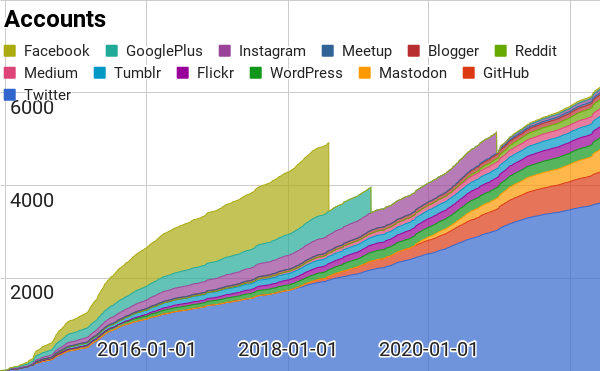
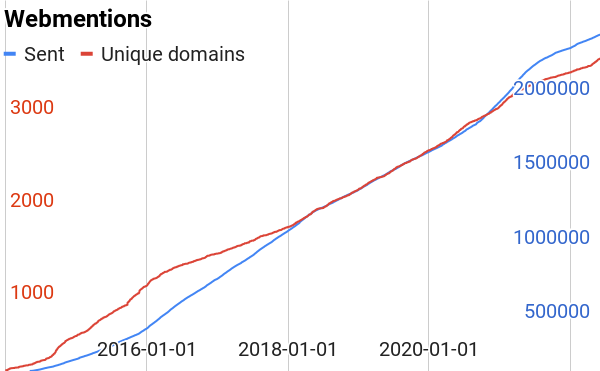
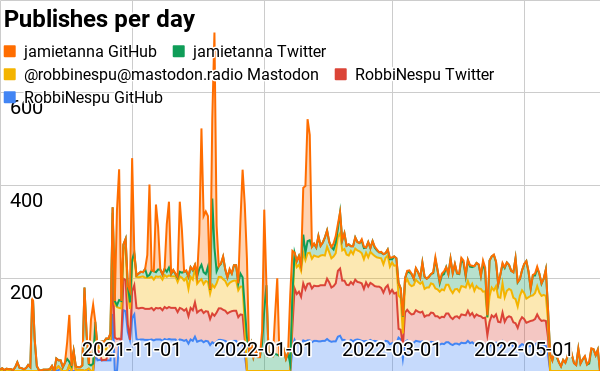
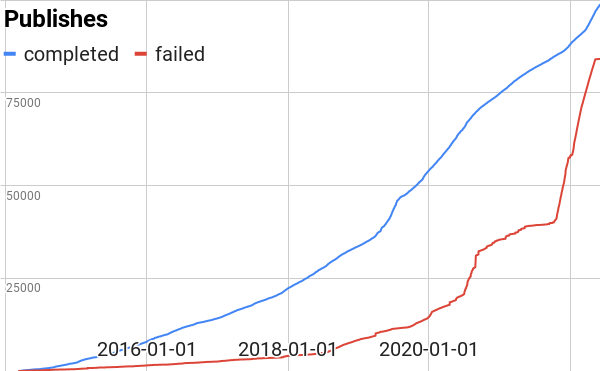
{
    "type": "entry",
    "published": "2022-06-05T23:27:15-07:00",
    "url": "https://snarfed.org/2022-06-05_bridgy-stats-update-7",
    "photo": [
        "https://snarfed.org/bridgy_stats/2022/accounts_stacked_thumb.png",
        "https://snarfed.org/bridgy_stats/2022/webmentions_thumb.png",
        "https://snarfed.org/bridgy_stats/2022/publishes_increase_thumb.png",
        "https://snarfed.org/bridgy_stats/2022/publishes_thumb.png"
    ],
    "syndication": [
        "https://news.indieweb.org/en/snarfed.org/2022-06-05_bridgy-stats-update-7"
    ],
    "name": "Bridgy stats update",
    "content": {
        "text": "It\u2019s that time of year again\u2026Bridgy stats update! Top line numbers: 6471 accounts, 28M silo responses, 4.7M links, 2.3M webmentions sent, 99k posts published, 102k blog posts processed, 16k blog webmentions received.\n\n \n  \n\n\n \n  \n\n\n \n  \n\n \n  \n Continue reading \u2192",
        "html": "<p>\n <a href=\"https://brid.gy/\">\n  </a></p>\n<p>It\u2019s that time of year again\u2026<a href=\"https://brid.gy/\">Bridgy</a> stats update! Top line numbers: 6471 accounts, 28M silo responses, 4.7M links, 2.3M webmentions sent, 99k posts published, 102k <a href=\"https://brid.gy/about#blogs\">blog posts processed</a>, 16k <a href=\"https://brid.gy/about#blogs\">blog webmentions</a> received.</p>\n<p>\n <a href=\"https://snarfed.org/bridgy_stats/2022/accounts_stacked.png\">\n  </a></p>\n\n<p>\n <a href=\"https://snarfed.org/bridgy_stats/2022/webmentions.png\">\n  </a></p>\n\n<p>\n <a href=\"https://snarfed.org/bridgy_stats/2022/publishes_increase.png\">\n  </a></p>\n<p>\n <a href=\"https://snarfed.org/bridgy_stats/2022/publishes.png\">\n  </a></p>\n<p> <a href=\"https://snarfed.org/2022-06-05_bridgy-stats-update-7#more-47005\">Continue reading <span>\u2192</span></a></p>"
    },
    "author": {
        "type": "card",
        "name": "Ryan Barrett",
        "url": "https://snarfed.org/",
        "photo": "https://secure.gravatar.com/avatar/947b5f3f323da0ef785b6f02d9c265d6?s=96&d=blank&r=g"
    },
    "post-type": "photo",
    "_id": "30238458",
    "_source": "3",
    "_is_read": true
}