Because of the alarming events unfolding at Twitter, like many I’ve been exploring Mastodon. I’m optimistic. You can find me at mastodon.social… or my own #indieweb website barryfrost.com.
{
    "type": "entry",
    "published": "2022-11-06T10:51:57.140Z",
    "url": "https://barryfrost.com/2022/11/because-of-the-alarming-events-unfolding",
    "category": [
        "personal",
        "twitter",
        "mastodon",
        "indieweb"
    ],
    "syndication": [
        "https://twitter.com/barryf/status/1589208967384891392"
    ],
    "content": {
        "text": "Because of the alarming events unfolding at Twitter, like many I\u2019ve been exploring Mastodon. I\u2019m optimistic. You can find me at mastodon.social\u2026 or my own #indieweb website barryfrost.com."
    },
    "author": {
        "type": "card",
        "name": "Barry Frost",
        "url": "https://barryfrost.com/",
        "photo": "https://barryfrost.com/barryfrost.jpg"
    },
    "post-type": "note",
    "_id": "32643361",
    "_source": "189",
    "_is_read": true
}
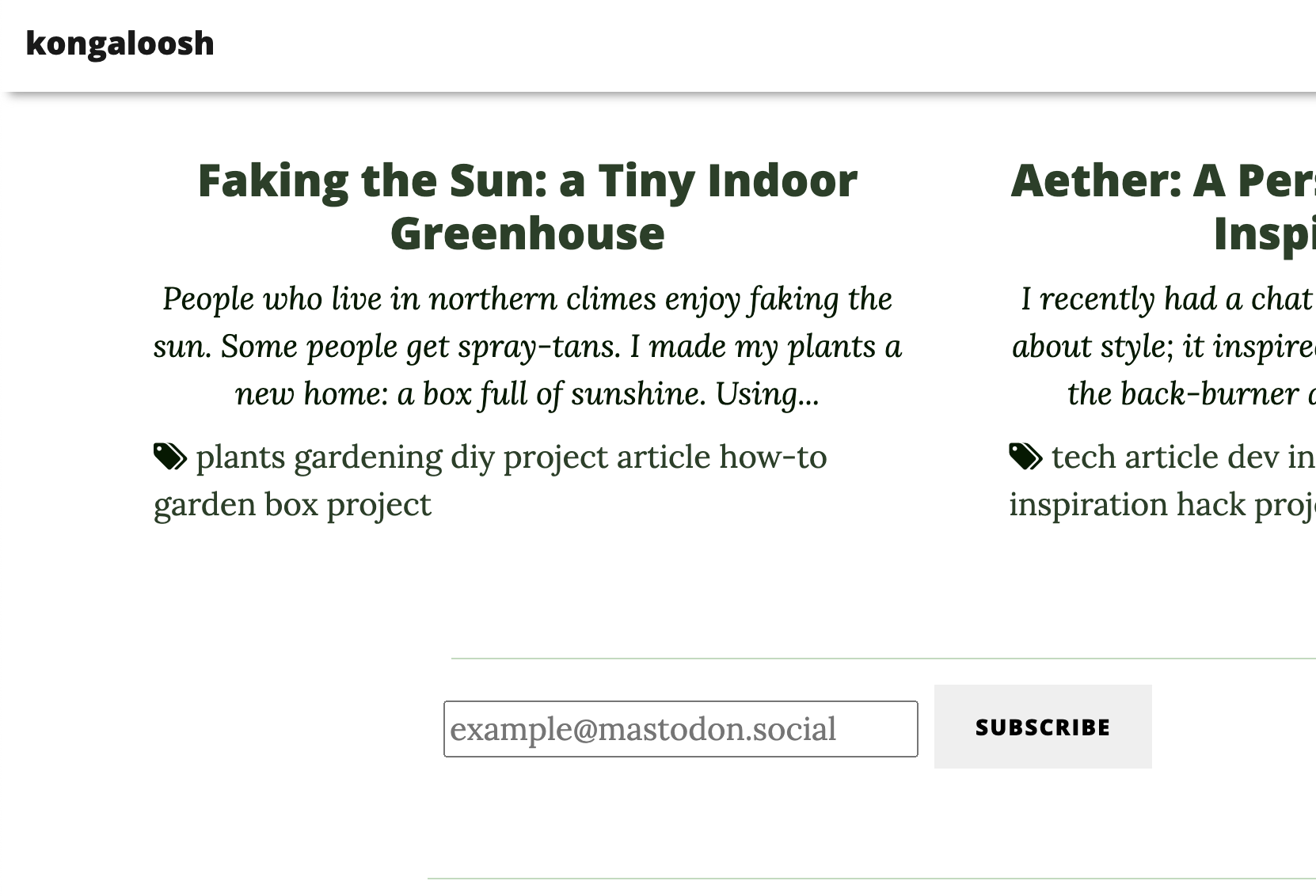
I've added a little subscribe button to my #indieweb site. Anyone using mastodon, or any ActivityPub based site can see my posts. It'll act just like I'm a mastodon user :)
Decentralisation!
indieweb
activitystreams
activitypub
decentralisation
tech
dev
{
    "type": "entry",
    "published": "2022-11-05 16:04:55.706706",
    "url": "https://kongaloosh.com/e/2022/11/5/ive-added-",
    "photo": [
        "https://kongaloosh.com/data/2022/11/5/2022-11-05--16-02-03-0.png",
        "https://kongaloosh.com/data/2022/11/5/2022-11-05--16-02-03.png"
    ],
    "syndication": [
        "https://twitter.com/kongaloosh/status/1588986068400996353"
    ],
    "content": {
        "text": "I've added a little subscribe button to my   #indieweb  site. Anyone using mastodon, or any ActivityPub based site can see my posts. It'll act just like I'm a mastodon user :)\nDecentralisation!\n\n\n    \n    \n        \n    \n    \n        \n    \n\n\n        \n\n        \n        \n            \n            \n        \n        \n\n\n        \n\n\n                                 \n                                            \n                \n                \n                \n                indieweb\n                \n                activitystreams\n                \n                activitypub\n                \n                decentralisation\n                \n                tech\n                \n                dev",
        "html": "<p>I've added a little subscribe button to my  <a href=\"https://kongaloosh.com/t/indieweb\"> #indieweb</a>  site. Anyone using mastodon, or any ActivityPub based site can see my posts. It'll act just like I'm a mastodon user :)</p>\n<p>Decentralisation!</p>\n<p>\n</p>\n    \n    <a href=\"https://kongaloosh.com/images/data/2022/11/5/2022-11-05--16-02-03-0.png\">\n        </a>\n    \n    <a href=\"https://kongaloosh.com/images/data/2022/11/5/2022-11-05--16-02-03.png\">\n        </a>\n    \n\n\n        \n\n        \n        \n            <p></p>\n            \n        \n        \n\n\n        \n\n\n                                 \n                                            \n                \n                <i></i>\n                \n                <a href=\"https://kongaloosh.com/t/indieweb\">indieweb</a>\n                \n                <a href=\"https://kongaloosh.com/t/activitystreams\">activitystreams</a>\n                \n                <a href=\"https://kongaloosh.com/t/activitypub\">activitypub</a>\n                \n                <a href=\"https://kongaloosh.com/t/decentralisation\">decentralisation</a>\n                \n                <a href=\"https://kongaloosh.com/t/tech\">tech</a>\n                \n                <a href=\"https://kongaloosh.com/t/dev\">dev</a>"
    },
    "author": {
        "type": "card",
        "name": "Alex Kearney",
        "url": "http://kongaloosh.com",
        "photo": null
    },
    "post-type": "photo",
    "_id": "32631748",
    "_source": "228",
    "_is_read": true
}
Not sure about going ahead and using Mastodon in the same way I used Twitter. It looks really nice and all that, but I managed to get out of the checking-my-stream-and-posting-something-every-few-minutes cycle, which was one of the main reasons I “went indieweb”.
{
    "type": "entry",
    "author": {
        "name": "Leon Paternoster",
        "url": "https://www.thisdaysportion.com",
        "photo": "https://avatars.micro.blog/avatars/2022/9498.jpg"
    },
    "url": "https://www.thisdaysportion.com/notes/to-toot-or-not-to-toot",
    "content": {
        "html": "<p>Not sure about going ahead and using Mastodon in the same way I used Twitter. It looks really nice and all that, but I managed to get out of the checking-my-stream-and-posting-something-every-few-minutes cycle, which was one of the main reasons I \u201cwent indieweb\u201d.</p>",
        "text": "Not sure about going ahead and using Mastodon in the same way I used Twitter. It looks really nice and all that, but I managed to get out of the checking-my-stream-and-posting-something-every-few-minutes cycle, which was one of the main reasons I \u201cwent indieweb\u201d."
    },
    "published": "2022-11-05T16:34:19+00:00",
    "post-type": "note",
    "_id": "33379991",
    "_source": "7224",
    "_is_read": true
}
Currently trying to get to grips with Pixelfed, and work out how all these indieweb things are going to for together.
At the minute it’s a mess.
{
    "type": "entry",
    "author": {
        "name": "Greg Morris",
        "url": "https://gr36.com",
        "photo": "https://avatars.micro.blog/avatars/2022/112759.jpg"
    },
    "url": "https://www.gr36.com/2022/11/05/currently-trying-to.html",
    "content": {
        "html": "<p>Currently trying to get to grips with Pixelfed, and work out how all these indieweb things are going to for together.</p>\n\n<p>At the minute it\u2019s a mess.</p>",
        "text": "Currently trying to get to grips with Pixelfed, and work out how all these indieweb things are going to for together.\n\nAt the minute it\u2019s a mess."
    },
    "published": "2022-11-05T12:25:56+00:00",
    "post-type": "note",
    "_id": "33379992",
    "_source": "7224",
    "_is_read": true
}
For those of you migrating to Mastodon:
@kongaloosh.com@kongaloosh.com
The authentic Alex Kearney on any server. #indieweb
social web
dev
rip
{
    "type": "entry",
    "published": "2022-11-04 23:05:31.051870",
    "url": "https://kongaloosh.com/e/2022/11/4/for-those-",
    "syndication": [
        "https://twitter.com/kongaloosh/status/1588729324680761345"
    ],
    "content": {
        "text": "For those of you migrating to Mastodon:\n@kongaloosh.com@kongaloosh.com\nThe authentic Alex Kearney on any server.   #indieweb \n        \n\n        \n        \n            \n            \n        \n        \n\n\n        \n\n\n                                 \n                                            \n                \n                \n                \n                social web\n                \n                dev\n                \n                rip",
        "html": "<p>For those of you migrating to Mastodon:</p>\n<p>@kongaloosh.com@kongaloosh.com</p>\n<p>The authentic Alex Kearney on any server.  <a href=\"https://kongaloosh.com/t/indieweb\"> #indieweb</a> </p>\n        \n\n        \n        \n            <p></p>\n            \n        \n        \n\n\n        \n\n\n                                 \n                                            \n                \n                <i></i>\n                \n                <a href=\"https://kongaloosh.com/t/social%20web\">social web</a>\n                \n                <a href=\"https://kongaloosh.com/t/dev\">dev</a>\n                \n                <a href=\"https://kongaloosh.com/t/rip\">rip</a>"
    },
    "author": {
        "type": "card",
        "name": "Alex Kearney",
        "url": "http://kongaloosh.com",
        "photo": null
    },
    "post-type": "note",
    "_id": "32613034",
    "_source": "228",
    "_is_read": true
}
Catch me on the indieweb
rip
life
social
{
    "type": "entry",
    "published": "2022-11-04 22:39:38.220396",
    "url": "https://kongaloosh.com/e/2022/11/4/catch-me-o",
    "syndication": [
        "https://twitter.com/kongaloosh/status/1588722813610991617"
    ],
    "content": {
        "text": "Catch me on the indieweb\n        \n\n        \n        \n            \n            \n        \n        \n\n\n        \n\n\n                                 \n                                            \n                \n                \n                \n                rip\n                \n                life\n                \n                social",
        "html": "<p>Catch me on the indieweb</p>\n        \n\n        \n        \n            <p></p>\n            \n        \n        \n\n\n        \n\n\n                                 \n                                            \n                \n                <i></i>\n                \n                <a href=\"https://kongaloosh.com/t/rip\">rip</a>\n                \n                <a href=\"https://kongaloosh.com/t/life\">life</a>\n                \n                <a href=\"https://kongaloosh.com/t/social\">social</a>"
    },
    "author": {
        "type": "card",
        "name": "Alex Kearney",
        "url": "http://kongaloosh.com",
        "photo": null
    },
    "post-type": "note",
    "_id": "32613035",
    "_source": "228",
    "_is_read": true
}

{
    "type": "entry",
    "published": "2022-11-05T00:59:50+00:00",
    "url": "https://werd.io/2022/voting-on-the-indieweb",
    "name": "Voting on the indieweb",
    "content": {
        "text": "If you\u2019re an American citizen, you should vote in next week\u2019s election. Maybe you already have: I sent in my mail-in ballot, which is by far the easiest and most convenient way to do your democratic duty, as well as the best way to vote while researching your choices. (All of which is probably why so many people want to do away with it.)I was asked a while back if there was an indieweb solution for adding a widget on your website to help people register to vote. I wish this was an easier problem to solve than it is: because every jurisdiction has different voting infrastructure that doesn\u2019t adhere to any reliably shared principles or standards, there\u2019s no open source way to make this work without staying on top of every single voting portal. There are proprietary embeds to make this work - notably from vote.org - but they offer very few customization options and essentially require a full-page takeover. To customize more fully, you need to pay: a way for the underlying nonprofit to pay its bills, but counter to the mission of getting more people to register.It seems to me that it would be in the interests of political parties to create simple voter registration tools and make it as easy as possible to integrate them into your site or app. Let people register as easily as possible, and direct them to the voting option that\u2019s best for them, all from the websites and apps they\u2019re already using. (And then, perhaps, track their registration automatically so they know if it was rejected for some reason.) Democracy is strongest when every citizen can use their democratic right to vote.I\u2019m not a govtech guy, but I\u2019m aware this is pie in the sky thinking. Still: the best way to make this happen would be to create a single standard for election registration. Provide a single interface standard and a set of APIs that all local election portals must implement, then make it incredibly easy for them to do so by providing libraries and open source software. The current, standards-less, highly-federated way government software works is ludicrous, and can only lead to a bad citizen experience. Not everyone needs to use the same software, but surely it should be possible to get states to agree to some base technical standards, in the same way they all now use HTTP and HTML.This post is mostly brought to you by anxiety about the election. I feel powerless to stop what I think is almost inevitably going to happen. Please, please, please, please vote.",
        "html": "<p>If you\u2019re an American citizen, you should vote in next week\u2019s election. Maybe you already have: I sent in my mail-in ballot, which is by far the easiest and most convenient way to do your democratic duty, as well as the best way to vote while researching your choices. (All of which is probably why so many people want to do away with it.)</p><p>I was asked a while back if there was an indieweb solution for adding a widget on your website to help people register to vote. I wish this was an easier problem to solve than it is: because every jurisdiction has different voting infrastructure that doesn\u2019t adhere to any reliably shared principles or standards, there\u2019s no open source way to make this work without staying on top of every single voting portal. There are proprietary embeds to make this work - <a href=\"https://www.vote.org/technology/\">notably from vote.org</a> - but they offer very few customization options and essentially require a full-page takeover. To customize more fully, <a href=\"https://vip.vote.org/\">you need to pay</a>: a way for the underlying nonprofit to pay its bills, but counter to the mission of getting more people to register.</p><p>It seems to me that it would be in the interests of political parties to create simple voter registration tools and make it as easy as possible to integrate them into your site or app. Let people register as easily as possible, and direct them to the voting option that\u2019s best for them, all from the websites and apps they\u2019re already using. (And then, perhaps, track their registration automatically so they know if it was rejected for some reason.) Democracy is strongest when every citizen can use their democratic right to vote.</p><p>I\u2019m not a govtech guy, but I\u2019m aware this is pie in the sky thinking. Still: the best way to make this happen would be to create a single standard for election registration. Provide a single interface standard and a set of APIs that all local election portals must implement, then make it incredibly easy for them to do so by providing libraries and open source software. The current, standards-less, highly-federated way government software works is ludicrous, and can only lead to a bad citizen experience. Not everyone needs to use the same software, but surely it should be possible to get states to agree to some base technical standards, in the same way they all now use HTTP and HTML.</p><p>This post is mostly brought to you by anxiety about the election. I feel powerless to stop what I think is almost inevitably going to happen. Please, please, please, please vote.</p>"
    },
    "author": {
        "type": "card",
        "name": "Ben Werdmuller",
        "url": "https://werd.io/profile/benwerd",
        "photo": "https://werd.io/file/5d388c5fb16ea14aac640912/thumb.jpg"
    },
    "post-type": "article",
    "_id": "32609958",
    "_source": "191",
    "_is_read": true
}
@mnot many AP impls, e.g. #BridgyFed as noted. Also @microdotblog. You can setup notes.mnot.net served by https://micro.blog/, post w their apps or https://indieweb.org/Micropub/Clients, @-mention w #Webmention, & have Mastodon followers w/o using Mastodon.
{
"type": "entry",
"published": "2022-11-02 20:25-0700",
"url": "http://tantek.com/2022/306/t1/micro-blog-micropub-clients-webmention",
"category": [
"BridgyFed",
"Webmention"
],
"in-reply-to": [
"https://twitter.com/mnot/status/1586279839752892417"
],
"content": {
"text": "@mnot many AP impls, e.g. #BridgyFed as noted. Also @microdotblog. You can setup notes.mnot.net served by https://micro.blog/, post w their apps or https://indieweb.org/Micropub/Clients, @-mention w #Webmention, & have Mastodon followers w/o using Mastodon.",
"html": "<a class=\"h-cassis-username\" href=\"https://twitter.com/mnot\">@mnot</a> many AP impls, e.g. #<span class=\"p-category\">BridgyFed</span> as noted. Also <a class=\"h-cassis-username\" href=\"https://twitter.com/microdotblog\">@microdotblog</a>. You can setup <a href=\"http://notes.mnot.net\">notes.mnot.net</a> served by <a href=\"https://micro.blog/\">https://micro.blog/</a>, post w their apps or <a href=\"https://indieweb.org/Micropub/Clients\">https://indieweb.org/Micropub/Clients</a>, @-mention w #<span class=\"p-category\">Webmention</span>, & have Mastodon followers w/o using Mastodon."
},
"author": {
"type": "card",
"name": "Tantek \u00c7elik",
"url": "http://tantek.com/",
"photo": "https://aperture-media.p3k.io/tantek.com/acfddd7d8b2c8cf8aa163651432cc1ec7eb8ec2f881942dca963d305eeaaa6b8.jpg"
},
"post-type": "reply",
"refs": {
"https://twitter.com/mnot/status/1586279839752892417": {
"type": "entry",
"url": "https://twitter.com/mnot/status/1586279839752892417",
"name": "@mnot\u2019s tweet",
"post-type": "article"
}
},
"_id": "32559256",
"_source": "1",
"_is_read": true
}
{
    "type": "entry",
    "published": "2022-10-31T23:33:22+00:00",
    "url": "https://werd.io/2022/the-blog-is-back",
    "name": "The blog is back",
    "content": {
        "text": "I\u2019m really heartened to see old-school blogging have a mini-resurgence. I\u2019ve got no idea if it\u2019ll stick, but for now, my feed reader is aglow with posts that run the gamut from quick thoughts to long-form essays, often illustrated with personal photographs. More of this, please. Much more of this.My favorite social network ever, by a long shot, is LiveJournal. Not only did Brad and co establish many of the norms that we now take for granted, but it was built around blogging: every post was a written piece. The comments were excellent, and everyone was contributing their own original work instead of reposting memes.Blogs + readers approximates this, although the commenting situation is too fragmented. Commenting isn\u2019t quite right in the indieweb, either: I\u2019m hankering for long threaded discussions rather than Twitter-style replies. I think we\u2019ll get there, though, and this is so much of a step forward from the social media morass.More! More! More!",
        "html": "<p>I\u2019m really heartened to see old-school blogging have a mini-resurgence. I\u2019ve got no idea if it\u2019ll stick, but for now, my feed reader is aglow with posts that run the gamut from quick thoughts to long-form essays, often illustrated with personal photographs. More of this, please. Much more of this.</p><p>My favorite social network ever, by a long shot, is LiveJournal. Not only did Brad and co establish many of the norms that we now take for granted, but it was built around blogging: every post was a written piece. The comments were excellent, and everyone was contributing their own original work instead of reposting memes.</p><p>Blogs + readers approximates this, although the commenting situation is too fragmented. Commenting isn\u2019t quite right in the indieweb, either: I\u2019m hankering for long threaded discussions rather than Twitter-style replies. I think we\u2019ll get there, though, and this is so much of a step forward from the social media morass.</p><p>More! More! More!</p>"
    },
    "author": {
        "type": "card",
        "name": "Ben Werdmuller",
        "url": "https://werd.io/profile/benwerd",
        "photo": "https://werd.io/file/5d388c5fb16ea14aac640912/thumb.jpg"
    },
    "post-type": "article",
    "_id": "32496945",
    "_source": "191",
    "_is_read": true
}
{
    "type": "entry",
    "published": "2022-10-30T17:25:37+00:00",
    "url": "https://werd.io/2022/substack-and-medium",
    "name": "Substack and Medium",
    "content": {
        "text": "If you receive my posts via email, you\u2019re now getting them through Substack. Nothing should substantially change, but they\u2019ll look a little different.This is the fourth newsletter platform I\u2019ve used for my writing: MailChimp, ConvertKit, and Buttondown all preceded it. This new change - which, let\u2019s be clear, is an experiment - is already a little different. That\u2019s because, unlike the others, Substack is more of a social network than a newsletter platform whose main competitor is very clearly Medium.(Worth declaring: I worked at Medium from 2016-2017 and consider its current CEO Tony Stubblebine to be a friend. I\u2019ve also been publicly critical of Substack\u2019s laissez-faire editorial strategy.)Substack\u2019s main draws are very similar to Medium\u2019s: you can make money from your writing; it will provide a beautiful, easy-to-use interface; it will find you readers. The mechanics of how it does that are different, though, and worth thinking about in the context of social network design.First, the money.This is the big carrot for new writers. (Content from my website will remain free, by the way.) Medium sets you up with the partner network: subscribers pay a flat $5 a month through its site. Funds are then allocated based on the fraction of each paying user\u2019s attention you attract.That means you can work on a big piece of writing that you think will attract a lot of attention and get paid for it without a lot of business preparation. Medium\u2019s paywall is leaky, so non-members will be able to read and help to promote it.While Medium\u2019s financial model is content-centric, Substack\u2019s is personality-based. Readers opt in to subscribe to a publisher, just as they would any newsletter. But publishers can opt to establish payment tiers that give subscribers access to premium posts if they pay more money. Attention doesn\u2019t come into it: a subscriber either believes you\u2019re worth paying a monthly fee for or they don\u2019t.The other trick is that, on Substack, publishers have to sign up separately to Stripe in order to gather payments. That means Stripe handles Know Your Customer requirements on behalf of Substack. Between Stripe fees and Substack\u2019s 10% take, the publisher is left with a little over 85% of subscription fees - which is a significantly better deal than many places on the web.Using revenue as a lens, then, whether you choose Medium or Substack depends on whether you have a following who might pay for your work. If you do great work, or are working on a single, amazing piece of writing, but don\u2019t have a following, Medium is clearly the better choice. If you already have a community or want to put in the work of building a following, Substack might have the edge right now.Second, the interface.Medium\u2019s writing interface is still the best, hands down. The attention to detail is superb, from font kerning through to embedding.Substack\u2019s is more utilitarian, but is still cleanly designed and distraction-free. Because of its email origins, there\u2019s no way it can possibly do some of the fancy embedding tricks that Medium is able to.I\u2019ve long written using iA Writer no matter where it\u2019s going, but Medium\u2019s interface remains much more enticing to me. There\u2019s also an API and - crucially, excitingly - a way to import posts from your personal blog and have the canonical link set to your blog\u2019s URL. That feature feels specifically built for me, and I love it.Finally, the community.Both platforms will find you readers, albeit in different ways.Again, Medium\u2019s model is content-centric: it will show you posts it thinks you\u2019ll find useful or interesting, no matter who they\u2019re by. The algorithm automatically promotes content inside implicit communities of interest. It will also try and show you content by people you know, however, partially by connecting to your Twitter network.Substack\u2019s is very personality-focused. It does the same Twitter trick as Medium: your followers from elsewhere who are already on Substack will know about your Substack feed. But it also operates using a system of direct recommendations; every Substack publisher directly suggests other publishers to follow. It\u2019s relationship-based rather than algorithmic: one can imagine asking a publisher if they\u2019d consider recommending you. Medium\u2019s algorithm is more of a black box (because it\u2019s likely being tweaked every day).Both services now offer a feed. Medium\u2019s, as discussed, is algorithmically-ordered so as to optimize for serendipity: you\u2019ll discover new content you didn\u2019t know you wanted to read. Substack\u2019s is much more like a traditional feed reader, in that you\u2019ll read the latest content from people you\u2019re subscribed to. (In fact, beautifully, it is a feed reader: you can bring your own RSS feeds from elsewhere.) Substack has traditional blog-style comments and hearts; Medium has claps to indicate attention and the concept of stories that follow stories rather than threaded comments. Both have merit, although Substack\u2019s approach is considerably more straightforward.Why choose?I don\u2019t: I\u2019m a happy user of both, while also publishing on my own site first in the indieweb tradition. I am, if you\u2019re interested, experimenting with a unique, native Substack about my work writing a book. And you can follow me on Medium.Moving to a community-based newsletter is strategic for me. I want to continue to build a following so I can share the work I\u2019m doing. Moving away from a straight newsletter platform is also financially beneficial: services like ConvertKit cost real money every month to operate. You can get started on both Medium and Substack for free.",
        "html": "<p>If you receive my posts via email, you\u2019re now getting them through <a href=\"https://substack.com\">Substack</a>. Nothing should substantially change, but they\u2019ll look a little different.</p><p>This is the fourth newsletter platform I\u2019ve used for my writing: <a href=\"https://mailchimp.com\">MailChimp</a>, <a href=\"https://convertkit.com\">ConvertKit</a>, and <a href=\"https://buttondown.email\">Buttondown</a> all preceded it. This new change - which, let\u2019s be clear, is an experiment - is already a little different. That\u2019s because, unlike the others, Substack is more of a social network than a newsletter platform whose main competitor is very clearly <a href=\"https://medium.com\">Medium</a>.</p><p>(Worth declaring: I worked at Medium from 2016-2017 and consider its current CEO Tony Stubblebine to be a friend. I\u2019ve also been publicly critical of Substack\u2019s laissez-faire editorial strategy.)</p><p>Substack\u2019s main draws are very similar to Medium\u2019s: you can make money from your writing; it will provide a beautiful, easy-to-use interface; it will find you readers. The mechanics of how it does that are different, though, and worth thinking about in the context of social network design.</p><p><strong>First, the money.</strong></p><p>This is the big carrot for new writers. (Content from my website will remain free, by the way.) Medium sets you up with the partner network: subscribers pay a flat $5 a month through its site. Funds are then allocated based on the fraction of each paying user\u2019s attention you attract.</p><p>That means you can work on a big piece of writing that you think will attract a lot of attention and get paid for it without a lot of business preparation. Medium\u2019s paywall is leaky, so non-members will be able to read and help to promote it.</p><p>While Medium\u2019s financial model is content-centric, Substack\u2019s is personality-based. Readers opt in to subscribe to a publisher, just as they would any newsletter. But publishers can opt to establish payment tiers that give subscribers access to premium posts if they pay more money. Attention doesn\u2019t come into it: a subscriber either believes you\u2019re worth paying a monthly fee for or they don\u2019t.</p><p>The other trick is that, on Substack, publishers have to sign up separately to Stripe in order to gather payments. That means Stripe handles Know Your Customer requirements on behalf of Substack. Between Stripe fees and Substack\u2019s 10% take, the publisher is left with a little over 85% of subscription fees - which is a significantly better deal than many places on the web.</p><p>Using revenue as a lens, then, whether you choose Medium or Substack depends on whether you have a following who might pay for your work. If you do great work, or are working on a single, amazing piece of writing, but don\u2019t have a following, Medium is clearly the better choice. If you already have a community or want to put in the work of building a following, Substack might have the edge right now.</p><p><strong>Second, the interface.</strong></p><p>Medium\u2019s writing interface is still the best, hands down. The attention to detail is superb, from font kerning through to embedding.</p><p>Substack\u2019s is more utilitarian, but is still cleanly designed and distraction-free. Because of its email origins, there\u2019s no way it can possibly do some of the fancy embedding tricks that Medium is able to.</p><p>I\u2019ve long written using <a href=\"https://ia.net/writer\">iA Writer</a> no matter where it\u2019s going, but Medium\u2019s interface remains much more enticing to me. There\u2019s also an API and - crucially, excitingly - a way to import posts from your personal blog and have the canonical link set to your blog\u2019s URL. That feature feels specifically built for me, and I love it.</p><p><strong>Finally, the community.</strong></p><p>Both platforms will find you readers, albeit in different ways.</p><p>Again, Medium\u2019s model is content-centric: it will show you posts it thinks you\u2019ll find useful or interesting, no matter who they\u2019re by. The algorithm automatically promotes content inside implicit communities of interest. It <em>will</em> also try and show you content by people you know, however, partially by connecting to your Twitter network.</p><p>Substack\u2019s is very personality-focused. It does the same Twitter trick as Medium: your followers from elsewhere who are already on Substack will know about your Substack feed. But it also operates using a system of direct recommendations; every Substack publisher directly suggests other publishers to follow. It\u2019s relationship-based rather than algorithmic: one can imagine asking a publisher if they\u2019d consider recommending you. Medium\u2019s algorithm is more of a black box (because it\u2019s likely being tweaked every day).</p><p>Both services now offer a feed. Medium\u2019s, as discussed, is algorithmically-ordered so as to optimize for serendipity: you\u2019ll discover new content you didn\u2019t know you wanted to read. Substack\u2019s is much more like a traditional feed reader, in that you\u2019ll read the latest content from people you\u2019re subscribed to. (In fact, beautifully, it <em>is</em> a feed reader: you can bring your own RSS feeds from elsewhere.) Substack has traditional blog-style comments and hearts; Medium has claps to indicate attention and the concept of stories that follow stories rather than threaded comments. Both have merit, although Substack\u2019s approach is considerably more straightforward.</p><p><strong>Why choose?</strong></p><p>I don\u2019t: I\u2019m a happy user of both, while also publishing on my own site first in the <a href=\"https://indieweb.org\">indieweb</a> tradition. I am, if you\u2019re interested, experimenting with <a href=\"https://benwerd.substack.com\">a unique, native Substack about my work writing a book</a>. And <a href=\"https://benwerd.medium.com\">you can follow me on Medium</a>.</p><p>Moving to a community-based newsletter is strategic for me. I want to continue to build a following so I can share the work I\u2019m doing. Moving away from a straight newsletter platform is also financially beneficial: services like ConvertKit cost real money every month to operate. You can get started on both Medium and Substack for free.</p>"
    },
    "author": {
        "type": "card",
        "name": "Ben Werdmuller",
        "url": "https://werd.io/profile/benwerd",
        "photo": "https://werd.io/file/5d388c5fb16ea14aac640912/thumb.jpg"
    },
    "post-type": "article",
    "_id": "32464057",
    "_source": "191",
    "_is_read": true
}
A lovely collection of blogs (and RSS feeds) that you can follow.
(Just in case, y’know, you might decide that following people on their own websites is better than following them on a website controlled by one immature manbaby who’s down with the racists.)
{
    "type": "entry",
    "published": "2022-10-30T09:23:07Z",
    "url": "https://adactio.com/links/19559",
    "category": [
        "blogs",
        "blogging",
        "indieweb",
        "personal",
        "publishing",
        "sharing",
        "websites",
        "blogroll",
        "rss",
        "feeds"
    ],
    "bookmark-of": [
        "https://mxb.dev/blogroll/"
    ],
    "content": {
        "text": "Blogroll | Max B\u00f6ck\n\n\n\nA lovely collection of blogs (and RSS feeds) that you can follow.\n\n(Just in case, y\u2019know, you might decide that following people on their own websites is better than following them on a website controlled by one immature manbaby who\u2019s down with the racists.)",
        "html": "<h3>\n<a class=\"p-name u-bookmark-of\" href=\"https://mxb.dev/blogroll/\">\nBlogroll | Max B\u00f6ck\n</a>\n</h3>\n\n<p>A lovely collection of blogs (and RSS feeds) that you can follow.</p>\n\n<p>(Just in case, y\u2019know, you might decide that following people on their own websites is better than following them on a website controlled by one immature manbaby who\u2019s down with the racists.)</p>"
    },
    "author": {
        "type": "card",
        "name": "Jeremy Keith",
        "url": "https://adactio.com/",
        "photo": "https://adactio.com/images/photo-150.jpg"
    },
    "post-type": "bookmark",
    "_id": "32456421",
    "_source": "2",
    "_is_read": true
}
Skimming some tweets about Jack Dorsey, there is a lot of confusion about what Bluesky is. Most people are stuck into thinking about social network silos, where you jump from platform to platform. As Facebook and Twitter stumble, the future is more distributed and IndieWeb-ified.
{
    "type": "entry",
    "author": {
        "name": "Manton Reece",
        "url": "https://www.manton.org/",
        "photo": "https://micro.blog/manton/avatar.jpg"
    },
    "url": "https://www.manton.org/2022/10/29/skimming-some-tweets.html",
    "content": {
        "html": "<p>Skimming some tweets about Jack Dorsey, there is a lot of confusion about what <a href=\"https://blueskyweb.org\">Bluesky</a> is. Most people are stuck into thinking about social network silos, where you jump from platform to platform. As Facebook and Twitter stumble, the future is more distributed and IndieWeb-ified.</p>",
        "text": "Skimming some tweets about Jack Dorsey, there is a lot of confusion about what Bluesky is. Most people are stuck into thinking about social network silos, where you jump from platform to platform. As Facebook and Twitter stumble, the future is more distributed and IndieWeb-ified."
    },
    "published": "2022-10-29T08:54:15-05:00",
    "post-type": "note",
    "_id": "32437686",
    "_source": "12",
    "_is_read": true
}
Skimming some tweets about Jack Dorsey, there is a lot of confusion about what Bluesky is. Most people are stuck into thinking about social network silos, where you jump from platform to platform. As Facebook and Twitter stumble, the future is more distributed and IndieWeb-ified.
{
    "type": "entry",
    "author": {
        "name": "Manton Reece",
        "url": "https://manton.org",
        "photo": "https://avatars.micro.blog/avatars/2022/3.jpg"
    },
    "url": "https://manton.org/2022/10/29/skimming-some-tweets.html",
    "content": {
        "html": "<p>Skimming some tweets about Jack Dorsey, there is a lot of confusion about what <a href=\"https://blueskyweb.org\">Bluesky</a> is. Most people are stuck into thinking about social network silos, where you jump from platform to platform. As Facebook and Twitter stumble, the future is more distributed and IndieWeb-ified.</p>",
        "text": "Skimming some tweets about Jack Dorsey, there is a lot of confusion about what Bluesky is. Most people are stuck into thinking about social network silos, where you jump from platform to platform. As Facebook and Twitter stumble, the future is more distributed and IndieWeb-ified."
    },
    "published": "2022-10-29T13:54:15+00:00",
    "post-type": "note",
    "_id": "33379993",
    "_source": "7224",
    "_is_read": true
}
One of the fascinating problems with trying to create non-corporate social media, alternatives to Twitter etc, and online life in general is that eventually someone has to decide who gets an account. Who gets a username, a domain name, etc. That has to be controlled by someone at some level to manage bad actors. For services like twitter, masto, etc, it's the person who runs the server. For domain names, which is the basis for identity on #indieweb that's done by registrars who use the fiscal cost of registration to manage who gets what, so then it's pay-to-play or piggyback off someone else's domain and thus you're beholden to someone else again. There's no equitable technical solution. A social solution is required.
{
    "type": "entry",
    "published": "2022-10-29T11:21:30",
    "url": "https://acegiak.net/o/6aa3a3be7c7a4a5ba5f2df0a679bbfbb",
    "content": {
        "text": "One of the fascinating problems with trying to create non-corporate social media, alternatives to Twitter etc, and online life in general is that eventually someone has to decide who gets an account. Who gets a username, a domain name, etc. That has to be controlled by someone at some level to manage bad actors. For services like twitter, masto, etc, it's the person who runs the server. For domain names, which is the basis for identity on #indieweb that's done by registrars who use the fiscal cost of registration to manage who gets what, so then it's pay-to-play or piggyback off someone else's domain and thus you're beholden to someone else again. There's no equitable technical solution. A social solution is required.",
        "html": "<p>One of the fascinating problems with trying to create non-corporate social media, alternatives to Twitter etc, and online life in general is that eventually <em>someone</em> has to decide who gets an account. Who gets a username, a domain name, etc. That has to be controlled by someone at some level to manage bad actors. For services like twitter, masto, etc, it's the person who runs the server. For domain names, which is the basis for identity on <a href=\"https://acegiak.net/t/indieweb\">#<span>indieweb</span></a> that's done by registrars who use the fiscal cost of registration to manage who gets what, so then it's pay-to-play or piggyback off someone else's domain and thus you're beholden to someone else again. There's no equitable technical solution. A social solution is required.</p>"
    },
    "author": {
        "type": "card",
        "name": "@ash@acegiak.net",
        "url": "https://acegiak.net/",
        "photo": "https://acegiak.net/static/icon.png"
    },
    "post-type": "note",
    "_id": "32435101",
    "_source": "185",
    "_is_read": true
}
But most importantly, always write your most important thoughts on your own site. You can share the link on as many platforms as you like and have conversations with anyone who wants to connect with you and your work. But nobody can take it from you. You are in control. Forever.
{
    "type": "entry",
    "published": "2022-10-29T10:17:51Z",
    "url": "https://adactio.com/links/19558",
    "category": [
        "social",
        "media",
        "twitter",
        "suspension",
        "indieweb",
        "personal",
        "publishing",
        "ownership"
    ],
    "bookmark-of": [
        "https://matthiasott.com/notes/suspension"
    ],
    "content": {
        "text": "Suspension \u00b7 Matthias Ott \u2013 User Experience Designer\n\n\n\n\n  But most importantly, always write your most important thoughts on your own site. You can share the link on as many platforms as you like and have conversations with anyone who wants to connect with you and your work. But nobody can take it from you. You are in control. Forever.",
        "html": "<h3>\n<a class=\"p-name u-bookmark-of\" href=\"https://matthiasott.com/notes/suspension\">\nSuspension \u00b7 Matthias Ott \u2013 User Experience Designer\n</a>\n</h3>\n\n<blockquote>\n  <p>But most importantly, always write your most important thoughts on your own site. You can share the link on as many platforms as you like and have conversations with anyone who wants to connect with you and your work. But nobody can take it from you. You are in control. Forever.</p>\n</blockquote>"
    },
    "author": {
        "type": "card",
        "name": "Jeremy Keith",
        "url": "https://adactio.com/",
        "photo": "https://adactio.com/images/photo-150.jpg"
    },
    "post-type": "bookmark",
    "_id": "32435073",
    "_source": "2",
    "_is_read": true
}
This is how I feel when I open up my feed reader—it feels like the opposite of opening Twitter:
The web remains a sea of interconnected ideas, across a kaleidoscope of forms and sources. Spending most of my time on just a handful of billion dollar sites squanders the possibilities and runs contrary to my values. There’s so much to be said for diversifying inputs, but there are only so many hours. It makes sense to economize.
{
    "type": "entry",
    "published": "2022-10-29T10:15:08Z",
    "url": "https://adactio.com/links/19557",
    "category": [
        "social",
        "media",
        "twitter",
        "attention",
        "indieweb"
    ],
    "bookmark-of": [
        "https://werd.io/view/63595bfc6e65cc5f8156d9b2"
    ],
    "content": {
        "text": "Thinking about leaving Twitter\n\n\n\nThis is how I feel when I open up my feed reader\u2014it feels like the opposite of opening Twitter:\n\n\n  The web remains a sea of interconnected ideas, across a kaleidoscope of forms and sources. Spending most of my time on just a handful of billion dollar sites squanders the possibilities and runs contrary to my values. There\u2019s so much to be said for diversifying inputs, but there are only so many hours. It makes sense to economize.",
        "html": "<h3>\n<a class=\"p-name u-bookmark-of\" href=\"https://werd.io/view/63595bfc6e65cc5f8156d9b2\">\nThinking about leaving Twitter\n</a>\n</h3>\n\n<p>This is how I feel <a href=\"https://adactio.com/journal/18322\">when I open up my feed reader</a>\u2014it feels like the opposite of opening Twitter:</p>\n\n<blockquote>\n  <p>The web remains a sea of interconnected ideas, across a kaleidoscope of forms and sources. Spending most of my time on just a handful of billion dollar sites squanders the possibilities and runs contrary to my values. There\u2019s so much to be said for diversifying inputs, but there are only so many hours. It makes sense to economize.</p>\n</blockquote>"
    },
    "author": {
        "type": "card",
        "name": "Jeremy Keith",
        "url": "https://adactio.com/",
        "photo": "https://adactio.com/images/photo-150.jpg"
    },
    "post-type": "bookmark",
    "_id": "32435074",
    "_source": "2",
    "_is_read": true
}

#TwitterMigration, first time?
Have posted notes at https://tantek.com/ since 2010, syndicated tweets & an #AtomFeed.
Added one .htaccess line, thanks to #BridgyFed, if you use #Mastodon, you can follow my #IndieWeb site:
@tantek.com@tantek.com
Which demonstrates both the redundancy & awkwardness (it’s not a clickable URL) of such @-@ (AT-AT) usernames.
Like why make me type or show “@tantek.com” twice like that?
Why can’t Mastodon follow a username of “@tantek.com”? Or just “tantek.com”?
And either way expanding it internally if need be to the AT-AT syntax.
Why this regression from what we had with classic feed readers where a domain was enough to discover & follow a feed?
Also, why does following show a blank result?
Contrast that with classic feed readers which immediately show you the most recent items in a feed you subscribed to.
Lastly (for now), I asked around and no one knew of a simple public way to “preview” or “validate” that @tantek.com@tantek.com actually “worked”. You have to be *logged-in* to a Mastodon instance and search for a username to check to see if it works.
Contrast that with https://validator.w3.org/feed/ which you can use without any log-in to validate that your classic feed file works.
Why these regressions from the days of feed readers?
{
"type": "entry",
"published": "2022-10-28 22:01-0700",
"url": "http://tantek.com/2022/301/t1/twittermigration-bridgyfed-mastodon-indieweb",
"category": [
"TwitterMigration",
"AtomFeed",
"BridgyFed",
"Mastodon",
"IndieWeb"
],
"content": {
"text": "#TwitterMigration, first time?\n\nHave posted notes at https://tantek.com/ since 2010, syndicated tweets & an #AtomFeed.\n\nAdded one .htaccess line, thanks to #BridgyFed, if you use #Mastodon, you can follow my #IndieWeb site:\n\n@tantek.com@tantek.com\n\nWhich demonstrates both the redundancy & awkwardness (it\u2019s not a clickable URL) of such @-@ (AT-AT) usernames.\n\nLike why make me type or show \u201c@tantek.com\u201d twice like that?\n\nWhy can\u2019t Mastodon follow a username of \u201c@tantek.com\u201d? Or just \u201ctantek.com\u201d?\nAnd either way expanding it internally if need be to the AT-AT syntax.\n\nWhy this regression from what we had with classic feed readers where a domain was enough to discover & follow a feed?\n\nAlso, why does following show a blank result?\n\nContrast that with classic feed readers which immediately show you the most recent items in a feed you subscribed to.\n\nLastly (for now), I asked around and no one knew of a simple public way to \u201cpreview\u201d or \u201cvalidate\u201d that @tantek.com@tantek.com actually \u201cworked\u201d. You have to be *logged-in* to a Mastodon instance and search for a username to check to see if it works.\n\nContrast that with https://validator.w3.org/feed/ which you can use without any log-in to validate that your classic feed file works.\n\nWhy these regressions from the days of feed readers?",
"html": "#<span class=\"p-category\">TwitterMigration</span>, first time?<br /><br />Have posted notes at <a href=\"https://tantek.com/\">https://tantek.com/</a> since 2010, syndicated tweets & an #<span class=\"p-category\">AtomFeed</span>.<br /><br />Added one .htaccess line, thanks to #<span class=\"p-category\">BridgyFed</span>, if you use #<span class=\"p-category\">Mastodon</span>, you can follow my #<span class=\"p-category\">IndieWeb</span> site:<br /><br /><a href=\"http://tantek.com\">@tantek.com@tantek.com</a><br /><br />Which demonstrates both the redundancy & awkwardness (it\u2019s not a clickable URL) of such @-@ (AT-AT) usernames.<br /><br />Like why make me type or show \u201c<a href=\"http://tantek.com\">@tantek.com</a>\u201d twice like that?<br /><br />Why can\u2019t Mastodon follow a username of \u201c<a href=\"http://tantek.com\">@tantek.com</a>\u201d? Or just \u201c<a href=\"http://tantek.com\">tantek.com</a>\u201d?<br />And either way expanding it internally if need be to the AT-AT syntax.<br /><br />Why this regression from what we had with classic feed readers where a domain was enough to discover & follow a feed?<br /><br />Also, why does following show a blank result?<br /><br />Contrast that with classic feed readers which immediately show you the most recent items in a feed you subscribed to.<br /><br />Lastly (for now), I asked around and no one knew of a simple public way to \u201cpreview\u201d or \u201cvalidate\u201d that <a href=\"http://tantek.com\">@tantek.com@tantek.com</a> actually \u201cworked\u201d. You have to be *logged-in* to a Mastodon instance and search for a username to check to see if it works.<br /><br />Contrast that with <a href=\"https://validator.w3.org/feed/\">https://validator.w3.org/feed/</a> which you can use without any log-in to validate that your classic feed file works.<br /><br />Why these regressions from the days of feed readers?"
},
"author": {
"type": "card",
"name": "Tantek \u00c7elik",
"url": "http://tantek.com/",
"photo": "https://aperture-media.p3k.io/tantek.com/acfddd7d8b2c8cf8aa163651432cc1ec7eb8ec2f881942dca963d305eeaaa6b8.jpg"
},
"post-type": "note",
"_id": "32431350",
"_source": "1",
"_is_read": true
}
I have no reason to leave twitter because my twitter is already just a shadow copy of my website, but if you want to find me elsewhere, you can follow me from Mastodon and micro.blog and others:
https://aaronparecki.com/aaronpk
https://micro.blog/aaronpk
{
    "type": "entry",
    "published": "2022-10-28T14:09:17-07:00",
    "url": "https://aaronparecki.com/2022/10/28/21/follow",
    "category": [
        "indieweb"
    ],
    "syndication": [
        "https://twitter.com/aaronpk/status/1586102839192932352"
    ],
    "content": {
        "text": "I have no reason to leave twitter because my twitter is already just a shadow copy of my website, but if you want to find me elsewhere, you can follow me from Mastodon and micro.blog and others:  \n\nhttps://aaronparecki.com/aaronpk  \n\nhttps://micro.blog/aaronpk",
        "html": "I have no reason to leave twitter because my twitter is already just a shadow copy of my website, but if you want to find me elsewhere, you can follow me from Mastodon and micro.blog and others:  <br /><br /><a href=\"https://aaronparecki.com/aaronpk\"><span>https://</span>aaronparecki.com/aaronpk</a>  <br /><br /><a href=\"https://micro.blog/aaronpk\"><span>https://</span>micro.blog/aaronpk</a>"
    },
    "author": {
        "type": "card",
        "name": "Aaron Parecki",
        "url": "https://aaronparecki.com/",
        "photo": "https://aperture-media.p3k.io/aaronparecki.com/41061f9de825966faa22e9c42830e1d4a614a321213b4575b9488aa93f89817a.jpg"
    },
    "post-type": "note",
    "_id": "32423246",
    "_source": "16",
    "_is_read": true
}
Your easy guide to starting a new blog.
A blog is an easy way to get started writing on the web. Your voice is important: it deserves its own site. The more people add their unique perspectives to the web, the more valuable it becomes.
{
    "type": "entry",
    "published": "2022-10-25T12:55:18Z",
    "url": "https://adactio.com/links/19546",
    "category": [
        "blogging",
        "writing",
        "sharing",
        "personal",
        "publishing",
        "indieweb",
        "blogs",
        "rss",
        "syndication",
        "cms",
        "platforms",
        "tools"
    ],
    "bookmark-of": [
        "https://getblogging.org/"
    ],
    "content": {
        "text": "Get Blogging!\n\n\n\n\n  Your easy guide to starting a new blog.\n  \n  A blog is an easy way to get started writing on the web. Your voice is important: it deserves its own site. The more people add their unique perspectives to the web, the more valuable it becomes.",
        "html": "<h3>\n<a class=\"p-name u-bookmark-of\" href=\"https://getblogging.org/\">\nGet Blogging!\n</a>\n</h3>\n\n<blockquote>\n  <p>Your easy guide to starting a new blog.</p>\n  \n  <p>A blog is an easy way to get started writing on the web. Your voice is important: it deserves its own site. The more people add their unique perspectives to the web, the more valuable it becomes. </p>\n</blockquote>"
    },
    "author": {
        "type": "card",
        "name": "Jeremy Keith",
        "url": "https://adactio.com/",
        "photo": "https://adactio.com/images/photo-150.jpg"
    },
    "post-type": "bookmark",
    "_id": "32327512",
    "_source": "2",
    "_is_read": true
}
A reminder that silos like Twitter can suspend your account without warning for no reason.
Having your own website is good.
{
    "type": "entry",
    "published": "2022-10-25T10:05:38Z",
    "url": "https://adactio.com/links/19544",
    "category": [
        "twitter",
        "suspension",
        "indieweb",
        "silos"
    ],
    "bookmark-of": [
        "https://www.matuzo.at/blog/2022/twitter-ban/"
    ],
    "content": {
        "text": "I broke the rules. - Manuel Matuzovi\u0107\n\n\n\nA reminder that silos like Twitter can suspend your account without warning for no reason.\n\nHaving your own website is good.",
        "html": "<h3>\n<a class=\"p-name u-bookmark-of\" href=\"https://www.matuzo.at/blog/2022/twitter-ban/\">\nI broke the rules. - Manuel Matuzovi\u0107\n</a>\n</h3>\n\n<p>A reminder that silos like Twitter can suspend your account without warning for no reason.</p>\n\n<p>Having your own website is good.</p>"
    },
    "author": {
        "type": "card",
        "name": "Jeremy Keith",
        "url": "https://adactio.com/",
        "photo": "https://adactio.com/images/photo-150.jpg"
    },
    "post-type": "bookmark",
    "_id": "32325153",
    "_source": "2",
    "_is_read": true
}