Die eigene Website ist nie wirklich fertig. 🙃
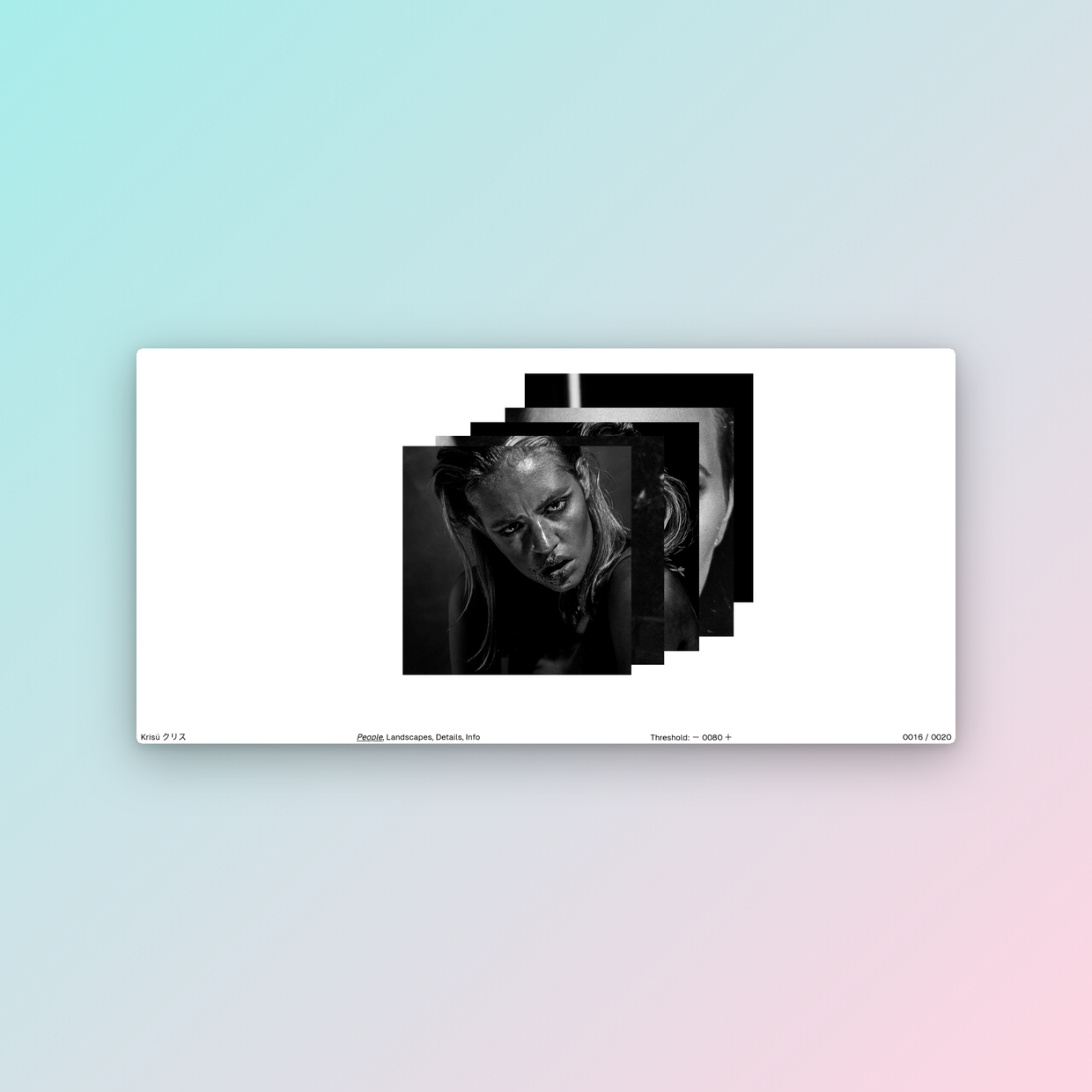
Mein Foto-Portfolio hat ein neues Design bekommen. 🚀
Der Fokus lag auf minimalistischen, Bild-zentrierter Präsentation.
Feedbacks sind willkommen. 👋
https://lab.krisu.eu/posts/photo-portfolio/
#IndieWeb #OpenSource #Minimalismus #webdesign
{
    "type": "entry",
    "author": {
        "name": "#indieweb",
        "url": "https://mastodon.social/tags/indieweb",
        "photo": null
    },
    "url": "https://mastodon.social/@Krisuuu/117104687098680910",
    "content": {
        "html": "<p>Die eigene Website ist nie wirklich fertig. \ud83d\ude43<br />Mein Foto-Portfolio hat ein neues Design bekommen. \ud83d\ude80<br />Der Fokus lag auf minimalistischen, Bild-zentrierter Pr\u00e4sentation.<br />Feedbacks sind willkommen. \ud83d\udc4b<br /><a href=\"https://lab.krisu.eu/posts/photo-portfolio/\"><span>https://</span><span>lab.krisu.eu/posts/photo-portf</span><span>olio/</span></a></p><p><a href=\"https://mastodon.social/tags/IndieWeb\">#<span>IndieWeb</span></a> <a href=\"https://mastodon.social/tags/OpenSource\">#<span>OpenSource</span></a> <a href=\"https://mastodon.social/tags/Minimalismus\">#<span>Minimalismus</span></a> <a href=\"https://mastodon.social/tags/webdesign\">#<span>webdesign</span></a></p>",
        "text": "Die eigene Website ist nie wirklich fertig. \ud83d\ude43\nMein Foto-Portfolio hat ein neues Design bekommen. \ud83d\ude80\nDer Fokus lag auf minimalistischen, Bild-zentrierter Pr\u00e4sentation.\nFeedbacks sind willkommen. \ud83d\udc4b\nhttps://lab.krisu.eu/posts/photo-portfolio/\n\n#IndieWeb #OpenSource #Minimalismus #webdesign"
    },
    "published": "2026-08-16T10:21:58+00:00",
    "photo": [
        "https://files.mastodon.social/media_attachments/files/117/104/687/035/117/686/original/8b6f262843ab31c0.png"
    ],
    "post-type": "photo",
    "_id": "49255298",
    "_source": "8007",
    "_is_read": false
}
My article was No.1 on Hacker News
A couple of weeks ago, Fabrizio of Passo.uno dropped me a message on LinkedIn and told me that my article, “Substack writers, you need a website!“, was No.2 on Hacker News. I thought he was pulling my leg.
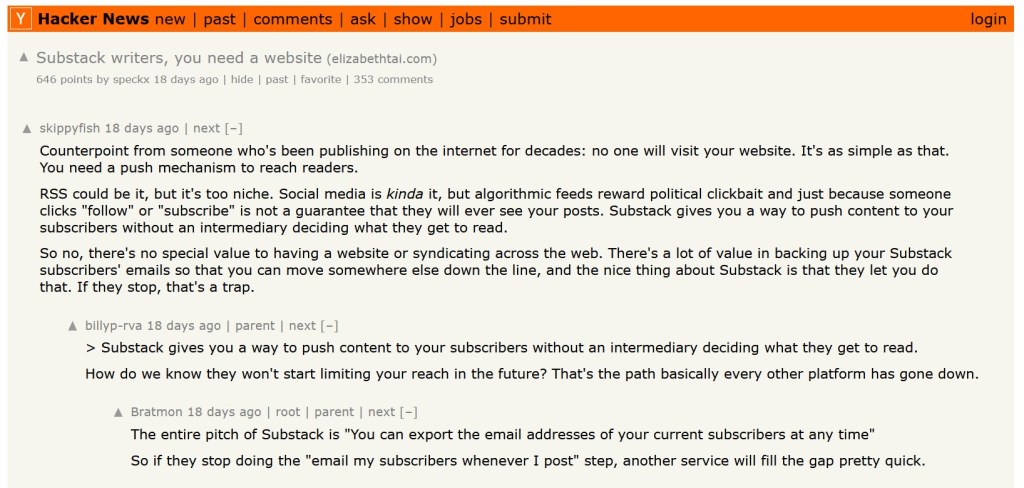
I checked Hacker News and indeed it was true: I was on the front page. By the time I checked, I had dropped to No.6, but I visited hnrankings.info to check the historical movement of the essay and saw that I was actually No.1 for a brief period.
I was absolutely stunned.
For one, although I do write about technical issues as a technical content writer and as a personal hobby, I am not technical-technical, if you know what I mean. Hacker News, the digital rag of SWEs around the world, highlights essays that I sometimes can barely comprehend. So, to be No.1 on that website is something I don’t even dream about.
It’s also a bit ironic, because the content of the blog post itself kind of proved my point. Before Hacker News picked up my post, it was actually picked up by WordPress.com and placed on the front page of its Freshly Pressed page. That was already a big deal.
When WordPress.com decided to highlight my post, I didn’t realize it. One day I just randomly noticed that the post was getting way more comments than I was used to. Usually I get about five or six comments at most, but on that day I discovered I had 50 comments. I thought maybe it was a fluke, or that somehow the topic had just resonated with people. Then I saw an email from WordPress.com telling me that I was selected to be featured on their Freshly Pressed page I got a lot of eyeballs due to that, which was great and made me pretty happy.
I firmly believe it is because of what WordPress did that I got noticed by the person who shared my article on Hacker News.
This would not have happened if I had published the post on Substack. For one, Substack tends to promote its superstars (i.e. those with a lot of subscribers, paid, preferably, and often not from my part of the world. Ahem.) Also, I doubt it’ll promote a post urging writers not to use Substack as their digital homes!
Still, it proves my point that promotional channels are equally important. If not for WordPress’s Discover page and Hacker News, I probably would not have been noticed at all.
Curiously, my Substack post highlighting the essay, Writers, don’t make Substack your digital home! is getting an uptick of comments lately. 32 comments so far! Highly unusual as I usually get less than a dozen comments, and usually from my usual readers. (FYI, I usually offer a bite-sized, behind-the-scenes version of the essay on my Substack, and invite readers to read the full essay.)
I think my essay coincided with a zeitgeist moment. I happened to write about Substack days before they rolled out their new Pangram AI detection feature.
People were already fed up about the state of platforms in general – what Cory Doctorow famously calls enshittification. Pangram was an “I’ve had it” moment for many Substackers already weary of being tossed around by lack of moderation, algorithms, rules and now a feature that may subject them to witch hunts. Pangram was the last straw.
Why writers need a website they own
My article, “Substack writers, you need a website!” was something I wrote out of frustration from what I’ve been seeing. I didn’t write
A lot of Substack writers are far too dependent on the platform to house their content. As the platform introduces more and more features they don’t like, many are complaining on the feed.
My frustration is borne out of the fact that many don’t seem to be aware that they can escape this “loop of doom,” so to speak. They don’t have to be trapped in this situation nor do they need to treat the platform as an be-all and end-all.
I also noticed that a lot of writers seem to think they can only choose between having their own website or being on Substack. The truth is, writers need to have a digital home that they own, and digital home means owning a domain name. It doesn’t matter what you build your site on—whether it’s WordPress, Ghost, or even Substack, really—as long as you have the domain name, you own the content. It’s like an address you keep forever.
However, if you don’t have a domain and your content lives on something like xx.substack.com or xx.wordpress.com, then the domain authority or “SEO juice” doesn’t belong to you. It belongs to those platforms. That’s why I’ve always championed the fact that you need to have your own website.
But a lot of writers I speak to are reluctant to do that, mostly because they are not technically inclined and feel overwhelmed by the thought of creating their own site. Perhaps it was incredibly hard to create a website in the 1990s, but it’s really much easier right now. There are so many services out there that can help you build your website without a speck of coding on your part. Heck, you can even vibe code a simple static website with ChatGPT if you want.
I realise I’m talking from the point of view of a technically inclined person. I work in tech, use software that would probably make most writers cross-eyed, and even build AI workflows in my company. But I’m telling you, it is not as difficult as you think.
For example, many would probably blink at my choice of hosting my website on WordPress.com. Although I have the technical skills to create my own static website—and did indeed build one at one point—I prefer to have other people manage it for me so that I can concentrate on writing. I chose WordPress.com because it’s one of the most common content management systems (CMS) on the internet. If WordPress.com doesn’t work out, I can easily port my website to another provider.
One day in the future, perhaps when I’m retired (because right now I’m too busy to even think about it), I hope to build my own static website so that my content is in Markdown first and then ported to the internet. But right now, the thought of doing that makes me tired because I have literally thousands of articles on my website. I’ve been publishing on elizabeththai.com since 2012 and have never really stopped, so it’s almost a 15-year footprint to port over. It’s not something you do lightly.
P.S. I have actually managed a few content migrations from one CMS to another for companies I’ve worked for, and I can tell you that each of them made me sweat bricks because they’re often not compatible. And even if they have an exporter feature, you’d have to clean up bugs and mangled content. If I were to migrate my own site, I would probably get professional help because there are far too many things that can go wrong in the process.
Still, some writers are not entirely convinced they need a website.
Many tell me they use Substack because they don’t get traffic to their own websites. Sure, that’s 100% true. Putting up a website doesn’t mean you’ll automatically get more traffic. In fact, it’ll often be the opposite due to the way the Internet is right now with SEO, and worsened by the fact that AI is now bypassing search engines by recommending websites instead. (Right now, corporations are having a headache trying to ensure their content gets recommended by the “answer engines”.)
I don’t get much traffic to my website most of the time (proof below); I’ll be surprised if I get a few hundred views a month. Perhaps I’m weird, but I do not care about traffic nor do I care how many subscribers I have. I care about my content having a home. I care about my content having an address that I own—meaning my own domain.
As you can see, my posts usually only get a few hundred views at best.So, the key for writers is to stop focusing on subscriber count or traffic. Focus instead on quality readers and engagement. Do your subscribers engage with your content? Leave comments? If you have only 100 subscribers but 30% of them talk to you via comments or social media, that’s far more valuable than having 100000 subscribers and no one bothers to engage with your content.
And whether your content goes viral and reaches tens of thousands of readers or not, don’t you want that traffic to go back to your website where people can discover your other content?
Having a digital home means that when one of your posts does go viral (whether recommended by sites like Hacker News or a Claude chatbot), people can find the rest of your work. Maybe they’ll even become a loyal subscriber.
In that essay, I pointed out that writers like John Scalzi have been blogging since the dawn of the internet. His digital footprint is massive, spanning decades. He has stated that his website will always be his home; while Twitter shuts down or other platforms fall, his website will always be there because he owns it. I want this for all writers.
It is pretty cool to have reached number one on Hacker News, but I fully expect my traffic to literally tank after this. Being viral is not eternal. I don’t chase clout, nor do I chase traffic or subscribers. What I value most is having a home that I can control, and that to me is far more valuable than anything else. I hope this is the lesson I can transmit to every writer debating whether they need to have a website.
Still, having my essay be No.1 on Hacker News is a feather in my cap, and as a writer I feel incredibly proud that my article has helped people think, debate and judging from the comments beneath the Hacker News post, quarrel (lol).
If you’re a writer on the fence, I hope that you will build your own digital home in the future. It’s one of the best ways to secure your content legacy.
#BeingAWriter #blog #blogging #HackerNews #indieweb #Internet #newsletter #Substack #writing
{
    "type": "entry",
    "author": {
        "name": "#indieweb",
        "url": "https://mastodon.social/tags/indieweb",
        "photo": null
    },
    "url": "https://elizabethtai.com/2026/08/16/my-article-was-no-1-on-hacker-news/",
    "content": {
        "html": "<p><strong>My article was No.1 on Hacker\u00a0News</strong></p>\n\n<p>A couple of weeks ago, Fabrizio of <a href=\"https://passo.uno/\">Passo.uno</a> dropped me a message on LinkedIn and told me that my article,  \u201c<a href=\"https://elizabethtai.com/2026/06/10/substack-writers-you-need-a-website/\">Substack writers, you need a website!</a>\u201c, was No.2\u00a0 on Hacker News. I thought he was pulling my leg.\u00a0</p><p>I checked H<a href=\"https://news.ycombinator.com/item?id=49086788\">acker News</a> and indeed it was true: I was on the front page. By the time I checked, I had dropped to No.6, but I visited hnrankings.info to check the historical movement of the essay and saw that I was actually No.1 for a brief period.\u00a0</p><p>I was absolutely stunned.\u00a0</p><p>For one, although I do write about technical issues as a technical content writer and as a personal hobby, I am not technical-technical, if you know what I mean. Hacker News, the digital rag of SWEs around the world, highlights essays that I sometimes can barely comprehend. So, to be No.1 on that website is something I don\u2019t even dream about.\u00a0</p><p>It\u2019s also a bit ironic, because the content of the blog post itself kind of proved my point. Before Hacker News picked up my post, it was actually picked up by <a href=\"http://wordpress.com\">WordPress.com</a> and placed on the front page of its <a href=\"https://wordpress.com/discover?ref=freshly-pressed\">Freshly Pressed</a> page. That was already a big deal.\u00a0</p><p>When <a href=\"http://wordpress.com\">WordPress.com</a> decided to highlight my post, I didn\u2019t realize it. One day I just randomly noticed that the post was getting way more comments than I was used to. Usually I get about five or six comments at most, but on that day I discovered I had 50 comments. I thought maybe it was a fluke, or that somehow the topic had just resonated with people. Then I saw an email from <a href=\"http://wordpress.com\">WordPress.com</a> telling me that I was selected to be featured on their Freshly Pressed page I got a lot of eyeballs due to that, which was great and made me pretty happy.</p><p>I firmly believe it is because of what WordPress did that I got noticed by the person who shared my article on Hacker News.</p><p>This would not have happened if I had published the post on Substack. For one, Substack tends to promote its superstars (i.e. those with a lot of subscribers, paid, preferably, and often not from my part of the world. Ahem.) Also, I doubt it\u2019ll promote a post urging writers not to use Substack as their digital homes!</p><p>Still, it proves my point that promotional channels are equally important. If not for WordPress\u2019s Discover page and Hacker News, I probably would not have been noticed at all.\u00a0</p><p>Curiously, my Substack post highlighting the essay, <a href=\"https://elizabethtai.substack.com/p/writers-dont-make-substack-your-digital\">Writers, don\u2019t make Substack your digital home!</a> is getting an uptick of comments lately. 32 comments so far! Highly unusual as I usually get less than a dozen comments, and usually from my usual readers. (FYI, I usually offer a bite-sized, behind-the-scenes version of the essay on my Substack, and invite readers to read the full essay.)</p><p>I think my essay coincided with a zeitgeist moment. I happened to write about Substack days before they rolled out their new <a href=\"https://elizabethtai.com/2026/07/23/pangram-in-substack-im-so-excited-for-the-ai-witch-hunts/\">Pangram AI detection feature</a>.\u00a0</p><p>People were already fed up about the state of platforms in general \u2013 what Cory Doctorow famously calls enshittification.\u00a0 Pangram was\u00a0 an \u201cI\u2019ve had it\u201d moment for many Substackers already weary of being tossed around by lack of moderation, algorithms, rules and now a feature that may subject them to witch hunts. Pangram was the last straw.</p><p><strong>Why writers need a website they own</strong></p><p>My article, \u201c<a href=\"https://elizabethtai.com/2026/06/10/substack-writers-you-need-a-website/\">Substack writers, you need a website!</a>\u201d was something I wrote out of frustration from what I\u2019ve been seeing. I didn\u2019t write</p><p>A lot of Substack writers are far too dependent on the platform to house their content. As the platform introduces more and more features they don\u2019t like, many are complaining on the feed.</p><p>My frustration is borne out of the fact that many don\u2019t seem to be aware that they can escape this \u201cloop of doom,\u201d so to speak. They don\u2019t have to be trapped in this situation nor do they need to treat the platform as an be-all and end-all.\u00a0</p><p>I also noticed that a lot of writers seem to think they can only choose between having their own website or being on Substack. The truth is, writers need to have a digital home that they own, and digital home means owning a domain name. It doesn\u2019t matter what you build your site on\u2014whether it\u2019s WordPress, Ghost, or even Substack, really\u2014as long as you have the domain name, you own the content. It\u2019s like an address you keep forever.\u00a0</p><p>However, if you don\u2019t have a domain and your content lives on something like <a href=\"http://xx.substack.com\">xx.substack.com</a> or <a href=\"http://xx.wordpress.com\">xx.wordpress.com</a>, then the domain authority or \u201cSEO juice\u201d doesn\u2019t belong to you. It belongs to those platforms. That\u2019s why I\u2019ve always championed the fact that you need to have your own website.\u00a0</p><p>But a lot of writers I speak to are reluctant to do that, mostly because they are not technically inclined and feel overwhelmed by the thought of creating their own site. Perhaps it was incredibly hard to create a website in the 1990s, but it\u2019s really much easier right now. There are so many services out there that can help you build your website without a speck of coding on your part. Heck, you can even vibe code a simple static website with ChatGPT if you want.</p><p>I realise I\u2019m talking from the point of view of a technically inclined person. I work in tech, use software that would probably make most writers cross-eyed, and even build AI workflows in my company. But I\u2019m telling you, it is not as difficult as you think.\u00a0</p><p>For example, many would probably blink at my choice of hosting my website on <a href=\"http://wordpress.com\">WordPress.com</a>. Although I have the technical skills to create my own static website\u2014and did indeed build one at one point\u2014I prefer to have other people manage it for me so that I can concentrate on writing. I chose <a href=\"http://wordpress.com\">WordPress.com</a> because it\u2019s one of the most common content management systems (CMS) on the internet. If <a href=\"http://wordpress.com\">WordPress.com</a> doesn\u2019t work out, I can easily port my website to another provider.\u00a0</p><p>One day in the future, perhaps when I\u2019m retired (because right now I\u2019m too busy to even think about it), I hope to build my own static website so that my content is in Markdown first and then ported to the internet. But right now, the thought of doing that makes me tired because I have literally thousands of articles on my website. I\u2019ve been publishing on <a href=\"http://elizabeththai.com\">elizabeththai.com</a> since 2012 and have never really stopped, so it\u2019s almost a 15-year footprint to port over. It\u2019s not something you do lightly.\u00a0</p><p>P.S. I have actually managed a few content migrations from one CMS to another for companies I\u2019ve worked for, and I can tell you that each of them made me sweat bricks because they\u2019re often not compatible. And even if they have an exporter feature, you\u2019d have to clean up bugs and mangled content. If I were to migrate my own site, I would probably get professional help because there are far too many things that can go wrong in the process.\u00a0</p><p>Still, some writers are not entirely convinced they need a website.</p><p>Many tell me they use Substack because they don\u2019t get traffic to their own websites. Sure, that\u2019s 100% true. Putting up a website doesn\u2019t mean you\u2019ll automatically\u00a0 get more traffic. In fact, it\u2019ll often be the opposite due to the way the Internet is right now with SEO, and worsened by the fact that AI is now bypassing search engines by recommending websites instead. (Right now, corporations are having a headache trying to ensure their content gets recommended by the \u201canswer engines\u201d.)</p><p>I don\u2019t get much traffic to my website most of the time (proof below); I\u2019ll be surprised if I get a few hundred views a month. Perhaps I\u2019m weird, but I do not care about traffic nor do I care how many subscribers I have. I care about my content having a home. I care about my content having an address that I own\u2014meaning my own domain.\u00a0</p>As you can see, my posts usually only get a few hundred views at best.<p>So, the key for writers is to stop focusing on subscriber count or traffic. Focus instead on quality readers and engagement. Do your subscribers engage with your content? Leave comments? If you have only 100 subscribers but 30% of them talk to you via comments or social media, that\u2019s far more valuable than having 100000 subscribers and no one bothers to engage with your content.</p><p>And whether your content goes viral and reaches tens of thousands of readers or not, don\u2019t you want that traffic to go back to your website where people can discover your other content?</p><p>Having a digital home means that when one of your posts does go viral (whether recommended by sites like Hacker News or a Claude chatbot), people can find the rest of your work. Maybe they\u2019ll even become a loyal subscriber.</p><p>In that essay, I pointed out that writers like John Scalzi have been blogging since the dawn of the internet. His digital footprint is massive, spanning decades. He has stated that his website will always be his home; while Twitter shuts down or other platforms fall, his website will always be there because he owns it. I want this for all writers.\u00a0</p><p>It is pretty cool to have reached number one on Hacker News, but I fully expect my traffic to literally tank after this. Being viral is not eternal. I don\u2019t chase clout, nor do I chase traffic or subscribers. What I value most is having a home that I can control, and that to me is far more valuable than anything else. I hope this is the lesson I can transmit to every writer debating whether they need to have a website.</p><p>Still, having my essay be No.1 on Hacker News is a feather in my cap, and as a writer I feel incredibly proud that my article has helped people think, debate and judging from the comments beneath the Hacker News post, quarrel (lol).\u00a0</p><p>If you\u2019re a writer on the fence, I hope that you will build your own digital home in the future. It\u2019s one of the best ways to secure your content legacy.</p><p></p>\n\n<a class=\"u-tag u-category\" href=\"https://elizabethtai.com/tag/being-a-writer/\">#BeingAWriter</a> <a class=\"u-tag u-category\" href=\"https://elizabethtai.com/tag/blog/\">#blog</a> <a class=\"u-tag u-category\" href=\"https://elizabethtai.com/tag/blogging/\">#blogging</a> <a class=\"u-tag u-category\" href=\"https://elizabethtai.com/tag/hacker-news/\">#HackerNews</a> <a class=\"u-tag u-category\" href=\"https://elizabethtai.com/tag/indieweb/\">#indieweb</a> <a class=\"u-tag u-category\" href=\"https://elizabethtai.com/tag/internet/\">#Internet</a> <a class=\"u-tag u-category\" href=\"https://elizabethtai.com/tag/newsletter/\">#newsletter</a> <a class=\"u-tag u-category\" href=\"https://elizabethtai.com/tag/substack/\">#Substack</a> <a class=\"u-tag u-category\" href=\"https://elizabethtai.com/tag/writing/\">#writing</a>",
        "text": "My article was No.1 on Hacker\u00a0News\n\nA couple of weeks ago, Fabrizio of Passo.uno dropped me a message on LinkedIn and told me that my article,  \u201cSubstack writers, you need a website!\u201c, was No.2\u00a0 on Hacker News. I thought he was pulling my leg.\u00a0\n\nI checked Hacker News and indeed it was true: I was on the front page. By the time I checked, I had dropped to No.6, but I visited hnrankings.info to check the historical movement of the essay and saw that I was actually No.1 for a brief period.\u00a0\n\nI was absolutely stunned.\u00a0\n\nFor one, although I do write about technical issues as a technical content writer and as a personal hobby, I am not technical-technical, if you know what I mean. Hacker News, the digital rag of SWEs around the world, highlights essays that I sometimes can barely comprehend. So, to be No.1 on that website is something I don\u2019t even dream about.\u00a0\n\nIt\u2019s also a bit ironic, because the content of the blog post itself kind of proved my point. Before Hacker News picked up my post, it was actually picked up by WordPress.com and placed on the front page of its Freshly Pressed page. That was already a big deal.\u00a0\n\nWhen WordPress.com decided to highlight my post, I didn\u2019t realize it. One day I just randomly noticed that the post was getting way more comments than I was used to. Usually I get about five or six comments at most, but on that day I discovered I had 50 comments. I thought maybe it was a fluke, or that somehow the topic had just resonated with people. Then I saw an email from WordPress.com telling me that I was selected to be featured on their Freshly Pressed page I got a lot of eyeballs due to that, which was great and made me pretty happy.\n\nI firmly believe it is because of what WordPress did that I got noticed by the person who shared my article on Hacker News.\n\nThis would not have happened if I had published the post on Substack. For one, Substack tends to promote its superstars (i.e. those with a lot of subscribers, paid, preferably, and often not from my part of the world. Ahem.) Also, I doubt it\u2019ll promote a post urging writers not to use Substack as their digital homes!\n\nStill, it proves my point that promotional channels are equally important. If not for WordPress\u2019s Discover page and Hacker News, I probably would not have been noticed at all.\u00a0\n\nCuriously, my Substack post highlighting the essay, Writers, don\u2019t make Substack your digital home! is getting an uptick of comments lately. 32 comments so far! Highly unusual as I usually get less than a dozen comments, and usually from my usual readers. (FYI, I usually offer a bite-sized, behind-the-scenes version of the essay on my Substack, and invite readers to read the full essay.)\n\nI think my essay coincided with a zeitgeist moment. I happened to write about Substack days before they rolled out their new Pangram AI detection feature.\u00a0\n\nPeople were already fed up about the state of platforms in general \u2013 what Cory Doctorow famously calls enshittification.\u00a0 Pangram was\u00a0 an \u201cI\u2019ve had it\u201d moment for many Substackers already weary of being tossed around by lack of moderation, algorithms, rules and now a feature that may subject them to witch hunts. Pangram was the last straw.\n\nWhy writers need a website they own\n\nMy article, \u201cSubstack writers, you need a website!\u201d was something I wrote out of frustration from what I\u2019ve been seeing. I didn\u2019t write\n\nA lot of Substack writers are far too dependent on the platform to house their content. As the platform introduces more and more features they don\u2019t like, many are complaining on the feed.\n\nMy frustration is borne out of the fact that many don\u2019t seem to be aware that they can escape this \u201cloop of doom,\u201d so to speak. They don\u2019t have to be trapped in this situation nor do they need to treat the platform as an be-all and end-all.\u00a0\n\nI also noticed that a lot of writers seem to think they can only choose between having their own website or being on Substack. The truth is, writers need to have a digital home that they own, and digital home means owning a domain name. It doesn\u2019t matter what you build your site on\u2014whether it\u2019s WordPress, Ghost, or even Substack, really\u2014as long as you have the domain name, you own the content. It\u2019s like an address you keep forever.\u00a0\n\nHowever, if you don\u2019t have a domain and your content lives on something like xx.substack.com or xx.wordpress.com, then the domain authority or \u201cSEO juice\u201d doesn\u2019t belong to you. It belongs to those platforms. That\u2019s why I\u2019ve always championed the fact that you need to have your own website.\u00a0\n\nBut a lot of writers I speak to are reluctant to do that, mostly because they are not technically inclined and feel overwhelmed by the thought of creating their own site. Perhaps it was incredibly hard to create a website in the 1990s, but it\u2019s really much easier right now. There are so many services out there that can help you build your website without a speck of coding on your part. Heck, you can even vibe code a simple static website with ChatGPT if you want.\n\nI realise I\u2019m talking from the point of view of a technically inclined person. I work in tech, use software that would probably make most writers cross-eyed, and even build AI workflows in my company. But I\u2019m telling you, it is not as difficult as you think.\u00a0\n\nFor example, many would probably blink at my choice of hosting my website on WordPress.com. Although I have the technical skills to create my own static website\u2014and did indeed build one at one point\u2014I prefer to have other people manage it for me so that I can concentrate on writing. I chose WordPress.com because it\u2019s one of the most common content management systems (CMS) on the internet. If WordPress.com doesn\u2019t work out, I can easily port my website to another provider.\u00a0\n\nOne day in the future, perhaps when I\u2019m retired (because right now I\u2019m too busy to even think about it), I hope to build my own static website so that my content is in Markdown first and then ported to the internet. But right now, the thought of doing that makes me tired because I have literally thousands of articles on my website. I\u2019ve been publishing on elizabeththai.com since 2012 and have never really stopped, so it\u2019s almost a 15-year footprint to port over. It\u2019s not something you do lightly.\u00a0\n\nP.S. I have actually managed a few content migrations from one CMS to another for companies I\u2019ve worked for, and I can tell you that each of them made me sweat bricks because they\u2019re often not compatible. And even if they have an exporter feature, you\u2019d have to clean up bugs and mangled content. If I were to migrate my own site, I would probably get professional help because there are far too many things that can go wrong in the process.\u00a0\n\nStill, some writers are not entirely convinced they need a website.\n\nMany tell me they use Substack because they don\u2019t get traffic to their own websites. Sure, that\u2019s 100% true. Putting up a website doesn\u2019t mean you\u2019ll automatically\u00a0 get more traffic. In fact, it\u2019ll often be the opposite due to the way the Internet is right now with SEO, and worsened by the fact that AI is now bypassing search engines by recommending websites instead. (Right now, corporations are having a headache trying to ensure their content gets recommended by the \u201canswer engines\u201d.)\n\nI don\u2019t get much traffic to my website most of the time (proof below); I\u2019ll be surprised if I get a few hundred views a month. Perhaps I\u2019m weird, but I do not care about traffic nor do I care how many subscribers I have. I care about my content having a home. I care about my content having an address that I own\u2014meaning my own domain.\u00a0As you can see, my posts usually only get a few hundred views at best.So, the key for writers is to stop focusing on subscriber count or traffic. Focus instead on quality readers and engagement. Do your subscribers engage with your content? Leave comments? If you have only 100 subscribers but 30% of them talk to you via comments or social media, that\u2019s far more valuable than having 100000 subscribers and no one bothers to engage with your content.\n\nAnd whether your content goes viral and reaches tens of thousands of readers or not, don\u2019t you want that traffic to go back to your website where people can discover your other content?\n\nHaving a digital home means that when one of your posts does go viral (whether recommended by sites like Hacker News or a Claude chatbot), people can find the rest of your work. Maybe they\u2019ll even become a loyal subscriber.\n\nIn that essay, I pointed out that writers like John Scalzi have been blogging since the dawn of the internet. His digital footprint is massive, spanning decades. He has stated that his website will always be his home; while Twitter shuts down or other platforms fall, his website will always be there because he owns it. I want this for all writers.\u00a0\n\nIt is pretty cool to have reached number one on Hacker News, but I fully expect my traffic to literally tank after this. Being viral is not eternal. I don\u2019t chase clout, nor do I chase traffic or subscribers. What I value most is having a home that I can control, and that to me is far more valuable than anything else. I hope this is the lesson I can transmit to every writer debating whether they need to have a website.\n\nStill, having my essay be No.1 on Hacker News is a feather in my cap, and as a writer I feel incredibly proud that my article has helped people think, debate and judging from the comments beneath the Hacker News post, quarrel (lol).\u00a0\n\nIf you\u2019re a writer on the fence, I hope that you will build your own digital home in the future. It\u2019s one of the best ways to secure your content legacy.\n\n\n\n#BeingAWriter #blog #blogging #HackerNews #indieweb #Internet #newsletter #Substack #writing"
    },
    "published": "2026-08-16T09:49:34+00:00",
    "photo": [
        "https://files.mastodon.social/cache/media_attachments/files/117/104/560/663/983/820/original/7c72911dc7077a91.jpg"
    ],
    "post-type": "photo",
    "_id": "49255119",
    "_source": "8007",
    "_is_read": false
}
Ho troppi canali di pubblicazione.
Si parte da finger, gopher, gemini, git e si arriva a Substack.
Che c'avrò mai da dire?
Ma il mio motto è *se è connesso o accessibile al pubblico ci scrivo sopra*.
Vale per il bagno dell'autogrill così come per il foglietto con su scritto "chiuso per ferie".
Datemi un telegrafo.
#smolnet #indieweb #writing #blog
{
    "type": "entry",
    "author": {
        "name": "#indieweb",
        "url": "https://mastodon.social/tags/indieweb",
        "photo": null
    },
    "url": "https://social.vivaldi.net/@hyblon/117104262637453087",
    "content": {
        "html": "<p>Ho troppi canali di pubblicazione. <br />Si parte da finger, gopher, gemini, git e si arriva a Substack. <br />Che c'avr\u00f2 mai da dire?<br />Ma il mio motto \u00e8 *se \u00e8 connesso o accessibile al pubblico ci scrivo sopra*.</p><p>Vale per il bagno dell'autogrill cos\u00ec come per il foglietto con su scritto \"chiuso per ferie\".</p><p>Datemi un telegrafo.<br /><a href=\"https://social.vivaldi.net/tags/smolnet\">#<span>smolnet</span></a> <a href=\"https://social.vivaldi.net/tags/indieweb\">#<span>indieweb</span></a> <a href=\"https://social.vivaldi.net/tags/writing\">#<span>writing</span></a> <a href=\"https://social.vivaldi.net/tags/blog\">#<span>blog</span></a></p>",
        "text": "Ho troppi canali di pubblicazione. \nSi parte da finger, gopher, gemini, git e si arriva a Substack. \nChe c'avr\u00f2 mai da dire?\nMa il mio motto \u00e8 *se \u00e8 connesso o accessibile al pubblico ci scrivo sopra*.\n\nVale per il bagno dell'autogrill cos\u00ec come per il foglietto con su scritto \"chiuso per ferie\".\n\nDatemi un telegrafo.\n#smolnet #indieweb #writing #blog"
    },
    "published": "2026-08-16T08:34:01+00:00",
    "post-type": "note",
    "_id": "49254920",
    "_source": "8007",
    "_is_read": false
}
測試 IndieWeb log site 同步至 Bluesky。
https://indielog.wastemobile.net/notes/ps1252zq
{
    "type": "entry",
    "published": "2026-08-16T03:51:51.494Z",
    "url": "https://bsky.app/profile/did:plc:m5vl7bsno3wuo5ailjx6vk5t/post/3mt6bworqyc2w",
    "content": {
        "text": "\u6e2c\u8a66 IndieWeb log site \u540c\u6b65\u81f3 Bluesky\u3002\n\nhttps://indielog.wastemobile.net/notes/ps1252zq"
    },
    "author": {
        "type": "card",
        "name": "wastemobile.bsky.social",
        "url": "https://bsky.app/profile/wastemobile.bsky.social",
        "photo": null
    },
    "post-type": "note",
    "_id": "49252759",
    "_source": "9305",
    "_is_read": false
}
After a number of conversations back and forth over the last few months with @samkeeper I finally decided I would springboard off her previous writing and expand a bit on what RSS can do for you!
https://shadenexus.ca/blog/posts/2026-08-15-rss.html
#rss #indieweb
{
    "type": "entry",
    "author": {
        "name": "#indieweb",
        "url": "https://mastodon.social/tags/indieweb",
        "photo": null
    },
    "url": "https://slime.global/@lunalapin/117102081027769661",
    "content": {
        "html": "<p>After a number of conversations back and forth over the last few months with <span class=\"h-card\"><a class=\"u-url\" href=\"https://slime.global/@samkeeper\">@<span>samkeeper</span></a></span> I finally decided I would springboard off her previous writing and expand a bit on what RSS can do for you! </p><p><a href=\"https://shadenexus.ca/blog/posts/2026-08-15-rss.html\"><span>https://</span><span>shadenexus.ca/blog/posts/2026-</span><span>08-15-rss.html</span></a></p><p><a href=\"https://slime.global/tags/rss\">#<span>rss</span></a> <a href=\"https://slime.global/tags/indieweb\">#<span>indieweb</span></a></p>",
        "text": "After a number of conversations back and forth over the last few months with @samkeeper I finally decided I would springboard off her previous writing and expand a bit on what RSS can do for you! \n\nhttps://shadenexus.ca/blog/posts/2026-08-15-rss.html\n\n#rss #indieweb"
    },
    "published": "2026-08-15T23:19:13+00:00",
    "post-type": "note",
    "_id": "49251647",
    "_source": "8007",
    "_is_read": false
}
If you liked The Bookstore Battle, my feed URL is https://sightlessscribbles.com/feed.xml #RSS #IndieWeb
{
    "type": "entry",
    "author": {
        "name": "#indieweb",
        "url": "https://mastodon.social/tags/indieweb",
        "photo": null
    },
    "url": "https://caneandable.social/@WeirdWriter/117101856081699836",
    "content": {
        "html": "<p>If you liked The Bookstore Battle, my feed URL is <a href=\"https://sightlessscribbles.com/feed.xml\"><span>https://</span><span>sightlessscribbles.com/feed.xml</span><span></span></a> <a href=\"https://caneandable.social/tags/RSS\">#<span>RSS</span></a> <a href=\"https://caneandable.social/tags/IndieWeb\">#<span>IndieWeb</span></a></p>",
        "text": "If you liked The Bookstore Battle, my feed URL is https://sightlessscribbles.com/feed.xml #RSS #IndieWeb"
    },
    "published": "2026-08-15T22:22:00+00:00",
    "post-type": "note",
    "_id": "49251419",
    "_source": "8007",
    "_is_read": false
}
kids now have no idea how good OKC was when it was good.
gonna need to be someone who operates a little indieweb dating site for love of it alone, not for profit
{
    "type": "entry",
    "published": "2026-08-15T21:18:04.887Z",
    "url": "https://bsky.app/profile/did:plc:dkcavtknfo4y6qwg6as5fow4/post/3mt5lwkn2ys2g",
    "content": {
        "text": "kids now have no idea how good OKC was when it was good.\n\ngonna need to be someone who operates a little indieweb dating site for love of it alone, not for profit"
    },
    "author": {
        "type": "card",
        "name": "werrrp.bsky.social",
        "url": "https://bsky.app/profile/werrrp.bsky.social",
        "photo": null
    },
    "post-type": "note",
    "_id": "49250917",
    "_source": "9305",
    "_is_read": false
}
I think my #Indiekit fork might be one of the very few setups where this happens:
You post from Phanpy or Moshidon — regular Mastodon clients, no Micropub support at all.
My custom Fedify AP answers the Mastodon client API, turns that request into a Micropub post, writes it to my own site as Mark…
{
    "type": "entry",
    "published": "2026-08-15T20:41:13.426Z",
    "url": "https://bsky.app/profile/did:plc:tk6bkjdozskzgb47umfelfpq/post/3mt5juno6t72z",
    "content": {
        "text": "I think my #Indiekit fork might be one of the very few setups where this happens:\n\nYou post from Phanpy or Moshidon \u2014 regular Mastodon clients, no Micropub support at all.\n\nMy custom Fedify AP answers the Mastodon client API, turns that request into a Micropub post, writes it to my own site as Mark\u2026"
    },
    "author": {
        "type": "card",
        "name": "rmendes.net",
        "url": "https://bsky.app/profile/rmendes.net",
        "photo": null
    },
    "post-type": "note",
    "_id": "49250672",
    "_source": "9305",
    "_is_read": false
}
I think my #Indiekit fork might be one of the very few setups where this happens:
You post from Phanpy or Moshidon — regular Mastodon clients, no Micropub support at all.
My custom Fedify AP answers the Mastodon client API, turns that request into a Micropub post, writes it to my own site as Markdown, and then federates it as #ActivityPub.
My blog via that same plug-in answers the Mastodon API.
So Phanpy and Moshidon think they’re talking to a Mastodon server.
They’re not. They’re writing Micropub.
The flow is : Mastodon client → Mastodon-compatible API → Micropub → Markdown file on my own site → ActivityStreams 2.0 → delivered to followers.
Same for edits: editing from Phanpy issues a Micropub replace, then broadcasts an Update(Note).
Plenty of projects do “native post → AP representation” (WordPress, Micro.blog).
What I haven’t seen elsewhere is the extra hop: a non-Micropub client producing a Micropub post without knowing it.
It’s been a fun coding summer 🌞😎
🔗 https://rmendes.net/notes/2026/08/15/c23ae
{
    "type": "entry",
    "author": {
        "name": "#indieweb",
        "url": "https://mastodon.social/tags/indieweb",
        "photo": null
    },
    "url": "https://rmendes.net/notes/2026/08/15/c23ae",
    "content": {
        "html": "<p>I think my #Indiekit fork might be one of the very few setups where this happens:</p>\n<p>You post from Phanpy or Moshidon \u2014 regular Mastodon clients, no Micropub support at all.</p>\n<p>My custom Fedify AP answers the Mastodon client API, turns that request into a Micropub post, writes it to my own site as Markdown, and then federates it as #ActivityPub.</p>\n<p>My blog via that same plug-in answers the Mastodon API.</p>\n<p>So Phanpy and Moshidon think they\u2019re talking to a Mastodon server.</p>\n<p>They\u2019re not. They\u2019re writing Micropub.</p>\n<p>The flow is : Mastodon client \u2192 Mastodon-compatible API \u2192 Micropub \u2192 Markdown file on my own site \u2192 ActivityStreams 2.0 \u2192 delivered to followers.</p>\n<p>Same for edits: editing from Phanpy issues a Micropub replace, then broadcasts an Update(Note).</p>\n<p>Plenty of projects do \u201cnative post \u2192 AP representation\u201d (WordPress, Micro.blog).</p>\n<p>What I haven\u2019t seen elsewhere is the extra hop: a non-Micropub client producing a Micropub post without knowing it.</p>\n<p>It\u2019s been a fun coding summer \ud83c\udf1e\ud83d\ude0e</p><p>\ud83d\udd17 <a href=\"https://rmendes.net/notes/2026/08/15/c23ae\">https://rmendes.net/notes/2026/08/15/c23ae</a></p>",
        "text": "I think my #Indiekit fork might be one of the very few setups where this happens:\nYou post from Phanpy or Moshidon \u2014 regular Mastodon clients, no Micropub support at all.\nMy custom Fedify AP answers the Mastodon client API, turns that request into a Micropub post, writes it to my own site as Markdown, and then federates it as #ActivityPub.\nMy blog via that same plug-in answers the Mastodon API.\nSo Phanpy and Moshidon think they\u2019re talking to a Mastodon server.\nThey\u2019re not. They\u2019re writing Micropub.\nThe flow is : Mastodon client \u2192 Mastodon-compatible API \u2192 Micropub \u2192 Markdown file on my own site \u2192 ActivityStreams 2.0 \u2192 delivered to followers.\nSame for edits: editing from Phanpy issues a Micropub replace, then broadcasts an Update(Note).\nPlenty of projects do \u201cnative post \u2192 AP representation\u201d (WordPress, Micro.blog).\nWhat I haven\u2019t seen elsewhere is the extra hop: a non-Micropub client producing a Micropub post without knowing it.\nIt\u2019s been a fun coding summer \ud83c\udf1e\ud83d\ude0e\n\n\ud83d\udd17 https://rmendes.net/notes/2026/08/15/c23ae"
    },
    "published": "2026-08-15T20:40:20+00:00",
    "post-type": "note",
    "_id": "49250607",
    "_source": "8007",
    "_is_read": false
}
{
    "type": "entry",
    "author": {
        "name": "#indieweb",
        "url": "https://mastodon.social/tags/indieweb",
        "photo": null
    },
    "url": "https://rmendes.net/notes/2026/08/15/test-post-from-omnibear-micropub-extension",
    "content": {
        "html": "<p>Test post from Omnibear #micropub extension</p><p>\ud83d\udd17 <a href=\"https://rmendes.net/notes/2026/08/15/test-post-from-omnibear-micropub-extension\">https://rmendes.net/notes/2026/08/15/test-post-from-omnibear-micropub-extension</a></p>",
        "text": "Test post from Omnibear #micropub extension\n\n\ud83d\udd17 https://rmendes.net/notes/2026/08/15/test-post-from-omnibear-micropub-extension"
    },
    "published": "2026-08-15T12:54:39+00:00",
    "post-type": "note",
    "_id": "49250387",
    "_source": "8007",
    "_is_read": false
}
Test post from Omnibear #micropub extension
{
    "type": "entry",
    "published": "2026-08-15T19:58:05.762Z",
    "url": "https://bsky.app/profile/did:plc:tk6bkjdozskzgb47umfelfpq/post/3mt5hhjuxha2v",
    "content": {
        "text": "Test post from Omnibear #micropub extension"
    },
    "author": {
        "type": "card",
        "name": "rmendes.net",
        "url": "https://bsky.app/profile/rmendes.net",
        "photo": null
    },
    "post-type": "note",
    "_id": "49250285",
    "_source": "9305",
    "_is_read": false
}
Test post from Omnibear #micropub extension
{
    "type": "entry",
    "published": "2026-08-15T19:57:50.549Z",
    "url": "https://bsky.app/profile/did:plc:tk6bkjdozskzgb47umfelfpq/post/3mt5hh3epeh2d",
    "content": {
        "text": "Test post from Omnibear #micropub extension"
    },
    "author": {
        "type": "card",
        "name": "rmendes.net",
        "url": "https://bsky.app/profile/rmendes.net",
        "photo": null
    },
    "post-type": "note",
    "_id": "49250286",
    "_source": "9305",
    "_is_read": false
}
Improved Plume onboarding and fixed a few bugs #micropub
and just after publishing this new version, I found a new bug, there should be 1.5.1 very soon !!!
https://rmendes.net/notes/2026/08/15/21ba2
{
    "type": "entry",
    "published": "2026-08-15T19:57:15.300Z",
    "url": "https://bsky.app/profile/did:plc:tk6bkjdozskzgb47umfelfpq/post/3mt5hfzqwv62z",
    "content": {
        "text": "Improved Plume onboarding and fixed a few bugs #micropub\nand just after publishing this new version, I found a new bug, there should be 1.5.1 very soon !!!\n\nhttps://rmendes.net/notes/2026/08/15/21ba2"
    },
    "author": {
        "type": "card",
        "name": "rmendes.net",
        "url": "https://bsky.app/profile/rmendes.net",
        "photo": null
    },
    "post-type": "note",
    "_id": "49250287",
    "_source": "9305",
    "_is_read": false
}
Improved Plume onboarding and fixed a few bugs #micropub
and just after publishing this new version, I found a new bug, there should be 1.5.1 very soon !!!
https://rmendes.net/notes/2026/08/15/21ba2
{
    "type": "entry",
    "published": "2026-08-15T19:57:00.647Z",
    "url": "https://bsky.app/profile/did:plc:tk6bkjdozskzgb47umfelfpq/post/3mt5hflrsmq25",
    "content": {
        "text": "Improved Plume onboarding and fixed a few bugs #micropub\nand just after publishing this new version, I found a new bug, there should be 1.5.1 very soon !!!\n\nhttps://rmendes.net/notes/2026/08/15/21ba2"
    },
    "author": {
        "type": "card",
        "name": "rmendes.net",
        "url": "https://bsky.app/profile/rmendes.net",
        "photo": null
    },
    "post-type": "note",
    "_id": "49250288",
    "_source": "9305",
    "_is_read": false
}
Looking for #moots
💀 #Horror
🌐 #IndieWeb
👻 #Paranormal
👹 #Folklore & #UrbanLegends
📸 #Photography
🤘 #MetalHead
🎒 #Hiking & #Geocaching
🔍 #TrueCrime & #Mysteries
📹 #VideoProduction
✒️ Occasional #Blogger
🔫 #TargetShooting
🧠 #OCD #GAD
🏳️🌈 #LGBTQIA
www.Drennan.uk
YouTube.com/ThingsThatGoBump
#PromoSky
{
    "type": "entry",
    "published": "2026-08-15T17:17:51.932Z",
    "url": "https://bsky.app/profile/did:plc:5h4udgpiko7ter3vqlxudzog/post/3mt56izeln22z",
    "content": {
        "text": "Looking for #moots\n\n\ud83d\udc80 #Horror\n\ud83c\udf10 #IndieWeb\n\ud83d\udc7b #Paranormal\n\ud83d\udc79 #Folklore & #UrbanLegends\n\ud83d\udcf8 #Photography\n\ud83e\udd18 #MetalHead\n\ud83c\udf92 #Hiking & #Geocaching\n\ud83d\udd0d #TrueCrime & #Mysteries\n\ud83d\udcf9 #VideoProduction\n\u2712\ufe0f Occasional #Blogger\n\ud83d\udd2b #TargetShooting\n\ud83e\udde0 #OCD #GAD\n\ud83c\udff3\ufe0f\u200d\ud83c\udf08 #LGBTQIA\n\nwww.Drennan.uk\nYouTube.com/ThingsThatGoBump\n\n#PromoSky",
        "html": "Looking for #moots\n\n\ud83d\udc80 #Horror\n\ud83c\udf10 #IndieWeb\n\ud83d\udc7b #Paranormal\n\ud83d\udc79 #Folklore & #UrbanLegends\n\ud83d\udcf8 #Photography\n\ud83e\udd18 #MetalHead\n\ud83c\udf92 #Hiking & #Geocaching\n\ud83d\udd0d #TrueCrime & #Mysteries\n\ud83d\udcf9 #VideoProduction\n\u2712\ufe0f Occasional #Blogger\n\ud83d\udd2b #TargetShooting\n\ud83e\udde0 #OCD #GAD\n\ud83c\udff3\ufe0f\u200d\ud83c\udf08 #LGBTQIA\n\nwww.Drennan.uk\nYouTube.com/ThingsThatGoBump\n\n#PromoSky"
    },
    "author": {
        "type": "card",
        "name": "drennan.uk",
        "url": "https://bsky.app/profile/drennan.uk",
        "photo": null
    },
    "post-type": "note",
    "_id": "49249140",
    "_source": "9305",
    "_is_read": false
}

{
    "type": "entry",
    "published": "2026-08-15T14:54:27.089218757+03:00",
    "url": "https://fireburn.ru/posts/dHpyTXV",
    "name": "Domain in peril",
    "content": {
        "text": "It looks like this domain is in peril.\nThe Russian government has made a law that you have to be identified via \u0413\u043e\u0441\u0443\u0441\u043b\u0443\u0433\u0438 to be able to manage a domain in the \".ru\" zone. Well, guess what, it's two weeks before the deadline, and I'm not up-to-date on this.\nI have a working \u0413\u043e\u0441\u0443\u0441\u043b\u0443\u0433\u0438 account. I could tie it to my registrar. There's just one hitch. The domain registrar still has my deadname on file and they don't seem to want to update it. And I can't bind my \u0413\u043e\u0441\u0443\u0441\u043b\u0443\u0433\u0438 to a domain which isn't registered \"in my name\" (meaning the data has to match).\nWell, partially this is on me, I guess, I should've been more proactive in managing my domain owner info. But can you blame a girl for only learning about all this around July? And it all worked just fine before, the registrar for whatever reason didn't even care that the passport on file was expired, like, five renewal terms ago.\nBut now the form that updates one's owner data is silently eating my documents with zero feedback and I feel like I'll have to message support (which I did) and wait for their reply.\nI guess the 14-year old me made a mistake when trusting my country with something so precious. And now I am paying the price for her lapse in judgement (but how could she have known?!)\nWhat do I stand to lose?\nThankfully, the domain's not gonna be cancelled, but if I don't manage to update all of the data and bind the \u0413\u043e\u0441\u0443\u0441\u043b\u0443\u0433\u0438 account in time, I may not able to renew it when winter comes. And this means I lose the domain in around 5 months. Let's try to enumerate what will be impacted:\nE-mail\nThankfully, my email is self-hosted. My archives are going to be fine. But the ability to receive email may be compromised as a result. And when some services don't allow changing your email address, because somebody had a bright idea of using email as primary key, that might be a problem.\nI'll need to compile a list of services I've ever registered on and see if any of them could accept an alternative email address.\nOh, and I'll have to put MX records on my other domain, probably. I think I could just route them to the same underlying mail server; Reverse-DNS could throw a spanner in the works, but surely one could work around that?\u2026 I'll need more research on this topic.\nBlog permalinks\nI've been linked around the web. I'm no celebrity, but I think there could be a few dozen permalinks on the Internet that will inevitably break if I have to move domains. Some of them are on publicly-editable websites, and I could update them; some of them are not and the website owners will have to put in the work.\nHopefully my website was crawled by the Web Archive? I'll need to test that~ I don't think I ever put on a robots.txt on the apex, so there should be nothing preventing archive.org from crawling my permalinks.\nIndieAuth\nThis domain is my IndieAuth identity. And while the website itself will be forever preserved (and could move to another domain if needed), I'm not sure how IndieAuth consumers might handle my me value changing.\nI planned to do roughly the following:\nMigrate my blog to another domain\nPut an IndieAuth shim onto this domain that redirects to the new location of my blog\nTry logging in around the web (mostly the IndieAuth wiki)\nSeeing if initiating the ceremony with https://fireburn.ru/ and ending it with me=\"https://vikanezrimaya.xyz/\" is gonna be handled correctly\nThe answer to the last bullet point: probably not. As far as I understand (and I've written two or three IndieAuth implementations from scratch, so I know a thing or two about the protocol), the domain is the root of identity, and a different me value is a different user entirely. This is how someone on a multi-identity website could log in with the root of their website and get to an identity selector that would allow them to choose the hat to wear for this sign-in. Every single persona is a different IndieAuth identity, because it's a different URL. And I don't know if any software would interpret something like a 301 redirect from a me value as a sign that it will need to be replaced \u2014 after all, somebody could be using me as the primary key (see the \"E-mail\" section above!).\nMemories\nWell, those will remain. As long as the archives have crawled my blog. As long as I live. But it's still gonna be sad to lose such a memento \u2014 a domain I owned almost since the day I gained a semblance of legal personhood in form of a passport and a bank card.\nI even messaged the support of my registrar back in the day, asking if one needed to be of age to register the domain. \"No\", they said, \"having a passport and a valid payment method are the only requirements\". It was a small window into the world for me \u2014 a place of my own.\nI don't want to lose it. \ud83d\ude2d\nAfterword\nIf anything happens. If this page disappears from the internet. Look for me at vikanezrimaya.xyz \u2014 I promise I'll try hard not to lose that one.\nI'll make sure this page is crawled by the Archive as soon as I post it, so this forever remains in history even if the domain were to be lost.",
        "html": "<p>It looks like this domain is in peril.</p>\n<p>The Russian government has made a law that you have to be identified via \u0413\u043e\u0441\u0443\u0441\u043b\u0443\u0433\u0438 to be able to manage a domain in the \".ru\" zone. Well, guess what, it's two weeks before the deadline, and I'm not up-to-date on this.</p>\n<p>I have a working \u0413\u043e\u0441\u0443\u0441\u043b\u0443\u0433\u0438 account. I could tie it to my registrar. There's just one hitch. The domain registrar still has my deadname on file and they don't seem to want to update it. And I can't bind my \u0413\u043e\u0441\u0443\u0441\u043b\u0443\u0433\u0438 to a domain which isn't registered \"in my name\" (meaning the data has to match).</p>\n<p>Well, partially this is on me, I guess, I should've been more proactive in managing my domain owner info. But can you blame a girl for only learning about all this around July? And it all worked just fine before, the registrar for whatever reason didn't even care that the passport on file was <em>expired, like, five renewal terms ago</em>.</p>\n<p>But now the form that updates one's owner data is silently eating my documents with zero feedback and I feel like I'll have to message support (which I did) and wait for their reply.</p>\n<p>I guess the 14-year old me made a mistake when trusting my country with something so precious. And now I am paying the price for her lapse in judgement (but how could she have known?!)</p>\n<h2>What do I stand to lose?</h2>\n<p>Thankfully, the domain's not gonna be cancelled, but if I don't manage to update all of the data and bind the \u0413\u043e\u0441\u0443\u0441\u043b\u0443\u0433\u0438 account in time, I may not able to renew it when winter comes. And this means I lose the domain in around 5 months. Let's try to enumerate what will be impacted:</p>\n<h3>E-mail</h3>\n<p>Thankfully, my email is self-hosted. My archives are going to be fine. But the ability to <em>receive</em> email may be compromised as a result. And when some services don't allow changing your email address, because somebody had a bright idea of using email as primary key, that might be a problem.</p>\n<p>I'll need to compile a list of services I've ever registered on and see if any of them could accept an alternative email address.</p>\n<p>Oh, and I'll have to put MX records on my other domain, probably. I think I could just route them to the same underlying mail server; Reverse-DNS could throw a spanner in the works, but surely one could work around that?\u2026 I'll need more research on this topic.</p>\n<h3>Blog permalinks</h3>\n<p>I've been linked around the web. I'm no celebrity, but I think there could be a few dozen permalinks on the Internet that will inevitably break if I have to move domains. Some of them are on publicly-editable websites, and I could update them; some of them are <em>not</em> and the website owners will have to put in the work.</p>\n<p>Hopefully my website was crawled by the Web Archive? I'll need to test that~ I don't think I ever put on a <code>robots.txt</code> on the apex, so there should be nothing preventing archive.org from crawling my permalinks.</p>\n<h3>IndieAuth</h3>\n<p>This domain is my <a href=\"https://indieweb.org/IndieAuth\">IndieAuth</a> identity. And while the website itself will be forever preserved (and could move to another domain if needed), I'm not sure how IndieAuth consumers might handle my <code>me</code> value changing.</p>\n<p>I planned to do roughly the following:</p>\n<ul><li>Migrate my blog to another domain</li>\n<li>Put an IndieAuth shim onto this domain that redirects to the new location of my blog</li>\n<li>Try logging in around the web (mostly the IndieAuth wiki)</li>\n<li>Seeing if initiating the ceremony with <code>https://fireburn.ru/</code> and ending it with <code>me=\"https://vikanezrimaya.xyz/\"</code> is gonna be handled correctly</li>\n</ul><p>The answer to the last bullet point: <em>probably not</em>. As far as I understand (and I've written two or three IndieAuth implementations <em>from scratch</em>, so I know a thing or two about the protocol), the domain is the root of identity, and a different <code>me</code> value <em>is a different user entirely</em>. This is how someone on a multi-identity website could log in with the root of their website and get to an <em>identity selector</em> that would allow them to choose the hat to wear for this sign-in. Every single persona is a different IndieAuth identity, because it's a different URL. And I don't know if any software would interpret something like a 301 redirect from a <code>me</code> value as a sign that it will need to be replaced \u2014 after all, somebody could be using <code>me</code> as the primary key (see the \"E-mail\" section above!).</p>\n<h3>Memories</h3>\n<p>Well, those will remain. As long as the archives have crawled my blog. As long as I live. But it's still gonna be sad to lose such a memento \u2014 a domain I owned almost since the day I gained a semblance of legal personhood in form of a passport and a bank card.</p>\n<p>I even messaged the support of my registrar back in the day, asking if one needed to be of age to register the domain. \"No\", they said, \"having a passport and a valid payment method are the only requirements\". It was a small window into the world for me \u2014 a place of my own.</p>\n<p><em>I don't want to lose it.</em> \ud83d\ude2d</p>\n<h2>Afterword</h2>\n<p>If anything happens. If this page disappears from the internet. Look for me at <a href=\"https://vikanezrimaya.xyz\">vikanezrimaya.xyz</a> \u2014 I promise I'll try hard not to lose that one.</p>\n<p>I'll make sure this page is crawled by the Archive as soon as I post it, so this forever remains in history even if the domain were to be lost.</p>"
    },
    "author": {
        "type": "card",
        "name": "Vika",
        "url": "https://fireburn.ru/",
        "photo": "https://fireburn.ru/.kittybox/media/uploads/fe/ad/f8/76/e94e284444605135ad468b1563070dac3d2ad642c366b1e180f6eb65"
    },
    "post-type": "article",
    "_id": "49249041",
    "_source": "1371",
    "_is_read": false
}
I’ve been updating the whole website to a new layout page by page!! This layout is a little better for viewing on mobile. I wanted it to be at least mildly navigable on mobile lol #indieweb
{
    "type": "entry",
    "published": "2026-08-15T16:11:35.613Z",
    "url": "https://bsky.app/profile/did:plc:jkzhf3zklgkrz4tx3mtiuwdm/post/3mt52sjaxndd5",
    "content": {
        "text": "I\u2019ve been updating the whole website to a new layout page by page!! This layout is a little better for viewing on mobile. I wanted it to be at least mildly navigable on mobile lol #indieweb"
    },
    "author": {
        "type": "card",
        "name": "deyathemuniz.bsky.social",
        "url": "https://bsky.app/profile/deyathemuniz.bsky.social",
        "photo": null
    },
    "post-type": "note",
    "_id": "49248747",
    "_source": "9305",
    "_is_read": false
}
{
    "type": "entry",
    "author": {
        "name": "#indieweb",
        "url": "https://mastodon.social/tags/indieweb",
        "photo": null
    },
    "url": "https://toot.wales/@mort8088/117100305124374389",
    "content": {
        "html": "<p>Dave Henry Blog - 2026 Blaugust 04 - Bubbles and stuff</p><p><a href=\"https://toot.wales/tags/blaugust\">#<span>blaugust</span></a> <a href=\"https://toot.wales/tags/blaugust2026\">#<span>blaugust2026</span></a> <a href=\"https://toot.wales/tags/indieWeb\">#<span>indieWeb</span></a> </p><p><a href=\"https://davehenry.blog/2026/08/2026-blaugust-04-bubbles-and-stuff/\"><span>https://</span><span>davehenry.blog/2026/08/2026-bl</span><span>august-04-bubbles-and-stuff/</span></a></p>",
        "text": "Dave Henry Blog - 2026 Blaugust 04 - Bubbles and stuff\n\n#blaugust #blaugust2026 #indieWeb \n\nhttps://davehenry.blog/2026/08/2026-blaugust-04-bubbles-and-stuff/"
    },
    "published": "2026-08-15T15:47:35+00:00",
    "post-type": "note",
    "_id": "49248562",
    "_source": "8007",
    "_is_read": false
}
The indieweb concept POSSE (Post on your Own Site Syndicate Elsewhere) comes to mind.
Also provide Atom/RSS feeds!
They let people follow updates on your website without needing an account or such. A lot of CMS and SSG software will generate them for you too.
{
    "type": "entry",
    "published": "2026-08-15T14:28:52.029Z",
    "url": "https://bsky.app/profile/did:plc:cdsdfye47rh6coqkb6ffsya7/post/3mt4v2t7w5c2x",
    "content": {
        "text": "The indieweb concept POSSE (Post on your Own Site Syndicate Elsewhere) comes to mind.\n\nAlso provide Atom/RSS feeds!\nThey let people follow updates on your website without needing an account or such. A lot of CMS and SSG software will generate them for you too."
    },
    "author": {
        "type": "card",
        "name": "luna.at.lunareclipse.zone",
        "url": "https://bsky.app/profile/luna.at.lunareclipse.zone",
        "photo": null
    },
    "post-type": "note",
    "_id": "49247899",
    "_source": "9305",
    "_is_read": false
}
There's a good reason why I rarely visit websites I follow via RSS, and, instead, choose to read in my RSS reader. While the rest of the #IndieWeb are today saying RSS readers are flawed because they strip out the amazing web design by default, I am here to protest and say, actually, every RSS app that does this is doing you and I a massive favor.
Your web design is certainly not worth putting up with if I dislike it the first time.
If I wanted to appreciate your web design, I wouldn't use an RSS reader.
My before morning tea snark.
Given this recent discourse, before long, the IndieWeb will turn around and say 'actually, ads are part of the human web!'
I need tea before I snark myself into an IRC chat room. :)
#RSS #WebDev
{
    "type": "entry",
    "author": {
        "name": "#indieweb",
        "url": "https://mastodon.social/tags/indieweb",
        "photo": null
    },
    "url": "https://caneandable.social/@WeirdWriter/117099858030610576",
    "content": {
        "html": "<p>There's a good reason why I rarely visit websites I follow via RSS, and, instead, choose to read in my RSS reader. While the rest of the <a href=\"https://caneandable.social/tags/IndieWeb\">#<span>IndieWeb</span></a> are today saying RSS readers are flawed because they strip out the amazing web design by default, I am here to protest and say, actually, every RSS app that does this is doing you and I a massive favor.</p><p>Your web design is certainly not worth putting up with if I dislike it the first time.</p><p>If I wanted to appreciate your web design, I wouldn't use an RSS reader.</p><p>My before morning tea snark.</p><p>Given this recent discourse, before long, the IndieWeb will turn around and say 'actually, ads are part of the human web!'</p><p>I need tea before I snark myself into an IRC chat room. :)</p><p><a href=\"https://caneandable.social/tags/RSS\">#<span>RSS</span></a> <a href=\"https://caneandable.social/tags/WebDev\">#<span>WebDev</span></a></p>",
        "text": "There's a good reason why I rarely visit websites I follow via RSS, and, instead, choose to read in my RSS reader. While the rest of the #IndieWeb are today saying RSS readers are flawed because they strip out the amazing web design by default, I am here to protest and say, actually, every RSS app that does this is doing you and I a massive favor.\n\nYour web design is certainly not worth putting up with if I dislike it the first time.\n\nIf I wanted to appreciate your web design, I wouldn't use an RSS reader.\n\nMy before morning tea snark.\n\nGiven this recent discourse, before long, the IndieWeb will turn around and say 'actually, ads are part of the human web!'\n\nI need tea before I snark myself into an IRC chat room. :)\n\n#RSS #WebDev"
    },
    "published": "2026-08-15T13:53:52+00:00",
    "post-type": "note",
    "_id": "49247623",
    "_source": "8007",
    "_is_read": false
}